
IHR WARENKORB IST AKTUELL LEER.
Haben Sie noch nichts passendes gefunden? Stöbern Sie durch unser komplettes Sortiment.
Oder melden Sie sich an bzw. registrieren Sie sich.
- Kostenlose Lieferung
- Kauf auf Rechnung
- Ex Libris Tiefpreis
- Filiallieferung und 650+ Abholorte
- Rabatt-Bons als Club-Mitglied
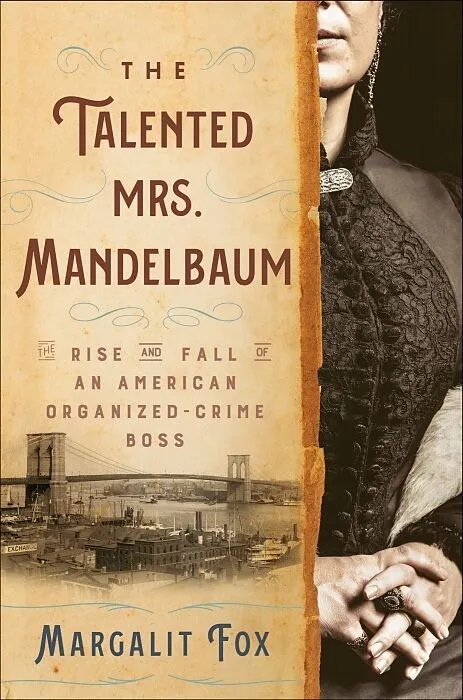
The Talented Mrs. Mandelbaum
Beschreibung
A Jewish mother of four, a gracious society hostess, a beloved member of her community--and the first widely renowned crime boss in America. Discover the true story from the bestselling author of In 1850, Fredericka Mandelbaum traveled to New York in steerage ...Format auswählen
- Fester EinbandCHF 35.90
Wird oft zusammen gekauft
Andere Kunden kauften auch
Beschreibung
A Jewish mother of four, a gracious society hostess, a beloved member of her community--and the first widely renowned crime boss in America. Discover the true story from the bestselling author of In 1850, Fredericka Mandelbaum traveled to New York in steerage and worked as a peddler on the streets of Lower Manhattan. By the 1870s she was a widow with four children, a fixture of high society, and an admired philanthropist. What had enabled a woman on the margins of American life to ascend from tenement poverty to immense wealth? In the intervening years, “Marm” Mandelbaum, as she was known, had become the country’s most notorious “fence”--a receiver of stolen goods--and a successful criminal mastermind. By the mid-1880s as much as $10 million worth of purloined luxury goods (the equivalent of nearly $300 million in today’s money) had passed through her modest haberdashery shop on the Lower East Side. Called “the nucleus and center of the whole organization of crime in New York City” by the But Fredericka Mandelbaum wasn’t just a successful crook: She was a business visionary--one of the first entrepreneurs in America to systemize formerly scattershot enterprise of property crime. Handpicking a cadre of New York''s foremost bank robbers, housebreakers, and shoplifters, and neatly bribing anyone who stood in her way, she handled logistics and organized supply chains--turning theft into a viable, scalable <The Talented Mrs. Mandelbaum< paints a vivid image of Gilded Age New York--a city teeming with delightful rogues, capitalist power brokers, and Tammany Hall bigwigs, all of whom straddled the line between underworld enterprise and the realm of “legitimate” commerce. Combining deep historical research with the narrative flair for which she is celebrated, Margalit Fox tells the unforgettable story of a once-famous, now-forgotten heroine, a tale that exemplifies the cherished rags-to-riches narrative of Victorian America while simultaneously upending it altogether....
Autorentext
Margalit Fox originally trained as a cellist and a linguist before pursuing journalism. As a senior writer in The New York Times’s Obituary News Department, she wrote the front-page public sendoffs of some of the leading cultural figures of our age. Winner of the William Saroyan Prize for Literature and author of four previous nonfiction books, The Confidence Men, Conan Doyle for the Defense, The Riddle of the Labyrinth and Talking Hands, Fox lives in Manhattan with her husband.
Klappentext
**America's first great organized-crime lord was a lady—a nice Jewish mother named Fredericka Mandelbaum.
"[Fox has] a nose for interesting facts, the ability to construct a taut narrative arc, and a Dickens-level gift for concisely conveying personality” —New York Magazine**
In 1850, an impoverished 25-year-old named Fredericka Mandelbaum traveled to New York in steerage and worked as a peddler on the streets of Lower Manhattan. By the 1870s she was a widow with four children, a fixture of high society, and an admired philanthropist. What had enabled a woman on the margins of American life to ascend from tenement poverty to immense wealth?
In the intervening years, “Marm” Mandelbaum, as she was known, had become the country’s most notorious “fence”—a receiver of stolen goods—and a successful criminal mastermind. By the mid-1880s as much as $10 million worth of purloined luxury goods (the equivalent of nearly $300 million in today’s money) had passed through her modest haberdashery shop on the Lower East Side. Called “the nucleus and center of the whole organization of crime in New York City” by the New York Times, she planned, financed, and profited from robberies of cash, gold, diamonds, and silk throughout the city and across the United States.
But Fredericka Mandelbaum wasn’t just a successful crook: She was a business visionary—one of the first entrepreneurs in America to systemize the formerly scattershot enterprise of property crime. Handpicking a cadre of New York's foremost bank robbers, housebreakers, and shoplifters, and neatly bribing anyone who stood in her way, she handled logistics and organized supply chains—turning theft into a viable, scalable business.
The Talented Mrs. Mandelbaum paints a vivid image of Gilded Age New York—a city teeming with delightful rogues, capitalist power brokers, and Tammany Hall bigwigs, all of whom straddled the line between underworld enterprise and the realm of “legitimate” commerce. Combining deep historical research with the narrative flair for which she is celebrated, Margalit Fox tells the unforgettable story of a once-famous, now-forgotten heroine, a tale that exemplifies the cherished rags-to-riches narrative of Victorian America while simultaneously upending it altogether.
Leseprobe
Chapter One
“The Mere Privilege of Breath”
She came here with nothing.
One of seven children of Samuel Abraham Weisner and the former Rahel Lea Solling, Fredericka Henriette Auguste Weisner was born on March 28, 1825, in Kassel, in what is now central Germany. Her family, which appears to have included itinerant peddlers, had been part of the region’s Jewish community—numbering fourteen to fifteen thousand in a population of just over half a million—for several generations.
Jewish life there was far from easy. Restrictive laws in many German states of the period governed what trades Jews could ply and where they could live, which by extension restricted whom they could marry. Physical violence against Jews by their Gentile neighbors was not unknown: Jews sometimes paid protection money to keep themselves and their families safe.
“Jews occupied a distinct and inferior status,” a twentieth-century history has noted. “Except for a tiny, wealthy elite who had gained the special favor of Christian rulers or aristocrats, the Jewish people of Central Europe remained what their ancestors had been for centuries past: traditional, pious, generally poor Dorfjuden—village Jews. . . . With agriculture, most guild-based crafts, and other more secure and lucrative occupations traditionally forbidden to them, Central European Jews overwhelmingly earned their often meagre livelihoods as minor traders, small-scale moneylenders, or petty artisans in such crafts as tailoring.”
As a girl, Fredericka would have had a basic education in reading, writing and arithmetic, taught either at home or at a local Jewish elementary school. She would also have received training, standard for Jewish girls of the day, in childcare and domestic arts, which typically included sewing, spinning, knitting, lacemaking, laundering and cooking. “Whatever the precise circumstances,” the historian Rona L. Holub has written, “she developed a keen intellect, a strong work ethic, and confidence in her own abilities.”
In 1848, Fredericka married Wolf Israel Mandelbaum, an itinerant peddler a few years her senior. Wolf, possibly with Fredericka helping him, spent days on the road each week, peddling in the countryside before returning home in time for the start of the Sabbath on Friday nights. Whether gained from direct experience or simply from knowledge of her husband’s trade, Mrs. Mandelbaum’s understanding of the mechanics of salesmanship would greatly abet her career in the criminal underworld.
The birth, in 1849, of the Mandelbaums’ first child, Breine (also known as Bertha or Bessy), would have further strained their precarious finances: The region was in the midst of an economic depression and was affected by a potato blight. In 1850, the Mandelbaums joined the thousands of…