
IHR WARENKORB IST AKTUELL LEER.
Haben Sie noch nichts passendes gefunden? Stöbern Sie durch unser komplettes Sortiment.
Oder melden Sie sich an bzw. registrieren Sie sich.
- Kostenlose Lieferung
- Kauf auf Rechnung
- Ex Libris Tiefpreis
- Filiallieferung und 650+ Abholorte
- Rabatt-Bons als Club-Mitglied
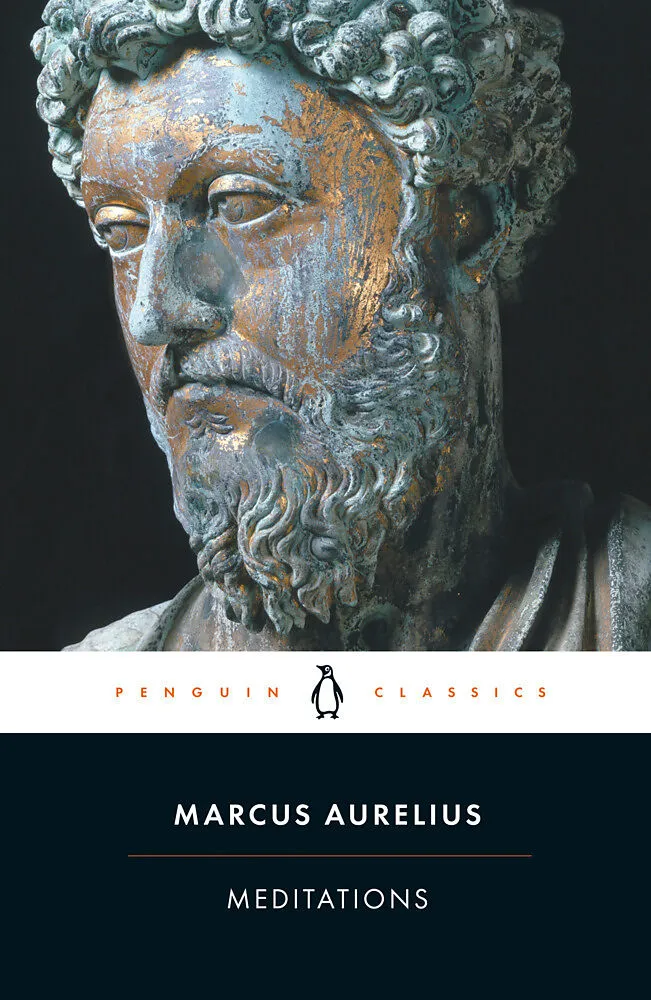
Meditations
Beschreibung
Zusatztext Here! for our age! is [Marcus's] great work presented in its entirety! strongly introduced and freshly! elegantly translated. Robert Fagles Informationen zum Autor Marcus Aurelius Antoninus was born to an upper-class Roman family in A.D. 121 and was...Format auswählen
- Kartonierter EinbandCHF 12.40
- Fester EinbandCHF 22.00
- E-Book (epub)CHF 9.00
- Fester EinbandCHF 21.75

Wird oft zusammen gekauft
Andere Kunden kauften auch
Beschreibung
Zusatztext Here! for our age! is [Marcus's] great work presented in its entirety! strongly introduced and freshly! elegantly translated. Robert Fagles Informationen zum Autor Marcus Aurelius Antoninus was born to an upper-class Roman family in A.D. 121 and was later adopted by the future emperor Antoninus Pius, whom he succeeded in 161. His reign was marked by a successful campaign against Parthia, but was overshadowed in later years by plague, an abortive revolt in the eastern provinces, and the deaths of friends and family, including his co-emperor Lucius Verus. A student of philosophy from his earliest youth, he was especially influenced by the first-century Stoic thinker Epictetus. His later reputation rests on his Meditations, written during his later years and never meant for formal publication. He died in 180, while campaigning against the barbarian tribes on Rome's northern frontier. Klappentext 'Their icy blasts are refreshing and restorative. They tell you the worst. And having heard the worst, you feel less bad' Blake Morrison Written in Greek by the only Roman emperor who was also a philosopher, without any intention of publication, the Meditations of Marcus Aurelius offer a remarkable series of challenging spiritual reflections and exercises developed as the emperor struggled to understand himself and make sense of the universe. While the Meditations were composed to provide personal consolation and encouragement, Marcus Aurelius also created one of the greatest of all works of philosophy: a timeless collection that has been consulted and admired by statesmen, thinkers and readers throughout the centuries.Translated with notes by MARTIN HAMMOND with an Introduction by DISKIN CLAY Leseprobe Book 1 Debts and Lessons 1. My grandfather Verus Character and self-control. 2. My father (from my own memories and his reputation) Integrity and manliness. 3. My mother Her reverence for the divine, her generosity, her inability not only to do wrong but even to conceive of doing it. And the simple way she lived-not in the least like the rich. 4. My great-grandfather To avoid the public schools, to hire good private teachers, and to accept the resulting costs as money well-spent. 5. My first teacher Not to support this side or that in chariot-racing, this fighter or that in the games. To put up with discomfort and not make demands. To do my own work, mind my own business, and have no time for slanderers. 6. Diognetus Not to waste time on nonsense. Not to be taken in by conjurors and hoodoo artists with their talk about incantations and exorcism and all the rest of it. Not to be obsessed with quail-fighting or other crazes like that. To hear unwelcome truths. To practice philosophy, and to study with Baccheius, and then with Tandasis and Marcianus. To write dialogues as a student. To choose the Greek lifestyle-the camp-bed and the cloak. 7. Rusticus The recognition that I needed to train and discipline my character. Not to be sidetracked by my interest in rhetoric. Not to write treatises on abstract questions, or deliver moralizing little sermons, or compose imaginary descriptions of The Simple Life or The Man Who Lives Only for Others. To steer clear of oratory, poetry and belles lettres. Not to dress up just to stroll around the house, or things like that. To write straightforward letters (like the one he sent my mother from Sinuessa). And to behave in a conciliatory way when people who have angered or annoyed us want to make up. To read attentively-not to be satisfied with "just getting the gist of it." And not to fall for every smooth talker. And for introducing me to Epictetus's lectures-and loaning me his own copy. 8. Apollonius Independence...
ldquo;Here, for our age, is [Marcus’s] great work presented in its entirety, strongly introduced and freshly, elegantly translated.” —Robert Fagles
Autorentext
Marcus Aurelius Antoninus was born to an upper-class Roman family in A.D. 121 and was later adopted by the future emperor Antoninus Pius, whom he succeeded in 161. His reign was marked by a successful campaign against Parthia, but was overshadowed in later years by plague, an abortive revolt in the eastern provinces, and the deaths of friends and family, including his co-emperor Lucius Verus. A student of philosophy from his earliest youth, he was especially influenced by the first-century Stoic thinker Epictetus. His later reputation rests on his Meditations, written during his later years and never meant for formal publication. He died in 180, while campaigning against the barbarian tribes on Rome's northern frontier.
Klappentext
'Their icy blasts are refreshing and restorative. They tell you the worst. And having heard the worst, you feel less bad' Blake Morrison
Written in Greek by the only Roman emperor who was also a philosopher, without any intention of publication, the Meditations of Marcus Aurelius offer a remarkable series of challenging spiritual reflections and exercises developed as the emperor struggled to understand himself and make sense of the universe. While the Meditations were composed to provide personal consolation and encouragement, Marcus Aurelius also created one of the greatest of all works of philosophy: a timeless collection that has been consulted and admired by statesmen, thinkers and readers throughout the centuries.
Translated with notes by MARTIN HAMMOND with an Introduction by DISKIN CLAY
Zusammenfassung
**A clear and eloquent leading translation of the Roman emperor’s reflections of human life and death, timeless Stoic philosophy that inspires countless others including The Daily Stoic author Ryan Holiday to use philosophy as a tool for self-improvement and resilience to live a better life
**Written in Greek by an intellectual Roman emperor without any intention of publication, the Meditations of Marcus Aurelius offer a wide range of fascinating spiritual reflections and exercises developed as the leader struggled to understand himself and make sense of the universe. Spanning from doubt and despair to conviction and exaltation, they cover such diverse topics as the question of virtue, human rationality, the nature of the gods and the values of leadership. But while the Meditations were composed to provide personal consolation, in developing his beliefs Marcus also created one of the greatest of all works of philosophy: a series of wise and practical aphorisms that have been consulted and admired by statesmen, thinkers and ordinary readers for almost two thousand years.
To provide a full understanding of Aurelius's seminal work, this edition includes explanatory notes, a general index, an index of quotations, an index of names, and an introduction by Diskin Clay putting the work in its biographical, historical, and literary context, a chronology of Marcus Aurelius's life and career.
Penguin Classics is the leading publisher of classic literature in the English-speaking world, representing a global bookshelf of the best works throughout history and across genres and disciplines. Readers trust the series to provide authoritative texts enhanced by introductions and notes by distinguished scholars and contemporary authors, as well as up-to-date translations by award-winning translators.
Leseprobe
Book 1
Debts and Lessons
- My grandfather Verus
Character and self-control.
- My father (from my own memories and
his reputation)
Integrity and manliness.
- My mother
Her reverence for the divine, her generosity, her inability not only to do wrong but even to conceive of doing it. And the simple way she lived-not in the least like the rich.
- My great-grandfather
To avoid the public schools, to hire good private teachers, and to accept the resulting costs as money well-spent.
- My first teacher
Not to support this…