Beschreibung
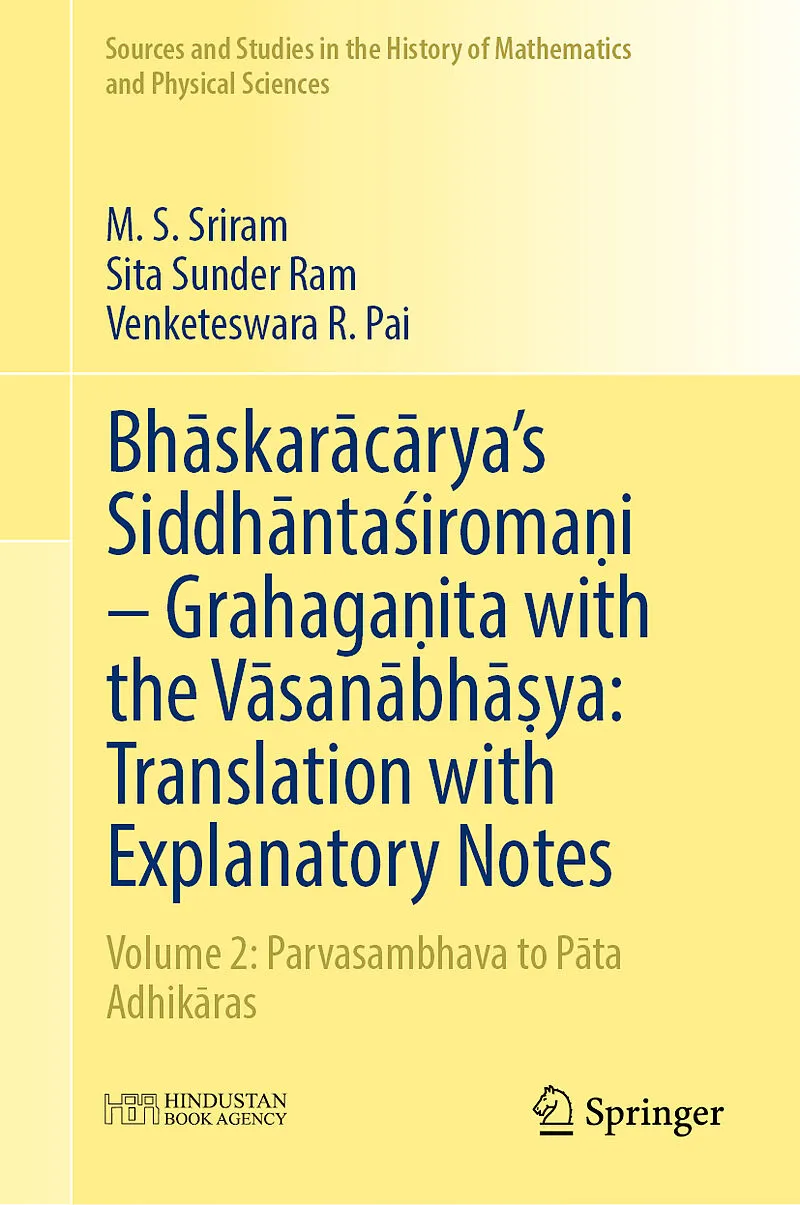
The Siddhntairomai was composed in 1150 CE by the celebrated mathematicianastronomer Bhskarcrya. In the Grahagaitdhyya part of it, most of the standard calculations and algorithms in Indian astronomy of his times are included. All these are explained in detai...The Siddhntairomai was composed in 1150 CE by the celebrated mathematicianastronomer Bhskarcrya. In the Grahagaitdhyya part of it, most of the standard calculations and algorithms in Indian astronomy of his times are included. All these are explained in detail with commentary on the text, namely, the Vsanbhya or Mitkar. This book is on this part only. All the 460 verses of this part have been translated afresh in this work. Now, it is in the Vsanbhya that the contents of the verses are expounded in detail. In addition, the detailed derivations and proofs of the statements and algorithms are presented in the upapattis. Study of the vsan is indispensable for understanding the methodology of, in particular, and thereby, of Indian astronomers in general. The distinct scientific method of Bhskara (indeed of the Indian astronomical tradition in general, of which he was a leading exponent), his approach to problems and the ways to solve them, can be understood only when one goes through the commentary and understands it. It is for this reason that the Vsanbhya has been translated into English for all the verses, for the first time. Explanatory notes based on the vsan of Bhskara have been provided for all the verses in modern notation, with a large number of diagrams to facilitate the understanding.
The Grahagaitdhyya has 12 chapters, which is divided into two volumes: Volume 1: Madhyama, Spaa, Triprana and Volume 2: Parvasambhava to Pta Adhikras. Volume 1 has three chaptersthe Madhyamdhikra, Spadhikra and the Triprandhikra. This volume has a comprehensive introduction and two appendices on the Indian planetary model and elements of spherical trigonometry, which make this book reasonably self-contained. Volume 2 has the nine chaptersParvasambhava, Candragrahaa, Sryagrahaa, Grahacchy, Udaysta, gonnati, Grahayuti, Bhagrahayuti and the Pta adhikras.
Explores Bhskara's scientific methods through detailed English translations and diagrams of all 460 original verses Studies Vsanbhya commentary to grasp Bhskara's unique problem-solving techniques and astronomical insights Presents classical Indian astronomy with clear explanations, derivations, and modern notation of key algorithms
Autorentext
M.S. Sriram is President of the Prof. K.V. Sarma Research Foundation, Chennai, India. Until 2011, he was Professor and Head in the Department of Theoretical Physics, University of Madras, India. Earlier, he worked at the University of Allahabad, India. He did his M.Sc. in physics and Ph.D. in theoretical physics from the IIT Kanpur, respectively in 1971 and 1978. He is Fellow of the INSA, in 2021, for his contributions in the area of Indian astronomy and mathematics. In addition, he has done research work in the areas of elementary particles, quantum field theory, and nonlinear dynamics and chaos. A distinguished researcher in the field of Indian astronomy and mathematics, he has published several research papers and three books supported by the Kerala School of Astronomy and Mathematics: Ganita-Yuktibhasa of Jyes hadeva, Tantrasangraha of Nilakan ha Somayaji, and Karanapaddhati of Putumana Somayaji, with coauthors. All these books have been co-published by Springer Nature.
Sita Sundar Ram is Secretary of Kuppuswami Sastri Research Institute, Mylapore, Chennai, India, and also of the Samskrita Academy, Madras, Mylapore, Chennai. She is also Honorary Member of P.S. Educational Society, Chennai. She did her B.Sc. in mathematics from the University of Madras, in 1970, M.A. in Sanskrit from the Karnatak University, Dharwar, in 1974, and Ph.D. in Sanskrit (on Bijapallava of Krsna Daivajña, Algebra in Sixteenth Century India: A Critical Study , in the field of Indian mathematics) from the University of Madras, in 2008. She was the Principal Investigator of several projects: (a) Astadashi project, editing and publishing of Bijaprabodha of Ramakrishna, unpublished commentary on Bijaganita of Bhaskaracarya (under the scheme of Special Grants for Sanskrit, Pali, Prakrit from the Central Sanskrit University) and (b) translation and study of the text Ganitasarasangraha of Mahavira. Author of the book, History of Ancient Indian Algebra, she has presented papers in many national and international conferences. She is a teacher of the online course in Sanskrit conducted by the Madras Sanskrit College, Chennai, and conducts classes for the UGC in Indian mathematics for B.A. Sanskrit. She has also given lectures on Indian mathematics in schools and colleges in Tamil Nadu and elsewhere and has given talks on Mathematics in Ancient India over the All India Radio.
Venketeswara R. Pai is Associate Professor in the Department of Humanities and Social Sciences at the IISER Pune, India. He is a distinguished scholar, whose research focuses on the historical development of the Vakya system of astronomy, manuscriptology and the scientific literature composed in Sanskrit. His deep engagement with traditional Indian knowledge systems is supported by his rare expertise in classical scripts such as Devanagari, Nandinagari, Tig ari, Malaya am and Grantha. He has authored many research papers and several book chapters, often collaborating with eminent scholars in the field. He is especially recognized for his critical editions and translations of Sanskrit astronomical texts, such as Karanapaddhati of Putumana Somayaji and ongoing work on Drkkarana, supported by institutions like the ICHR and the INSA, New Delhi. His publications explore a wide range of topics from mathematical series in medieval India to observational records of stars in Indian texts demonstrating his deep engagement with both historical scholarship and the technical aspects of ancient Indian science. He holds a Ph.D. in Indian astronomy and mathematics from the IIT Bombay. Recipient of the Satish Bhatnagar Award from the Indian Mathematical Society and the inaugural INSA medal for Young Historian of Science, he is also one of the founding members of Indian National Young Academy of Science (INYAS), INSA.
Inhalt
Chapter Possibility of Eclipses.- Chapter Lunar eclipse.- Chapter Solar eclipse.- Chapter Shadow of a planet.- Chapter (Heliacal) Rising and Settting of Planets.- Chapter Elevation of the lunar cusps.- Chapter Conjunctions of planets.- Chapter Conjunction of a star and a planet.- Chapter Equal declinations of the Sun and the Moon.