
IHR WARENKORB IST AKTUELL LEER.
Haben Sie noch nichts passendes gefunden? Stöbern Sie durch unser komplettes Sortiment.
Oder melden Sie sich an bzw. registrieren Sie sich.
- Kostenlose Lieferung
- Kauf auf Rechnung
- Ex Libris Tiefpreis
- Filiallieferung und 650+ Abholorte
- Rabatt-Bons als Club-Mitglied
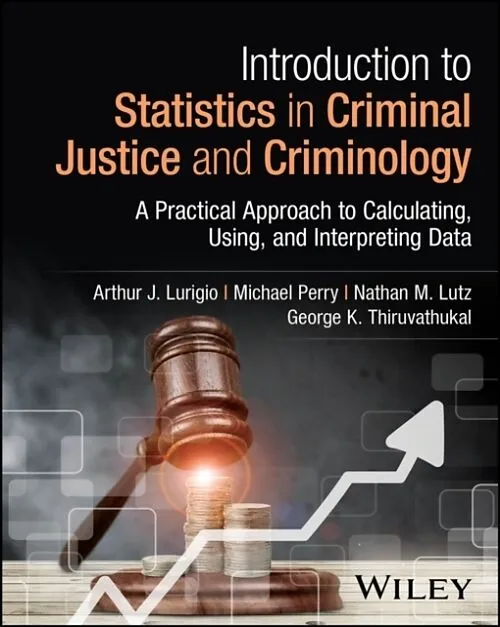
Introduction to Statistics in Criminal Justice and Criminology
Beschreibung
Informationen zum Autor Arthur J. Lurigio, PhD, is Professor of Psychology and Criminal Justice and Criminology at Loyola University Chicago. A distinguished scholar with more than 500 publications, he has received numerous awards recognizing his contributions...Format auswählen
- Kartonierter EinbandCHF 106.80

Wird oft zusammen gekauft
Andere Kunden kauften auch
Beschreibung
Informationen zum Autor Arthur J. Lurigio, PhD, is Professor of Psychology and Criminal Justice and Criminology at Loyola University Chicago. A distinguished scholar with more than 500 publications, he has received numerous awards recognizing his contributions to criminal justice research, mental health, and applied scholarship. Michael Perry, PhD, is Senior Lecturer of Mathematics and Statistics at Loyola University. He teaches a range of statistics courses and has published research across polymerization, public health, and quantitative modeling, bringing applied mathematical expertise to criminal justice education. Nathan M. Lutz, PhD, is a pediatric psychologist and Clinical Assistant Professor at Nationwide Children's Hospital in Columbus, Ohio. His research focuses on improving outcomes for youth involved in child welfare and enhancing measurement-based behavioral health care. George K. Thiruvathukal, PhD, is Professor and Chairperson of Computer Science at Loyola University Chicago and Visiting Computer Scientist at Argonne National Laboratory. Author or co-author of more than 200 publications and 6 books, his research spans high-performance computing, distributed systems, and artificial intelligence. Klappentext Introduction to Statistics in Criminal Justice and Criminology: A Practical Approach to Calculating, Using, and Interpreting Data provides students with a clear, structured path to the quantitative tools that shape empirical inquiry in the field. Written by an interdisciplinary team spanning criminal justice, psychology, mathematics, and computer science, this textbook emphasizes the practical purposes of statistical thinking while explaining how data is organized, described, compared, and analyzed to answer meaningful research questions. Each chapter opens with a relatable scenario that frames key concepts, guiding students from foundational topics such as descriptive statistics and normal distributions to applications including hypothesis testing, chi-square analysis, regression, ANOVA, and survival analysis. Step-by-step examples, end-of-chapter problems, and intuitive visual displays reinforce learning. A companion software tool strengthens computational literacy, allowing students to work through calculations aligned with chapter material. Designed for undergraduate and graduate courses in criminal justice statistics, this textbook supports required quantitative training across criminal justice curricula. Students gain the skills to interpret research findings, evaluate evidence critically, and engage in data-informed study and professional practice throughout their careers. Inhaltsverzeichnis About the Authors xiii Acknowledgements xv 1 Introduction 1 1.1 Statistics 1 1.2 Types of Statistics: Descriptive and Inferential 1 1.3 Basic Statistical Concepts and Terminology 2 1.3.1 Population, Element, Census, and Sample 2 1.3.2 Data and Variables 3 1.3.3 Variable Types 4 1.3.4 Levels of Variables and Scales 4 1.3.5 Nominal Scales 4 1.3.6 Ordinal Scales 5 1.3.7 Interval Scales 6 1.3.8 Ratio Scales 6 1.3.9 Likert Scales 6 1.3.10 The Hierarchy of Measurement Scales 7 1.4 Dependent and Independent Variables 10 1.5 Practical Application of Statistics 11 1.6 Introduction to SAS 11 1.7 Summary 12 1.8 Exercises 12 1.9 Answers to Exercises 14 References 16 2 Organizing and Describing Data 17 2.1 The Jail Report 17 2.2 Organizing and Describing Data 17 2.3 Frequency Distributions 18 2.3.1 Absolute Frequency Distributions 18 2.3.2 Relative Frequency Distributions 19 2.3.3 Relative Frequency Distributions 20 2.3.4 Cumulative Relative Frequency Distributions 22 2.3.5 Interval Frequency Distributions...
Autorentext
Arthur J. Lurigio, PhD, is Professor of Psychology and Criminal Justice and Criminology at Loyola University Chicago. A distinguished scholar with more than 500 publications, he has received numerous awards recognizing his contributions to criminal justice research, mental health, and applied scholarship. Michael Perry, PhD, is Senior Lecturer of Mathematics and Statistics at Loyola University. He teaches a range of statistics courses and has published research across polymerization, public health, and quantitative modeling, bringing applied mathematical expertise to criminal justice education. Nathan M. Lutz, PhD, is a pediatric psychologist and Clinical Assistant Professor at Nationwide Children's Hospital in Columbus, Ohio. His research focuses on improving outcomes for youth involved in child welfare and enhancing measurement-based behavioral health care. George K. Thiruvathukal, PhD, is Professor and Chairperson of Computer Science at Loyola University Chicago and Visiting Computer Scientist at Argonne National Laboratory. Author or co-author of more than 200 publications and 6 books, his research spans high-performance computing, distributed systems, and artificial intelligence.
Klappentext
Introduction to Statistics in Criminal Justice and Criminology: A Practical Approach to Calculating, Using, and Interpreting Data provides students with a clear, structured path to the quantitative tools that shape empirical inquiry in the field. Written by an interdisciplinary team spanning criminal justice, psychology, mathematics, and computer science, this textbook emphasizes the practical purposes of statistical thinking while explaining how data is organized, described, compared, and analyzed to answer meaningful research questions. Each chapter opens with a relatable scenario that frames key concepts, guiding students from foundational topics such as descriptive statistics and normal distributions to applications including hypothesis testing, chi-square analysis, regression, ANOVA, and survival analysis. Step-by-step examples, end-of-chapter problems, and intuitive visual displays reinforce learning. A companion software tool strengthens computational literacy, allowing students to work through calculations aligned with chapter material. Designed for undergraduate and graduate courses in criminal justice statistics, this textbook supports required quantitative training across criminal justice curricula. Students gain the skills to interpret research findings, evaluate evidence critically, and engage in data-informed study and professional practice throughout their careers.
Inhalt
About the Authors xiii
Acknowledgements xv
1 Introduction 1
1.1 Statistics 1
1.2 Types of Statistics: Descriptive and Inferential 1
1.3 Basic Statistical Concepts and Terminology 2
1.3.1 Population, Element, Census, and Sample 2
1.3.2 Data and Variables 3
1.3.3 Variable Types 4
1.3.4 Levels of Variables and Scales 4
1.3.5 Nominal Scales 4
1.3.6 Ordinal Scales 5
1.3.7 Interval Scales 6
1.3.8 Ratio Scales 6
1.3.9 Likert Scales 6
1.3.10 The Hierarchy of Measurement Scales 7
1.4 Dependent and Independent Variables 10
1.5 Practical Application of Statistics 11
1.6 Introduction to SAS 11
1.7 Summary 12
1.8 Exercises 12
1.9 Answers to Exercises 14
References 16
2 Organizing and Describing Data 17
2.1 The Jail Report 17
2.2 Organizing and Describing Data 17
2.3 Frequency Distributions 18
2.3.1 Absolute Frequency Distributions 18
2.3.2 Relative Frequency Distributions 19
2.3.3 Relative Frequency Distributions 20
2.3.4 Cumulative Relative Frequency Distributions 22
2.3.5 Interval Frequency Distributions 23
2.3.6 Frequency Distributions in SAS 26
2.4 Visual Techniques 27
2.4.1 Bar Graphs 28
2.4.2 Bar Graphs in SAS 30
2.4.3 Pie Charts 31
2.4.4 Pie Charts in SAS 33
2.4.5 Histograms 33
2.4.6 Histograms in SAS 33
2.4.7 Polygons 35
2.4.8 Polygons in SAS 36
2.5 Properties of Distributions 37
2.5.1 Central Tendency 37
2.5.2 Variability 37
2.5.3 Skewness 37
2.5.4 Kurtosis 39
2.6 Summary 41
2.7 Exercises 42
2.8 Answers to Exercises 43
References 47
3 Comparative Statistics 48
3.1 Re-electing the County Sheri…