Speak Data
Beschreibung
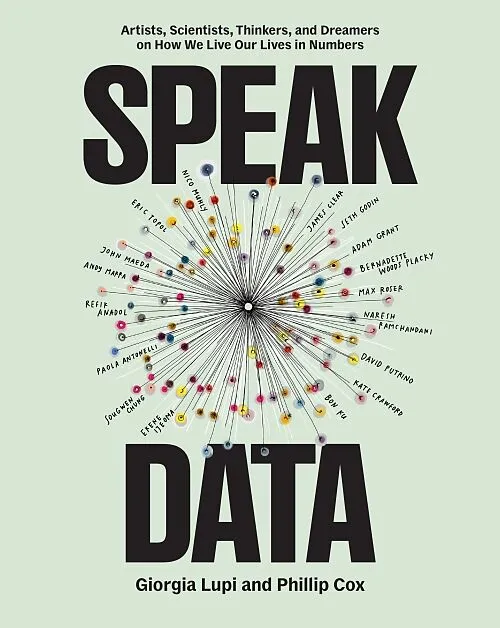
This is no ordinary data science book. Speak Data is the first pop nonfiction book to explore the definition of data and its impacts on our daily lives . Bold color graphics and playful illustrations by award-winning information designer Giorgia Lupi guide you...Format auswählen
- Kartonierter EinbandCHF 39.10

Wird oft zusammen gekauft
Andere Kunden kauften auch
Beschreibung
This is no ordinary data science book. Speak Data is the first pop nonfiction book to explore the definition of data and its impacts on our daily lives . Bold color graphics and playful illustrations by award-winning information designer Giorgia Lupi guide you from one observation and revelation to the next. Data is the most powerful force in society today. From the global scale of financial markets and communication networks to the smallest moments of personal observation and social connection, data is created, shared, and analyzed at a speed and volume once unimaginable. Whether we realize it or not, we are surrounded by invisible ecosystems of data. This fresh Modern Love -style take approaches data from multiple perspectives, showing how data affects everything from our health and wellness to our creativity, activism, and much more. Seventeen interviews with global thought leaders in the worlds of business, tech, health, art, and more provide unique insight into the dynamic and surprisingly interdisciplinary nature of data, including: Tech pioneer John Maeda on the value of data visualization during global emergencies. Marketing legend Seth Godin on how to use data to get people to really care about climate change. Museum curator Paola Antonelli on whether data is art. Atomic Habits author James Clear on the ways data can (and can’t) describe human identity. AI data artist Refik Anadol on how big datasets can dream. And many more. Authors Giorgia Lupi and Phillip Cox invite us to think differently about how numbers, statistics, and algorithms play out in our lives, presenting a new and uniquely multifaceted paradigm for understanding data’s impact. The exciting visual expansion and illumination of the ideas within each chapter make understanding data fun and approachable for every reader. ...
Autorentext
Giorgia Lupi is a designer, artist, and partner at the international design firm Pentagram. A two-time TED speaker, she is a leading voice for a more humanistic approach to data. Giorgia is the author of two books, Dear Data, exploring the details of daily life through hand-drawn visual data, and Observe, Collect, Draw! A Visual Journal, a guided journal for collecting visual data. She was the 2022 recipient of the National Design Award from the Cooper Hewitt, Smithsonian Design Museum, and her work is part of the permanent collection of the Museum of Modern Art.
Giorgia's work is inspired by the belief that data has the capacity to make us all more human-advancing our intelligence, engagement, and delight. She has been featured in numerous media outlets, including The New York Times, The New Yorker, The Guardian, The Washington Post, T Magazine, NPR, BBC, Vogue, and Vanity Fair. A visual Op Ed that Giorgia Lupi published in The New York Times in 2023 about how she uses data to track her experience with long Covid received widespread acclaim.
Phillip Cox is a writer and strategist. Previously an associate partner at Pentagram, he has worked as a branding consultant for a variety of for-profit and non-profit organizations. He is also the author of What a Building Does: The Hoosier Modernisms of Evans Woollen, in addition to other articles on architecture and the built environment.
Klappentext
The first pop nonfiction book to explore the definition of data and how we can learn to speak that language features thought-provoking conversations with 17 extraordinary leaders in business, tech, medicine, psychology, health, art, and more who share new ideas about data, unpacking its powerful ability to reveal patterns, tell stories, stir emotion, and illuminate complexity.
Data may be the most powerful force in society today. Data is everywhere, present in every moment, every event, every transaction, or interaction with someone else. Every time you send a text, call a friend, fill out a form, hail a taxi, stream a movie, surf the web, pay a bill, buy groceries, buy anything, take your temperature, count your steps, swipe right (or left), you generate data.
There's data in the weather, in the air, in the ground, in outer space. If you own a smartwatch, you carry data on your body. If you have a cardiac pacemaker, you carry data in your body.
So, what is data, really? It's a question that is surprisingly hard to answer. To some, data means numbers: figures on a screen, dots on a graph. It's also often (falsely) equated with facts, an invariable form of concrete knowledge that always tells the truth. But in reality, data is hardly so incontrovertible. Data is an abstraction of reality, a useful but imperfect representation of real life. Like life, it's full of nuance, imprecision, and ambivalence. It's quantitative and it's qualitative. And it's made by us-humans.
These are some of the ideas that information designers **Giorgia Lupi **and Phillip Cox explore in their fascinating new book Speak Data: Artists, Scientists, Thinkers, and Dreamers on How We Live Our Lives in Numbers.
Speak Data invites us to see data differently-not just as numbers on a chart, but as a way to understand and communicate who we are, how we connect, and how we make sense of the world. It's grounded in the principles of Data Humanism, a concept developed by coauthor and award-winning information designer Giorgia Lupi, which centers on people, rather than numbers, in its conception of data. In this beautifully illustrated book, the authors present data as a vocabulary that anyone can use, showing that when we truly learn to "speak data," we can open up new worlds of meaning about ourselves and everything around us.
Interviews in Speak Data include:
- Tech pioneer John Maeda on the value of data visualization during global emergencies.
- Marketing legend Seth Godin on how to use data to get people to really care about climate change.
- Museum curator Paola Antonelli on whether data is art.
- Atomic Habits author James Clear on the ways data can (and can't) describe human identity.
- Al data artist Refik Anadol on how big datasets can dream.
- Organizational psychologist Adam Grant on using data to communicate nuance and uncertainty.
- Activist Andy Marra on how to count something that's never been counted before-and why it matters who is asking the questions.
- Writer Naresh Ramchanda on why he's a "data optimist" and how data can close the empathy gap.
- Economist Max Roser on using data to see stories, and not just trends.
- Neuroscientist and physical therapist David Putrino on how tracking long Covid has taught him to think differently about patient data versus patient experience.
- Physician and design researcher Bon Ku on how data revealed a better way to design hospital emergency departments.
- Al scholar Kate Crawford on why questions about the future of AI are really questions about the future of democracy.
- Artist Ekene ljeoma on why we have all the data we need to make change.
- And many more.