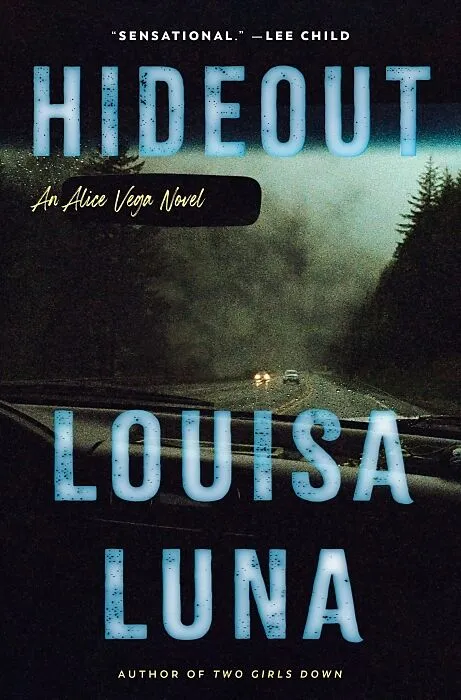
Hideout
Beschreibung
“Luna takes the usual private eye tropes and imbues them with added resonance. Vega is an excellent investigator who doesn’t bounce back right away from physical harm, and her relationship with Cap earns its complexity. I know I’ll be reading...Format auswählen
- Fester EinbandCHF 30.00

Wird oft zusammen gekauft
Andere Kunden kauften auch
Beschreibung
“Luna takes the usual private eye tropes and imbues them with added resonance. Vega is an excellent investigator who doesn’t bounce back right away from physical harm, and her relationship with Cap earns its complexity. I know I’ll be reading more of this series, and you should, too.” –Sarah Weinman, The New York Times Book Review
“Exhilarating. . .Vega’s PI partner, Max Caplan, lends support, but it is the no-nonsense Vega who carries the day. Readers will want to see a lot more of this kick-butt hero.” **–*Publishers Weekly
***“Vega. . . returns with a fury that singes the corners off the pages. This is the third Alice Vega novel (after The Janes, 2020), and they just keep getting better, thanks to brilliant characterizations and lots of surprises. Jack Reacher fans will adore her. The vengeful Alice is as intriguing as the bride in Kill Bill. Viva la Vega!” **–Booklist starred review
**The third novel in the Alice Vega series is another thrilling ride from the very start to the end. . .Fans will eat this book up. –Red Carpet Crash
“After two well-received outings (e.g., The Janes), Alice Vega returns to demonstrate her talent for uncovering seemingly unrecoverable truths.” —Library Journal
Autorentext
LOUISA LUNA is the author of the Alice Vega novels The Janes and Two Girls Down as well as Brave New Girl and Crooked. She was born and raised in San Francisco and lives in Brooklyn, New York, with her husband and daughter.
Klappentext
**In this powerful new thriller, Alice Vega and Max Caplan return, uncovering a network of white supremacists in their search for a long-lost counter-culture hero.
****"Alice Vega is sensational—I want to see lots more of her." —Lee Child, #1 New York Times best-selling author
Alice Vega has made a career of finding the missing and vulnerable against a ticking clock, but she's never had a case like that of Zeb Williams, missing for thirty years. It was 1984, and the big Cal-Stanford football game was tied with seconds left on the clock. Zeb Williams grabbed the ball and ran the wrong way, through the marching band, off the field, and out of the stadium. He disappeared into legend, replete with Elvis-like sightings and a cult following.
Zeb's cold trail leads Vega to southern Oregon, where she discovers an anxious community living under siege by a local hate group called the Liberty Boys. As Vega starts digging into the past, the mystery around Zeb's disappearance grows deeper, and the reach of the Liberty Boys grows more disturbing. Everyone has something to hide, and no one can cut to the truth like Alice Vega. But this time, her partner Max Caplan has his own problems at home, and the trouble Vega finds might be too much for her to handle.
Louisa Luna understands suspense, tension, and character like only the best writers in crime fiction do—and she may well write the best interrogations in the genre. Hideout is pure adrenaline and Luna's most intimate thriller yet, a classic cold case wrapped in a timely confrontation with a terrifyingly real network of white supremacists and homegrown terrorists.
Leseprobe
1
Zeb Williams kicked the turf with the tip of his cleat and thought about what was underneath. The field used to be real green, but the school switched it to the Brillo Pad when Zeb got to UC Berkeley in ’81. He thought that was lousy, since he’d mostly learned the game on grass. But he also had experience with dirt, mud, pavement. He’d gone down on a lot of sidewalks growing up, face smashed into the curb. The Italians would make fun of his bruises but shut right up when they saw how good he was with a ball. Soccer wasn’t his thing; basketball sometimes, but what he was really good at was any game when he had to throw and catch. He started playing football at Riordan in the city when the coaches discovered he could also kick. Even cross-country his freshman year. On top of the rest, it turned out he could run, too.
He took a deep breath in through his nose and wished the field was natural so he could smell it a little bit. Right then it would’ve made him feel like he was in the right place, about to kick an extra point.
“You ready, Two?” said Bear Thomas, the holder, jogging in place while the last seconds of the time-out ticked.
The joke on Bear was always “Hey, Bear, what would you do if your mama named you Bruin?” Or “Duck,” or “Trojan.” And then, when they really wanted to piss him off: “She should’ve named you Cardinal after all.”
Now, though, no one was joking, and Bear was jacked up; Zeb watched him hit his palm against the side of his helmet, still dancing around in his spot.
Zeb raised his head about an inch but cast his eyes up higher, toward the stands, and suddenly he could hear all the people. Sixty-five thousand, they told him. That’s what they were expecting. It always surprised him, the sound that that many people made. Most of the time, it was one continuous noise that hushed and rose to a shriek, over and over, like a fighter jet flying back and forth.
Carmen was up there somewhere. She seemed too refined for cheering. Although, since they started dating, she’d told him it was hard for her to watch the games because she got so nervous about the outcome. Apparently, she’d never cared that much before.
He smiled behind his face mask, thinking about her. He liked her because she was so honest. Other girls only talked about what they thought he wanted to hear: game stats; odds; recruiting news. Or they’d do their best not to care less, too preoccupied by modern dance or politics or whatever they studied. It would not have occurred to Carmen to pretend to be cool. She would be just fine in life.
Which brought him back: what was underneath the turf? He’d heard it was a thin layer of rubber below the Brillo. Below that, gravel. Below that, concrete. Below that, dirt. Below that, below that . . .
The time-out was done. Bear clapped his hands once.
“Go,” he said to Zeb, then squatted, waiting for the snap.
Zeb nodded, glancing up at the board. 6–6. 4th quarter. 7 seconds. The Stanford kicker was already in the doghouse for missing his extra point, all the love from the fans dried up the second the ball sailed just past the left goalpost. Could be me, thought Zeb. Could be any of us at any time.
He shook out his hands and his feet and then kept a little bend in his knees, left foot in front of the right, torso leaning forward.
Buck Reinhart snapped the ball, and Bear caught it, set it upright, and held his right arm out like he always did, like he was balancing the ball with the power of his mind.
Zeb waited. On the clock it took less than a second, but time on the field was different. Sometimes he felt like it might be a new year out in the world by the time the game was finally over.
He stepped forward—left, right, left—but instead of kicking with his right, he leaned down all the way and grabbed the ball with one hand, gave Bear a shove with the other. Bear tumbled to the ground in shock.
Zeb looked down at the ball tucked nice and snug in his forearm, then back up at the clock. 4 seconds now. He didn’t have much time at all.
He turned around and started to run, headed for Stanford’s end zone.
He heard Bear yelling as he chased him; Bear had been a corner in high school, too, so he was fast, but not as fast as Zeb. He could see the Cal defense coming for him off the sidelines: Jimmy Moffat the tackle, Roger Swain the outside linebacker, f…