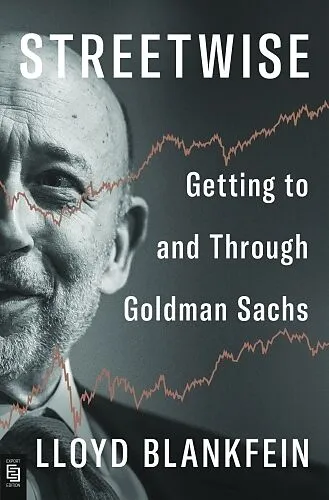
Streetwise
Beschreibung
From the long-tenured head of an institution legendary for its far-sighted culture of success, a candid memoir of global leadership in an age of extreme turbulence When Lloyd Blankfein was attacked as a Wall Street fat cat, he had to smile, thinking of his pre...Format auswählen
- Kartonierter EinbandCHF 24.30
- Fester EinbandCHF 37.20

Wird oft zusammen gekauft
Andere Kunden kauften auch
Beschreibung
From the long-tenured head of an institution legendary for its far-sighted culture of success, a candid memoir of global leadership in an age of extreme turbulence When Lloyd Blankfein was attacked as a Wall Street fat cat, he had to smile, thinking of his precarious childhood in the notorious public housing projects of East New York, Brooklyn, and a high school so chaotic he didn’t feel safe enough to use the bathroom once in his time there. Harvard was a total moon shot, and his outsider status never wore off, there or at Harvard Law. When he struck people as street-y, it wasn’t Wall Street they were thinking of. But if the chip never quite left the shoulder, neither did a wry, resilient spirit, and a lucid, democratic intelligence that saw through airs and found talent and ideas in unlikely places. Suffusing <Street Wise< is the author’s deep and abiding respect for the partnership culture of Goldman Sachs. We follow the never-ending work to protect and preserve that culture through all sorts of tumult--the challenge behind every other challenge. He is open about when he and the firm got it wrong, which was often enough, but the creative, risk-taking spirit was never snuffed, even as the failsafes put in place to protect against downside risk to the firm and its clients held when they were needed the most. A marvelous blueprint for the wise stewardship of a cause that is larger than yourself, <Street Wise< will inspire and inform readers throughout the global business community, and beyond....
Autorentext
Lloyd Blankfein
Klappentext
**The New York Times bestseller
From the long-tenured head of Goldman Sachs, an institution legendary for its culture of success, comes a candid memoir of global leadership in an age of extreme turbulence.
"Funny, mainly blunt, unexpectedly vulnerable and rarely apologetic.” —*Bloomberg
*“No one has gotten inside the secret walls of Goldman Sachs and told the story of everything about it, warts and all. Now the man who ran it tells all—and it’s incredible.” —Jim Cramer
"Lively and insightful." —The Wall Street Journal**
When Lloyd Blankfein was attacked as a Wall Street fat cat, he had to smile, thinking of his precarious childhood in the notorious public housing projects of East New York, Brooklyn, and attending a high school so chaotic he didn’t feel safe leaving class to go to the bathroom in his time there. Harvard University was a total moonshot, and his outsider status never wore off, there or at Harvard Law. When he struck people as street-y, it wasn’t Wall Street they were thinking of. But if the chip never quite left Blankfein's shoulder, neither did a wry, resilient spirit and a lucid, democratic intelligence that saw through airs and found talent and ideas in unlikely places.
Streetwise is a delightfully honest, sharp and often very funny reckoning with the author’s education—in finance, human nature, and the workings of the world. It abounds with lessons about leading teams of brilliant, aggressive, competitive people and harmonizing them around shared goals; changing when times are hard and when they’re good; managing risk; and knowing a crisis is at hand before it swamps you so you can guide your team to the further shore. Blankfein is famed for his calm hand on Goldman Sachs’s tiller during the global financial crisis, and that story is told in full here, among many other decisive episodes.
Suffusing Streetwise is the author’s deep and abiding respect for the partnership culture of Goldman Sachs. We follow the never-ending work to protect and preserve that culture through all sorts of tumult—the challenge behind every other challenge. He is open about when he and the firm got it wrong, which was often enough, but the creative, risk-taking spirit was never snuffed—even as the fail-safes put in place to protect the firm and its clients held when they were needed the most. A powerful blueprint for the wise stewardship of a cause that is larger than yourself, Streetwise will inspire and inform readers throughout the global business community and beyond.
Leseprobe
Chapter 1
Advantages
When I go into a room full of people, I have to decide whether I'm going to be the member of the establishment or the kid from Brooklyn.
I am a product of East New York, Brooklyn, where I grew up in the projects, and I still see the world through those eyes. To this day, I have to concentrate to say rather and not rath-uh. I can't compare myself with people I've worked with who overcame really severe disadvantage, like broken homes, civil wars, extreme poverty, or forced emigration. But growing up in public housing, in a family that was just getting by, and attending public schools that were failing, left its mark on me. I struggle with ambivalence. I spend half my time wanting to give stuff to my kids, the other half tormenting them for having stuff I gave them that I didn't have.
My earliest memories are from the South Bronx, where my family lived in a tenement building on Leggett Avenue. I used to love watching the coal that heated the building get delivered. It made a roar as it poured from the truck down a chute into the cellar. Another memory: the organ-grinder who sometimes played on the sidewalk outside our apartment. My mother wrapped a coin in paper and threw it out the window for his monkey to pick up.
When I was three, we moved from the Bronx to East New York, in search of a better life-which, for a time, we found. The year was 1957 and the city hadn't yet finished paving the streets of the new public housing development we were moving into, the Linden Houses, run by the New York City Housing Authority. This was subsidized housing for the working class, with buildings arrayed in an irregular pattern bordered by bits of landscaped greenery. They were not yet "the projects." At the time, it must have seemed like Shangri-la to my parents. Everything was clean and new. Children had an actual playground, with swings and monkey bars to climb. The neighborhood was reasonably safe. Those nineteen largely identical redbrick high-rises were not yet blighted in the ways they would be by the time I was in high school.
My mother, my father, my sister, my grandmother, and I occupied a small apartment with two bedrooms and a bathroom, maybe eight hundred square feet, on the fourth floor of a fourteen-story tower at 243 Wortman Avenue. My sister, Jacky, and I shared a bedroom, while my grandmother, Lilly, slept on a foldout couch in the living room. It was tight but neat. You weren't allowed to sit on a bed-beds were for sleeping, not sitting, according to my mom. There were plastic slipcovers on every piece of furniture that anyone could sit on or lean against. When we got our first TV, a big console set that I watched every afternoon and evening while lying on the living room floor, my mom made me rotate to different places on the floor so I wouldn't wear out the rug unevenly. When my parents retired to Florida decades later, the furniture they left behind was in pristine condition.
My Blankfein ancestors were Yiddish-speaking Jews who emigrated in the 1880s from a shtetl that was then in Russia and is now part of Poland. Isaac Blankfein, my paternal great-grandfather, worked as a tailor on Delancey Street, on the Lower East Side. He started a wholesale garment business that moved around Lower Manhattan, first to Greene Street-long before that neighborhood was called SoHo-then to Bleecker Street in Greenwich Village, then to East 14th Street. My grandfather Saul, who died when I was six, was the youngest of Isaac's five sons, and the only one who stayed involved in the family business. When that business went bad during the Depression, our branch of the family became the poor relations…