
IHR WARENKORB IST AKTUELL LEER.
Haben Sie noch nichts passendes gefunden? Stöbern Sie durch unser komplettes Sortiment.
Oder melden Sie sich an bzw. registrieren Sie sich.
- Kostenlose Lieferung
- Kauf auf Rechnung
- Ex Libris Tiefpreis
- Filiallieferung und 650+ Abholorte
- Rabatt-Bons als Club-Mitglied
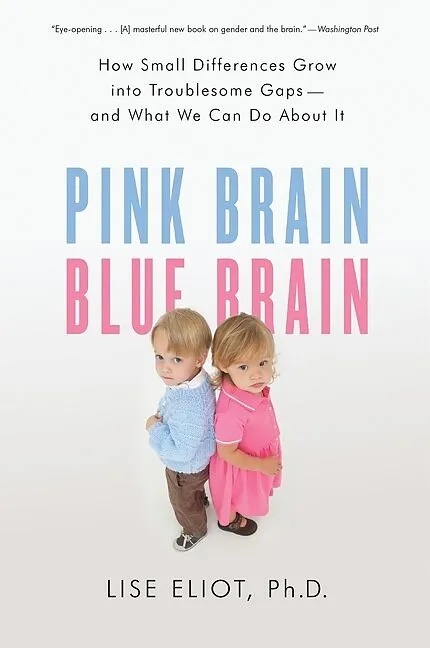
Pink Brain, Blue Brain
Beschreibung
In the past decade, we've heard a lotaboutthe innate differences between males and females, so we've come to accept that boys can't focus in the classroom and girls are obsessed with relationships. In Pink Brain, Blue Brain, neu-roscientist Lise...Format auswählen
- Kartonierter EinbandCHF 22.70
Wird oft zusammen gekauft
Andere Kunden kauften auch
Beschreibung
In the past decade, we've heard a lotaboutthe innate differences between males and females, so we've come to accept that boys can't focus in the classroom and girls are obsessed with relationships. In Pink Brain, Blue Brain, neu-roscientist Lise Eliot turns this thinking on its head. Presenting the latest science from birth to puberty, Eliot zeroes in on the precise differences between boys and girls, reining in harmful stereotypes. She argues convincingly that infant brains are so malleable that what begin as small differences at birth become amplified over time, as parents and teachers - and the culture at large - unwittingly reinforce gender stereotypes.
The good news is that by appreciating how sex differences emerge - rather than assuming them to be fixed biological facts - we can help all children reach their fullest potential. Eliot offers teachers and parents concrete ways to help close the troubling gaps between boys and girls and ultimately end the gender wars that currently divide us.
“Lise Eliot nimbly refutes the overemphasis on sex differences that has dominated popular thinking in our Mars and Venus age--but without resorting to a facile denial of differences, either. This is a lively, marvelously clear and readable book that combines all the latest research on sex differences with smart, sensible and humane advice to parents on how bring out the fullest potential in both boys and girls.”
—Margaret Talbot, Staff Writer, *The New Yorker
*
“I wish that Pink Brain, Blue Brain had been available when my children were small. It’s smart about our biology, smart about our culture—and genuinely thought-provoking in considering the way the two intersect. Read it if you’re a parent seeking some savvy insight on child rearing, as a teacher looking to help students—or just read it for the pleasure of understanding yourself a little better.”
—Deborah Blum, Pulitzer Prize winner and author of *Sex on the Brain: The Biological Differences Between Men and Women
*
“Lise Eliot surveys the real science of sex differences in a way that is clear and careful as well as entertaining, and her advice on everything from public policy to parenting is sensible and scientifically grounded.”
— Mark Liberman, University of Pennsylvania
“Lise Eliot covers a wealth of the best scientific work on gender in an accessible and engaging style. The suggestions she offers for raising and teaching children are well grounded in research and readily implemented in practice. Pink Brain, Blue Brain is an excellent resource for parents, educators, and anyone else interested in how boys and girls develop.”
—Lynn S. Liben, Ph.D., Distinguished Professor of Psychology at Penn State University
“I can’t stop talking about Pink Brain, Blue Brain. Every time I see a toddler on a playground, or walk into a toy store, I remember some remarkable new fact I learned from Lise Eliot. This book will change the way you think about boys, girls, and how we come to be who we are.”
—Jonah Lehrer, author of How We Decide and *Proust Was a Neuroscientist
*“[a] sharp, information-packed, and wonderfully readable book” —*Mother Jones
*
“This is an important book and highly recommended for parents, teachers, and anyone who works with children.” —*Library Journal
*“(a) refreshingly reasonable and reassuring look at recent alarming studies about sex differences in determining the behavior of children....Eliot’s work demonstrates a remarkable clarity of purpose.”
—*Publishers Weekly
*
“Read [this] masterful book and you'll never view the sex-differences debate the same way again.”
—*Newsweek
*“eye-opening...[a] masterful new book on gender and the brain...Eliot’s contribution in Pink Brain, Blue Brain is to explain, clearly and authoritatively, what the research on brain-based sex difference actually shows, and to offer helpful suggestions about how we can erase the small gaps for our children instead of turning them into larger ones.”—*Washington Post
*
“refreshingly evenhanded...Written in a readable style and organized in chapters ordered by age level, this makes some scientific concepts about brain development accessible to laypeople...Anyone interested in child development and gender studies will be enlightened.” —Booklist
"Considering the nonsense already in print (much of it erroneously presented as scientific fact), Pink Brain, Blue Brain should be required reading for anyone who wants a more thoughtful consideration of how the brains of boys and girls do—but mostly do not—differ." &mdas
Autorentext
Lise Eliot is Associate Professor of Neuroscience at The Chicago Medical School of Rosalind Franklin University of Medicine and Science. The mother of two sons and a daughter, she is also the author of What’s Going on in There? How the Brain and Mind Develop in the First Five Years of Life.
Leseprobe
You’re finally getting to know the new neighbors. They moved in a week ago, but you’ve had no chance to chat, which is surely why you didn’t notice sooner that the woman is pregnant. Very pregnant, by the looks of it.
“How wonderful!” you croon over your common fence. “Do you know if you’re having a boy or girl?”
Why is this always the first question we ask when learning about a new baby? The answer is simple: because sex is a big deal. Not just the act of it, but the fact of it. Of all the characteristics a child brings into the world, being male or female still has the greatest impact — on future relationships, personality, skills, career, hobbies, health, and even the kind of parent the child is likely to become. That’s why 68 percent of expectant parents learn the sex of their child before birth and why you know your neighbor is naive to answer, “We really don’t care, as long as the baby is healthy!”
Most American parents hope to have at least one child of each sex. We enjoy the differences between them, even as we worry about their consequences. Will this little boy, now so active and exuberantly affectionate, settle down enough to begin school? Will he form meaningful relationships with his friends and teachers? Will he still express his feelings or, for that matter, communicate with us at all when he grows up?
For parents of girls, the fears run in the opposite direction. Here she is, so confident and full of life. Will she still dig for worms and wonder about the planets when she’s in middle school? Will she be assertive enough when she lands her first job out of college? Will it be any easier for her generation to juggle career and family when she grows up?
Boys and girls are different. This fact, obvious to every previous generation, comes as a bewildering revelation to many parents today. Raised in an era of equal rights, we assume — or at least hope — that differences between the sexes are made, not inborn. We mingle comfortably with members of the opposite sex, harangue as easily about sports as cooking, and cheerfully compete in the workplace — all the while pretending the two sexes are more or less the same.
Until we have kids of our own, at which point the differences are impossible to ignore.
Like many parents, I could cite endless examples of the differences between our daughter and two sons: Julia loves shopping, while Sam and Toby can barely be persuaded to try on jeans at the mall. Then there was the eveni…