
IHR WARENKORB IST AKTUELL LEER.
Haben Sie noch nichts passendes gefunden? Stöbern Sie durch unser komplettes Sortiment.
Oder melden Sie sich an bzw. registrieren Sie sich.
- Kostenlose Lieferung
- Kauf auf Rechnung
- Ex Libris Tiefpreis
- Filiallieferung und 650+ Abholorte
- Rabatt-Bons als Club-Mitglied
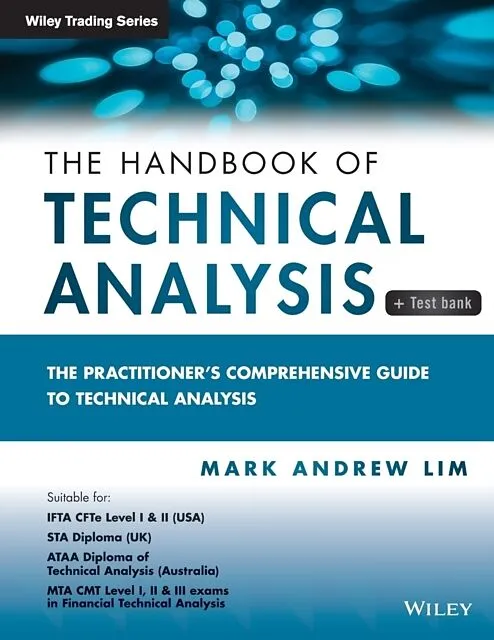
The Handbook of Technical Analysis + Test Bank
Beschreibung
A self study exam preparatory guide for financial technical analysis certifications Written by the course director and owner of www.tradermasterclass.com, a leading source of live and online courses in trading, technical analysis, and money management, A Handb...Format auswählen
- Kartonierter Einband (Kt)CHF 123.60

Wird oft zusammen gekauft
Andere Kunden kauften auch
Beschreibung
A self study exam preparatory guide for financial technical analysis certifications
Written by the course director and owner of www.tradermasterclass.com, a leading source of live and online courses in trading, technical analysis, and money management, A Handbook of Technical Analysis: The Practitioner's Comprehensive Guide to Technical Analysis is the first financial technical analysis examination preparatory book in the market. It is appropriate for students taking IFTA CFTe Level I and II (US), STA Diploma (UK), Dip TA (Aus), and MTA CMT Level I, II, and III exams in financial technical analysis, as well as for students in undergraduate, graduate, or MBA courses.
The book is also an excellent resource for serious traders and technical analysts, and includes a chapter dedicated to advanced money management techniques. This chapter helps complete a student's education and also provides indispensable knowledge for FOREX, bond, stock, futures, CFD, and option traders.
- Learn the definitions, concepts, application, integration, and execution of technical-based trading tools and approaches
- Integrate innovative techniques for pinpointing and handling market reversals
- Understand trading mechanisms and advanced money management techniques
- Examine the weaknesses of popular technical approaches and find more effective solutions
The book allows readers to test their current knowledge and then check their learning with end-of-chapter test questions that span essays, multiple choice, and chart-based annotation exercises. This handbook is an essential resource for students, instructors, and practitioners in the field. Alongside the handbook, the author will also publish two full exam preparatory workbooks and a bonus online Q&A Test bank built around the most popular professional examinations in financial technical analysis.
Autorentext
MARK ANDREW LIM graduated from King's College London in Special Physics. He was awarded the Bronwen Wood Memorial Prize in financial technical analysis by the Society of Technical Analysis (UK) in 2007 and holds IFTA's CFTe designation. Mark is the author of The Profitable Art and Science of Vibratrading and also a contributing author of The Wiley Trading Guide Volume II. He conducts a range of technical analysis and trading Masterclasses via online webinars and onsite seminars, covering intermediate to advanced profit extraction methodologies for directional and non-directional trading. He can be reached at www.tradermasterclass.com.
Inhalt
Foreword xiii
Preface xv
Acknowledgments xxi
About the Author xxiii
Chapter 1 Introduction to the Art and Science of Technical Analysis 1
1.1 Main Objective of Technical Analysis 1
1.2 Dual Function of Technical Analysis 3
1.3 Forecasting Price and Market Action 3
1.4 Classifying Technical Analysis 11
1.5 Subjectivity in Technical Analysis 16
1.6 Basic Assumptions of Technical Analysis 30
1.7 Four Basic Assumptions in the Application of Technical Analysis 39
1.8 Market Participants 40
1.9 Chapter Summary 42
Chapter 1 Review Questions 43
Chapter 2 Introduction to Dow Theory 45
2.1 Origins and Proponents of Dow Theory 45
2.2 Basic Assumptions of Dow Theory 46
2.3 Challenges to Dow Theory 62
2.4 Chapter Summary 64
Chapter 2 Review Questions 64
Chapter 3 Mechanics and Dynamics of Charting 65
3.1 The Mechanics and Dynamics of Charting 65
3.2 Gap Action: Four Types of Gaps 72
3.3 Constant Chart Measures 73
3.4 Futures Contracts 89
3.5 Chapter Summary 97
Chapter 3 Review Questions 98
Chapter 4 Market Phase Analysis 99
4.1 Dow Theory of Market Phase 99
4.2 Chart Pattern Interpretation of Market Phase 104
4.3 Volume and Open Interest Interpretation of Market Phase 112
4.4 Moving Average Interpretation of Market Phase 115
4.5 Divergence and Momentum Interpretation of Market Phase 116
4.6 Sentiment Interpretation of Market Phase 118
4.7 Sakata's Interpretation of Market Phase 119
4.8 Elliott's Interpretation of Market Phase 120
4.9 Cycle Analysis Interpretation of Market Phase 122
4.10 Chapter Summary 124
Chapter 4 Review Questions 124
Chapter 5 Trend Analysis 125
5.1 Definitions of a Trend 125
5.2 Quality of Trend: 16 Price Characteristics Impacting Future Price Action and Trend Strength 132
5.3 Price and Trend Filters 144
5.4 Trend Participation 145
5.5 Price Inflection Points 148
5.6 Trendlines, Channels, and Fan Lines 155
5.7 Trend Retracements 166
5.8 Gaps and Trends 166
5.9 Trend Directionality 168
5.10 Drummond Geometry 169
5.11 Forecasting Trend Reversals 170
5.12 Chapter Summary 171
Chapter 5 Review Questions 171
Chapter 6 Volume and Open Interest 173
6.1 The Mechanics of Volume Action 173
6.2 Volume Oscillators 203
6.3 Chapter Summary 208
Chapter 6 Review Questions 208
Chapter 7 Bar Chart Analysis 209
7.1 Price Bar Pattern Characteristics 209
7.2 Price Bar Pattern Characteristics 211
7.3 Popular Bar Reversal Patterns 218
7.4 Volatility Based Breakout Patterns 230
7.5 Chapter Summary 233
Chapter 7 Review Questions 233
Chapter 8 Window Oscillators and Overlay Indicators 235
8.1 Defining Indicators and Oscillators 235
8.2 Eight Ways to Analyze an Oscillator 240
8.3 Cycle Period, Multiple Timeframes, and Lagging Indicators 252
8.4 Input Data 253
8.5 Trend Trading Using Oscillators 255
8.6 Window Oscillators 255
8.7 Overlay Indicators 262
8.8 Chapter Summary 266
Chapter 8 Review Questions 266
Chapter 9 Divergence Analysis 267
9.1 Definition of Divergence 268
9.2 General Concept of Divergence 272
9.3 Standard and Reverse Divergence 291
9.4 Price Confirmation in Divergence Analysis 323
9.5 Signal Alternation between Standard and Reverse Divergence 337
9.6 More Examples of Divergence 338
9.7 Chapter Summary 354
Chapter 9 Review Questions 355
Chapter 10 Fibonacci Number and Ratio Analysis 357
10.1 The Fibonacci Number Series 357
10.2 Fibonacci Ratios 359
10.3 Fibonacci Retracements, Extensions, Projections, and Expansions 363
10.4 Fibonacci ( Based) Percentage Retracement Levels within an Observed Price Range 368
10.5 Fibonacci ( Based) Percentage Extension Levels beyond an Observed Price Range 375
10.6 Fibonacci ( Based) Percentage Expansion Levels beyond an Observed Price Range 379
10.7 Fibonacci ( Based) Percentage Projection Levels from a Significant Peak or Trough 384
10.8 Why Should Fibonacci Ratios or Numbers Work at All? 388
10.9 Geometrically versus Numerically Based Fibonacci Operations 389
10.10 The Fibonacci Trader's Technical Toolbox 392
10.11 Area of Application 394
10.12 Selecting Effective Inflection Points for Fibonacci Operations 396
10.13 Fibonacci, Dow, Gann, and Floor Trader's Pivot Point Levels 397
10.14 Probability of Continuation and Reversal in Fibonacci Retracements and Extensions 400
10.15 Fibonacci Based Entries, Stoplosses, and Minimum Price Objectives 400
10.16 Fibonacci Twö and Three Leg Retracements 402
10.17 Fibonacci Fan Lines 409
10.18 Fibonacci Channel Expansions 412
10.19 Fibonacci Arcs 414
10.20 Supportive and Resistive Fibonacci Clusters 415
10.21 Potential Barriers in Fibonacci Projections 417
10.22 Fibonacci Time and Ratio Projection Analysis on Elliott Waves 417
10.23 Chapter Summery 431
Chapter 10 Review Questions 431
Chapter 11 Moving Averages 433
11.1 Seven Main Components of Moving Averages 433
11.2 Nine Main Applications of Moving Averages 451
11.3 Chapter Summary 462
Chapter 11 Review Questions 463
Chapter 12 Envelopes and Methods of Price Containment 465
12.1 Containing Price Action and Volatility about a Central Value 465
12.2 Adjusting Bands for Effective Price Containment 475
12.3 Methods of Price Containment 477
12.4 Chapter Summery 492
Chapter 12 Review Questions 492
**Chapter 13 Ch…