Beschreibung
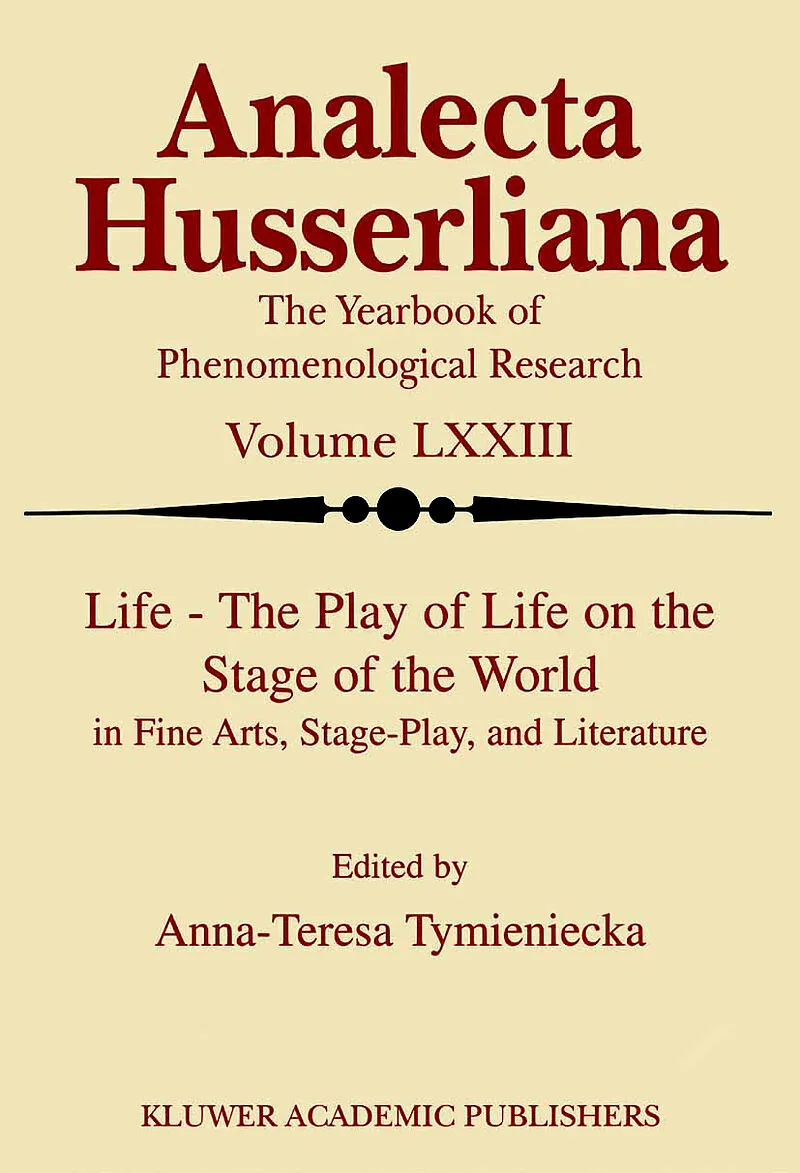
"All life upon the stage"; the Theatrum Mundi. In this volume, a seventeenth century metaphor is revisited and is seen as applying to all art in all times. In the "magic mirror of art" the human being discerns the hidden spheres of human life and commemorates ..."All life upon the stage"; the Theatrum Mundi. In this volume, a seventeenth century metaphor is revisited and is seen as applying to all art in all times. In the "magic mirror of art" the human being discerns the hidden spheres of human life and commemorates and celebrates its glorious victories and mourns its ignominious defeats. Let us rediscover Art as a witness to the human predicament as well as a celebrant of humanity's most sublime moments. This is the invitation of this collection of studies by A-T. Tymieniecka, Hanna Scolnicov, Muella Erkilic, Matt Landrus, Patricia Trutty-Coohill, Monika Bakke, David Brubaker, Tammy Knipp, Howard Pearce, Ellen J. Burns, G. Backhaus, Ethan J. Leib, Lawrence Kimmel, Ingrid Scheibler, Gottfried Scholz, L.F. Werth, A. Carillo, M. Statkiewicz, K. O'Rourke, B. Meyler, H. Meltzer, Jiuan Heng, W.V. Davies.
Art as mirror of life, human life as participating in a stage play, corresponds to the fervent search human being of the causes, reasons, puzzles of our existence which elude us in the concrete life. This XVII c. conception of Theatrum Mundi opens as this volume shows a fascinating field of investigation for our times.
Autorentext
Anna-Teresa Tymieniecka is a Polish-born American philosopher, one of the most important and continuously active contemporary phenomenologists, founder and president of "The World Phenomenology Institute".
Klappentext
"All life upon the stage"; the Theatrum Mundi. In this volume, a seventeenth century metaphor is revisited and is seen as applying to all art in all times. In the "magic mirror of art" the human being discerns the hidden spheres of human life and commemorates and celebrates its glorious victories and mourns its ignominious defeats. Let us rediscover Art as a witness to the human predicament as well as a celebrant of humanity's most sublime moments. This is the invitation of this collection of studies by A-T. Tymieniecka, Hanna Scolnicov, Muella Erkilic, Matt Landrus, Patricia Trutty-Coohill, Monika Bakke, David Brubaker, Tammy Knipp, Howard Pearce, Ellen J. Burns, G. Backhaus, Ethan J. Leib, Lawrence Kimmel, Ingrid Scheibler, Gottfried Scholz, L.F. Werth, A. Carillo, M. Statkiewicz, K. O'Rourke, B. Meyler, H. Meltzer, Jiuan Heng, W.V. Davies. Art as mirror of life, human life as participating in a stage play, corresponds to the fervent search human being of the causes, reasons, puzzles of our existence which elude us in the concrete life. This XVII c. conception of Theatrum Mundi opens as this volume shows a fascinating field of investigation for our times.
Inhalt
Theatrum Mundi in the Theatre: Shakespeare and Calderón.- The Theater of Life and Imaginative Universals in Architectural Space.- Leonardo da Vinci's Ideas of World Harmony.- The Renaissance Painter as Dramaturge.- Intimate Bodies of the Solar System.- Dwelling in Nature: Ethics, Form and Postmodern Architecture.- Virtual Environments: Psychosocial Happenings and the Theater of Life.- Music on the Stage of Life.- Illusion and Essence: Husserl's Epoché, Gadamer's Transformation into Structure, and Mamet's Theatrum Mundi.- An Exploration of Post-Aesthetic Analysis: W. A. Mozart's Die Zauberflöte by Ingmar Bergman.- The Feel of the Flesh: Towards an Ontology of Music.- Foreman FOR Every MAN: Pearls for Pigs.- Reconciliation and Harmony: The Philosophical Art of Tragic Drama.- Art as Festival: Transcending the Self through the Work of Art.- The Greatest Opera Event of the Eighteenth Century: Costanza e Fortezza and Its Political and Religious Message to the Europe of 1723.- Eugene O'Neill's Diverse Use of Fog as an Existential Metaphor.- Life as Self-Production in Kierkegaard's Early Work.- The Idea of Chaos and the Theater of Cruelty.- Ritual and Performance in the Theater of Romanticism: Delacroix's Self-Staging at the Paris Salon.- Linguistic Works of Art at the Borderlines: Ontological Exclusion in Ingarden and Gadamer 289.- Ingarden: Viewing Art as Existentially Autonomous.- Ritual and the Body in Literati Painting.- The Presence of Absence: Mirrors and Mirror Imagery in the Poetry of R. S. Thomas.- Index of Names.