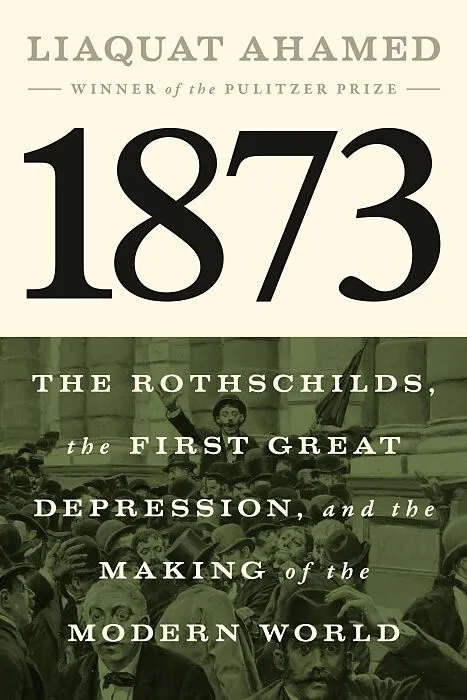
1873
Beschreibung
From the author of the Pulitzer-Prize-winning Lords of Finance, another magnificent and timely reckoning with the first truly global financial calamity through the prism of the famous banking family at the center of the whirlwind Over the course of the 1850s a...Format auswählen
- Fester EinbandCHF 33.50

Wird oft zusammen gekauft
Andere Kunden kauften auch
Beschreibung
From the author of the Pulitzer-Prize-winning Lords of Finance, another magnificent and timely reckoning with the first truly global financial calamity through the prism of the famous banking family at the center of the whirlwind Over the course of the 1850s and 1860s, during the first era of globalization, the world experienced an unprecedented economic boom. Fueling this expansion was an explosion in borrowing through the global bond market, which provided financing for the century''s most costly and transformative innovation: the railroad. At the hub of the bond market stood one family--the Rothschilds. With offices in London, Paris, Vienna, and Frankfurt, and through their agent August Belmont in New York, the Rothschilds were arguably the wealthiest and most powerful family in world history, possessing an unmatched ability to mobilize capital on a massive scale and wielding unparalleled political influence. The boom predictably swelled into a series of bubbles that burst simultaneously in the early 1870s, cascading from one country to the next across Europe and the world. Governments of the major economic powers responded by blundering amid the tumult into a precipitous remaking of the global currency system--a move that not only exacerbated the ensuing economic collapse but set the stage for a prolonged twenty-year period of punitive deflation. This deflation sparked waves of populism and anti-globalization sentiment. As Liaquat Ahamed shows us in this enthralling history, the crisis of 1873 was, among other things, a death blow to Reconstruction in the United States and the proximate cause of the Ottoman Empire''s slow death spiral and Britain''s takeover of Egypt. Ironically, as markets grew irrationally frenzied, the Rothschilds had presciently managed to protect themselves from the worst financial effects. Nevertheless, when the deluge came, they were viciously scapegoated everywhere as part of a wider spasm of ;hatred directed at "Jewish finance," a strain of antisemitism that would come to full evil flower in Austria and Germany during the 20th;century. <1873< is a marvelous birds-eye reckoning with the full dimension of the crisis, from its build-up to its long aftermath.;Through the Rothschilds and a cast of other eyewitnesses, including Karl Marx and Mark Twain making cameos at crucial moments, we have witnesses on the ground to give us the human perspective. And we have a great and brilliant financial historian’s firm grasp of the larger forces at play to create a truly cohesive global narrative with thrilling explanatory power....
Autorentext
Liaquat Ahamed graduated with degrees in economics from Cambridge and Harvard, worked at the World Bank in Washington, D.C., and had a twenty-five career as a professional investment manager based in London and New York before turning to writing. His first book, Lords of Finance: The Bankers Who Broke the World, about the lead up to the 1929 Great Depression, won the Pulitzer Prize for History, the Council on Foreign Relations Arthur Ross Gold Medal, and the Financial Times Best Business Book of the Year Award. He is a trustee of the Putnam Funds, an adviser to the Rock Creek Group, and the Chair of the Sun Valley Writers’ Conference. He lives in Los Angeles and Washington, D.C. with his wife Meena.
Zusammenfassung
From the author of the Pulitzer Prize–winning Lords of Finance, a magnificent and timely reckoning with the first truly global financial calamity and the famous banking family at the center of the whirlwind
Over the course of the 1850s and 1860s, during the first era of globalization, the world experienced an unprecedented economic boom. Fueling this expansion was an explosion in the global bond market, at the hub of which stood one family—the Rothschilds, arguably the wealthiest banking family in history. While the giant sums of capital provided through the bond market built the railroads, the century’s most transformative investments, the money raised also unleashed a frenzy of speculation, massive overinvestment, and wasteful borrowing by governments.
With excessive euphoria leading to disappointed expectations, in the early 1870s the bubble burst. Stock markets from Vienna to New York crashed, and dozens of railroads and many governments defaulted. Financial officials responded by blundering into a precipitous remaking of the global currency system—exacerbating the ensuing economic collapse and setting the stage for decades of a punitive deflation that sparked waves of anti-globalist populism. As Liaquat Ahamed shows us in this enthralling history, the crisis of 1873 was, among other things, a death blow to Reconstruction in the United States and the proximate cause of the Ottoman Empire’s slow death spiral. Ironically, though the Rothschilds had presciently kept a low profile during the bubble, when the deluge came, they were viciously scapegoated as part of a wider hatred directed at “Jewish finance,” a strain of antisemitism that would come to full evil flower during the twentieth century.
1873 is a bird’s-eye reckoning with the full dimension of the crisis, from its buildup to its long aftermath. The Rothschilds and a cast of other witnesses give us the human perspective. And we have a brilliant financial historian’s grasp of the larger forces at play, resulting in a global narrative with thrilling explanatory power.