Haben Sie noch nichts passendes gefunden? Stöbern Sie durch unser komplettes Sortiment.
Oder melden Sie sich an bzw. registrieren Sie sich.


Beschreibung
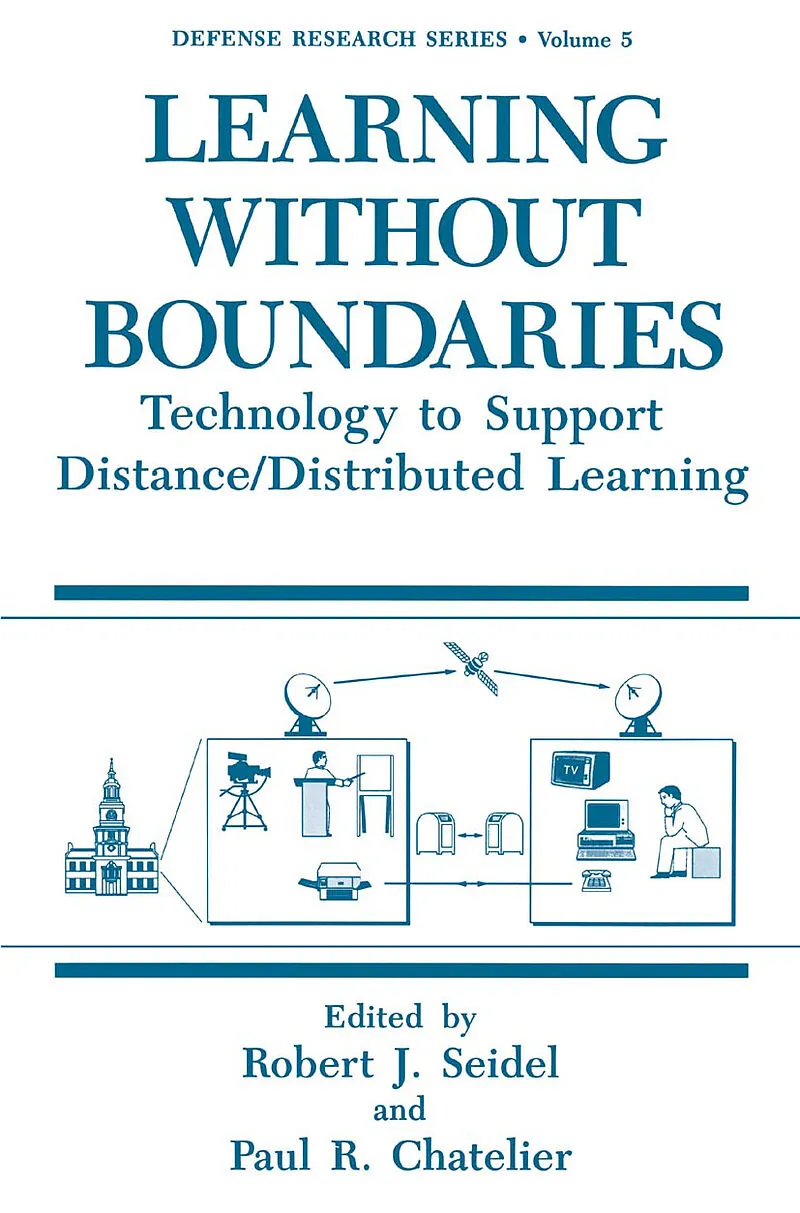
This collection of papers is the result of a workshop sponsored by NATO's Defense Research Group Panel 8 during the Fall of 1993. The workshop was held at the University of German Armed Forces at Neubiberg (Munich) Germany 29 September-l October, 1993. Robert ...This collection of papers is the result of a workshop sponsored by NATO's Defense Research Group Panel 8 during the Fall of 1993. The workshop was held at the University of German Armed Forces at Neubiberg (Munich) Germany 29 September-l October, 1993. Robert J. Seidel Paul R. Chatelier U.S. Army Research Institute for the Executive Office of the President Behavioral and Social Sciences Office of Science and Technology Policy Washington, D.C. Washington, D.C. v PREFACE We would like to thank the authors of the papers for providing an excellent coverage of this rapidly developing technology, the session chairpersons for providing excellent structure and management for each group of papers, and each session's discussant's for their summary and personal views of their sessions papers. Our special thanks go to Dr. Rolfe Otte, the German ministry of Defense's research study group member and the person responsible for our being able to have this workshop in Munich. We are also grateful to Dr. H. Closhen of the IABG for technical and administrative assistance throughout the planning and conduct of the workshop.
Autorentext
Currently, Dr. Robert J. Seidel is Research Chief Emeritus at the Army Research Institute. He attained his Ph.D. in Experimental Psychology from the University of Pennsylvania and was a NIH Special Postdoctoral Fellow at Stanford University. He has taught full- time at Denison University, and part-time at, George Washington University, the University of Maryland, and Trinity College in Connecticut. He has a varied and rich experience base spanning over 36 years of research, development, and management in the areas of experimental design, individualized instruction, computer-administered instruction, technology transfer, distance learning, and evaluation. In these areas of expertise, he has given many talks, nationally and internationally, published numerous articles and seven books. He was principal investigator for a National Science Foundation grant, which resulted in his co-authoring, (with colleagues B. Hunter, C. Kastner, and M. Rubin) Learning Alternatives in U.S. Education: Where student and computer meet. Dr. Seidel organized, then conducted an educational technology conference, and subsequently edited (with M. Rubin) a book, Computers and Communication, based on the findings from the conference. The next book, Computer Literacy, was edited by Dr. Seidel, R. Anderson, and B. Hunter. He has also managed groups of research personnel in both the private sector and in government, and has served many years as an advisor to NATO for the implementation of advanced technologies. As part of his NATO work, Dr. Seidel served as senior editor and contributed chapters to four books dealing with the use of technology in education and training.Kathy Cox-Perencevich is finishing up her dissertation towards obtaining her Ph.D. at the University of Maryland in educational psychology, while working full-time as a lead researcher at The National Reading Research Center. She attained a M.S. in educational psychology at the Pennsylvania State University and completedteacher certification programs in elementary education and in special education in Massachusetts. Ms. Cox-Perencevich has been pursuing research related to diagnosing and improving students engagement in literacy development. Her overall focus has been on cognition and motivation in classroom settings. In that regard, she has a number of recent publications in educational psychology journals, and book chapters, dealing with techniques for enhancing motivation and cognitive development in the field of Reading.Allyson Kett is presently completing her work towards a Psy.D. in Clinical Psychology from the American School of Professional Psychology at Argosy University, Washington D.C., and is a National Consortium Research Fellow at the U.S. Army Research Institute in Arlington, VA. Prior to coming to D.C., she obtained her M.A. in Clinical Psychology with a specialization in Education at Teachers College of Columbia University in New York City and her B.A. in psychology from the College of William and Mary in Williamsburg, Virginia. Ms. Kett has a broad, verse background in developing and delivering instruction in the training and educational fields. She worked at the New York Bankers Association developing educational programs for bankers of all levels. In addition, she has experience working in the educational field, including developing instructional materials for, and assisting in the teaching of, children of all ages who are mentally challenged and/or have developmental disabilities. Ms. Kett also assisted in planning, organizing, and implementing seminars and leadership forums for a national, industry sponsored, college Scholars Program.
Klappentext
Proceedings of the NATO Defense Research Group, Panel 8 Workshop on Distance/Distributed Learning held in Neubiberg, Munich, Germany, September 28-October 1, 1993.
Inhalt
Learning Without Boundaries: An Overview of Distance/Distributed Learning.- Discussant Section A: Technology Requirements.- 1. An Analysis of Conferencing as Technology for Distributed Training: Perspectives on Functionality, Instrumentation, Organizational Integration, and Cost-Effectiveness.- 2. Organisational Requirements for Educational Technologies Development and Use.- 3. Some Instructional Theory Driven Aspects of Electronic Technology Supported Distance/Distributed Learning.- 4. New Paradigms for Motivation to Learn and to Continue Learning.- Discussant Session B: Today's Technological Capabilities.- 5. Critical Decision Making in the Context of Command and Control: A Computer Simulation Approach to Its Training.- 6. ECOM: Electronic Communication in Distance Learning.- 7. Technical and Administrative Issues in Distributed Training Technology.- Discussant Section C: Instructional Development.- 8. Distance Education in the Royal Netherlands Army Training Command.- 9. Educational Programmes in the Federal Republic of Germany: A Review of Experiences.- 10. Attitudinal Considerations in Distributed Training.- Discussant Section D: Technologies Available for Application.- 11. Training in the Close Combat Tactical Trainer.- 12. Advanced Technologies Applied to Training DesignDistance Learning: Technologies Available for Application: Network Simulation: Lessons for Training System Design Derived from the UK(AGPT) CATT Trial.- 13. Tactical Environment Simulation for Training the Crews of the LeClerc Tank.- Discussant Session E: Technology Transfer and Multiple use of Technologies for Education and Training.- 14. NTTCa New Window Into Federal R&D Information.- 15. Italian Experiences in Distance Education and Trends towards Knowledge and Technology Transfer.- 16.Transfer of Educational Materials and SystemsProblems, Solutions and Technology.- Overview of the Telematics Programme for Flexible and Distance Learning (Delta).
15%