
IHR WARENKORB IST AKTUELL LEER.
Haben Sie noch nichts passendes gefunden? Stöbern Sie durch unser komplettes Sortiment.
Oder melden Sie sich an bzw. registrieren Sie sich.
- Kostenlose Lieferung
- Kauf auf Rechnung
- Ex Libris Tiefpreis
- Filiallieferung und 650+ Abholorte
- Rabatt-Bons als Club-Mitglied
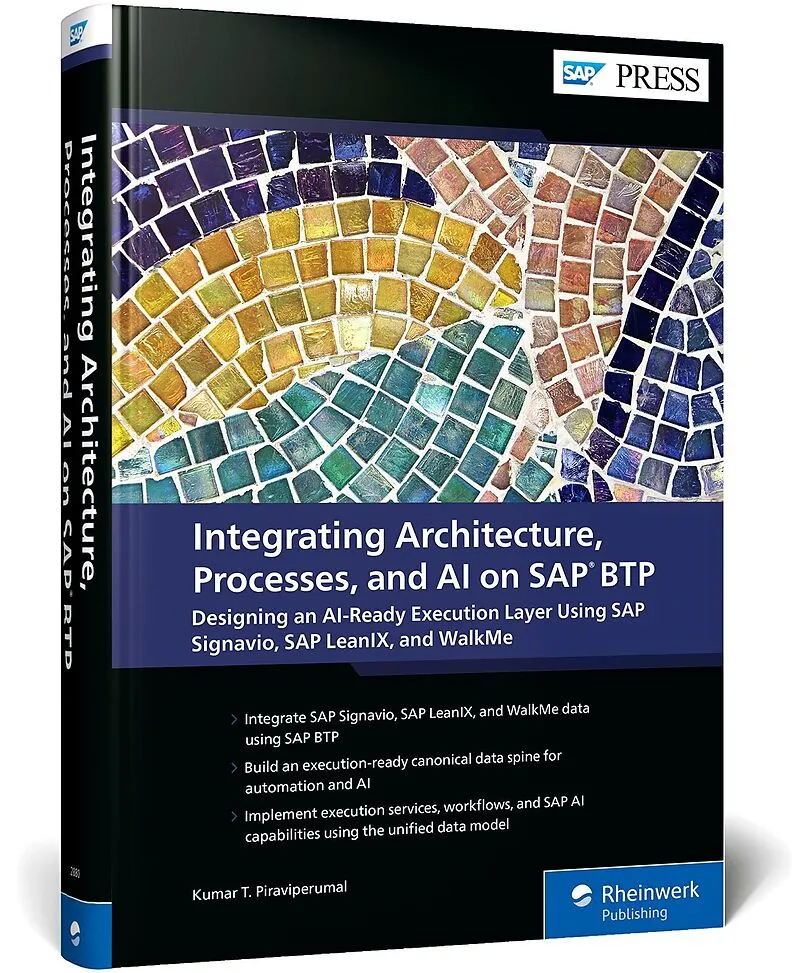
Integrating Architecture, Processes, and AI on SAP BTP
Beschreibung
Planning to implement AI and automation? Start by preparing your foundation. Most organizations document processes and architecture, but don't connect them in a way that's useful for AI models and automation workflows. This book shows you how to use SAP Signa...
Format auswählen
- Fester EinbandCHF 104.05

Wird oft zusammen gekauft
Andere Kunden kauften auch
Beschreibung
Planning to implement AI and automation? Start by preparing your foundation. Most organizations document processes and architecture, but don't connect them in a way that's useful for AI models and automation workflows. This book shows you how to use SAP Signavio, SAP LeanIX, and WalkMe to transform your architecture and process data into a unified execution layer on SAP BTP. You'll learn to model processes, map applications to process steps, capture adoption telemetry, design integration flows, and prepare data for AI and automation. Move from static documentation to an execution-ready SAP architecture!
a. Designing the Canonical Data Spine
Discover why point-to-point integrations fail and how to implement a normalized canonical model on SAP BTP. Define stable identifiers, ownership rules, versioning strategies, and audit mechanisms that support execution-grade automation and AI.
b. Integrating Process and Architecture Data
Structure process and architecture data for downstream consumption using SAP Signavio and SAP LeanIX. Map L4/L5 process steps to applications and interfaces, design ingestion flows, and build reusable execution services for process lookup, context enrichment, and change impact analysis.
c. Enabling AI and Automation
Prepare enterprise data for SAP's AI services. Define eligibility rules, role-based scoping, grounding constraints, and human-in-the-loop validation. Deploy AI services on top of a secure, integrated foundation.
Highlights:
- SAP Signavio
- SAP LeanIX
- WalkMe
- AI execution
- SAP AI Core
- Generative AI Hub
- Automated workflows
- SAP Build Process Automation
- SAP Build Work Zone
- Security
- Monitoring
Implement execution services, workflows, and SAP AI capabilities using the unified data model
Autorentext
Kumar T. Piraviperumal has worked with SAP technologies since 1997, building a career that spans enterprise delivery, architecture leadership, and professional education. Over nearly three decades, his work has focused on how large organizations design, integrate, and operate complex SAP landscapes under real-world constraints.He currently leads a global SAP business transformation practice at Cognitus with revenues exceeding USD 100 million, operating across more than 19 countries. In this capacity, Kumar is responsible for shaping transformation strategy, enterprise and solution architecture standards, delivery governance, and execution models for organizations undertaking large-scale SAP S/4HANAcentric programs. His work is grounded in environments where scale, regulatory requirements, and operational continuity are non-negotiable.Kumar's industry experience is concentrated in utilities, automotive, and large-scale information technology and services organizations. Across these sectors, he has led and advised initiatives involving end-to-end process transformation, enterprise integration, financial consolidation, planning, and operational modernization. He has supported global rollouts, regulatory-driven change programs, and post-merger integration efforts, often in situations where SAP business transformation management tools, SAP BTP, and analytics platforms were introduced concurrently, without an established integration model.Alongside his practitioner work, Kumar has maintained a strong commitment to academic engagement and professional enablement. He has written for SAPinsider magazine and the MIT Technology Journal, and has taught and contributed to courses at MIT Open University, focusing on enterprise systems, transformation frameworks, and the application of emerging technologies in large organizations. He has also been actively involved with SAP University Alliances and SAP Education Services, delivering enablement programs for consultants, architects, and client teams worldwide.Kumar has directly taught and supported core SAP curricula, including S4H100 and S4H200, SAP BPC for consolidation and planning, SAP Analytics Cloud (SAC), and SAP Group Reporting. This sustained involvement in SAP education has shaped his perspective on the gap between formal product training and the realities of execution in complex enterprise environments (a gap that strongly informs the content of this book).He is a frequent speaker and sponsor at SAP-focused events such as SAP enterprise architecture conferences, SAP SAPPHIRE, SAPinsider events, SAP Transformation Excellence Summit, and SAP TechEd, and regularly collaborates with SAP product teams, partners, and enterprise architecture leaders. His current work increasingly focuses on execution-grade transformation and the responsible application of AI in SAP landscapes.This book reflects Kumar's combined experience as a practitioner, architect, and educator. It presents a field-tested, technically rigorous view of how SAP Signavio, SAP LeanIX, SAP BTP, WalkMe, SAP Build, SAP Work Zone, and SAP AI can be integrated into a coherent, governed execution platform, grounded not in abstract theory, but in sustained delivery and academic inquiry.
Inhalt
... Preface ... 27
... Who This Book Is For ... 28
... What You Will Learn ... 28
... A Single Worked Example, Followed Throughout ... 29
... How to Use This Book ... 29
PART I ... Technical Context and Integration Principles ... 31
1 ... Why Enterprise Architecture and Business Process Architecture Data Must Be Integrated for AI Execution ... 33
1.1 ... The Structural Failure of Most Transformation Programs ... 34
1.2 ... Limitations of Isolated Process Repositories ... 37
1.3 ... Limitations of Isolated Enterprise Architecture Repositories ... 39
1.4 ... Why SAP AI Requires Unified Semantic Context ... 41
1.5 ... The Role of SAP BTP as the Data Spine, Integration Layer, and Extension Layer ... 44
1.6 ... Non-Goals: What AI Must Not Automate ... 46
1.7 ... Summary ... 48
2 ... Reference Integration Architecture ... 53
2.1 ... Logical Architecture Overview ... 54
2.2 ... Authoritative Systems of Record ... 56
2.3 ... Data Ownership and Write Boundaries ... 57
2.4 ... Integration and Extension Responsibilities ... 60
2.5 ... Execution and Consumption Layers ... 62
2.6 ... Security Architecture Principles for Process- and AI-Driven Integration ... 64
2.7 ... Identity, Authentication, and Authorization in SAP Signavio, SAP LeanIX, and SAP BTP ... 66
2.8 ... Data Access Segmentation and Role-Based Exposure of the Data Spine ... 69
2.9 ... Security Boundaries Between Execution Services, AI Services, and User Interfaces ... 71
2.10 ... Auditability, Traceability, and Non-Repudiation by Design ... 71
2.11 ... Allocation of Security Responsibilities Across Platforms ... 73
2.12 ... Summary ... 75
PART II ... Configuring SAP Signavio for Execution and AI Readiness ... 81
3 ... SAP Signavio Data Model for Integration ... 83
3.1 ... L4 and L5 Process Object Requirements ... 84
3.2 ... Process and Activity Identifiers ... 87
3.3 ... Mandatory Execution Attributes ... 92
3.4 ... Roles, Variants, and Localization ... 95
3.5 ... Versioning and Lifecycle Management ... 101
3.6 ... What Must Not Be Modeled in SAP Signavio ... 105
3.7 ... Summary ... 109
4 ... Extending SAP Signavio for Downstream Consumption ... 115
4.1 ... Standard Attributes Versus Custom Attributes ... 116
4.2 ... External Reference Patterns ... 124
4.3 ... Preparing SAP Signavio APIs for Extraction ... 128
4.4 ... Event Versus Batch Export Considerations ... 136
4.5 ... Validation and Data Quality Checks ... 142
4.6 ... Summary ... 150
PART III ... Configuring SAP LeanIX for Dependency and Context Data ... 153
5 ... SAP LeanIX Data Model for Integration ... 155
5.1 ... The Running Scenario: Cost Center to Position ... 157
5.2 ... Application Objects…