Beschreibung
The architecture of the human language faculty has been one of the main foci of the linguistic research of the last half century. This branch of linguistics, broadly known as Generative Grammar, is concerned with the formulation of explanatory formal accounts...
The architecture of the human language faculty has been one of the main foci of the linguistic research of the last half century. This branch of linguistics, broadly known as Generative Grammar, is concerned with the formulation of explanatory formal accounts of linguistic phenomena with the ulterior goal of gaining insight into the properties of the 'language organ'. The series comprises high quality monographs and collected volumes that address such issues. The topics in this series range from phonology to semantics, from syntax to information structure, from mathematical linguistics to studies of the lexicon.
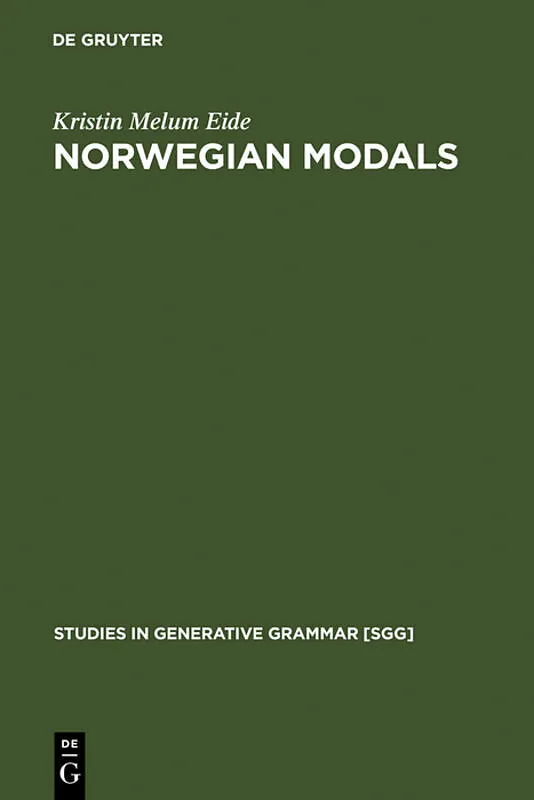
Norwegian Modals is a detailed description of the syntactic and semantic properties of modals in Norwegian. Modal verbs in Mainland Scandinavian languages have received much less attention than their English and German counterparts, hence this book seizes the opportunity to present a range of new data and generalizations relevant for the study of Scandinavian languages, but also for the study of modality in Germanic and other languages. The book critically evaluates a range of proposals from the modality literature, focusing on the Theta-properties and the scopal properties of Modals in Germanic languages, and concludes that none of these previous proposals are able to account for the syntax of modals in Norwegian. The Theta-properties of modals are shown to depend on the construction in which the modal occurs, hence neither a raising analysis, a control analysis, nor a raising-versus-control analysis in fact suffices to exhaust these properties of Norwegian modals. The interplay of modals with tense and aspect is likewise thoroughly investigated, presenting a range of data revealing that existing universalist proposals are insufficient to account for even quite regular patterns. Instead, a new analysis is presented, building on a new compositional tense system which exploits aspectual features of predicates and selectional preferences of modal classes.
Autorentext
Kristin Melum Eide, ** Norwegian University of Science and Technology, Trondheim, Norway.
Klappentext
Norwegian Modals is a detailed description of the syntactic and semantic properties of modals in Norwegian. Modal verbs in Mainland Scandinavian languages have received much less attention than their English and German counterparts, hence this book seizes the opportunity to present a range of new data and generalizations relevant for the study of Scandinavian languages, but also for the study of modality in Germanic and other languages. The book critically evaluates a range of proposals from the modality literature, focusing on the Theta-properties and the scopal properties of Modals in Germanic languages, and concludes that none of these previous proposals are able to account for the syntax of modals in Norwegian. The Theta-properties of modals are shown to depend on the construction in which the modal occurs, hence neither a raising analysis, a control analysis, nor a raising-versus-control analysis in fact suffices to exhaust these properties of Norwegian modals. The interplay of modals with tense and aspect is likewise thoroughly investigated, presenting a range of data revealing that existing universalist proposals are insufficient to account for even quite regular patterns. Instead, a new analysis is presented, building on a new compositional tense system which exploits aspectual features of predicates and selectional preferences of modal classes.