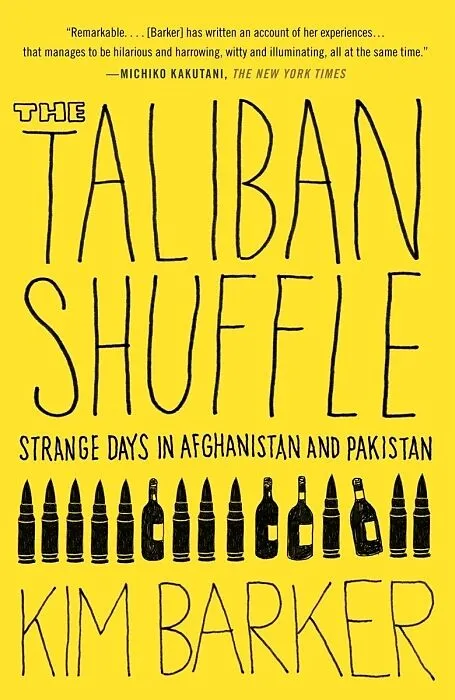
The Taliban Shuffle
Beschreibung
Zusatztext 77519264 Informationen zum Autor Kim Barker Klappentext Now a Major Motion Picture titled Whiskey Tango Foxtrot starring Tina Fey, Margot Robbie, Martin Freeman, Alfred Molina, and Billy Bob Thornton. When Kim Barker first arrived in Kabul as a jour...Format auswählen
- Kartonierter EinbandCHF 25.10

Wird oft zusammen gekauft
Andere Kunden kauften auch
Beschreibung
Zusatztext 77519264 Informationen zum Autor Kim Barker Klappentext Now a Major Motion Picture titled Whiskey Tango Foxtrot starring Tina Fey, Margot Robbie, Martin Freeman, Alfred Molina, and Billy Bob Thornton. When Kim Barker first arrived in Kabul as a journalist in 2002, she barely owned a passport, spoke only English and had little idea how to do the "Taliban Shuffle" between Afghanistan and Pakistan. No matter-her stories about Islamic militants and shaky reconstruction were soon overshadowed by the bigger news in Iraq. But as she delved deeper into Pakistan and Afghanistan, her love for the hapless countries grew, along with her fear for their future stability. In this darkly comic and unsparing memoir, Barker uses her wry, incisive voice to expose the absurdities and tragedies of the "forgotten war," finding humor and humanity amid the rubble and heartbreak. Leseprobe CHAPTER 1 WELCOME TO THE TERRORDOME I had always wanted to meet a warlord. So we parked our van on the side of the beige road and walked up to the beige house, past dozens of skinny young soldiers brandishing Kalashnikov assault rifles and wearing mismatched khaki outfits and rope belts hiked high on their waists. Several flaunted kohl eyeliner and tucked yellow flowers behind their ears. Others decorated their rifle butts with stickers of flowers and Indian movie starlets. Male ethnic Pashtuns loved flowers and black eyeliner and anything fluorescent or sparkly, maybe to make up for the beige terrain that stretched forever in Afghanistan, maybe to look pretty. Outside the front door, my translator Farouq and I took off our shoes before walking inside and sitting cross-legged on the red cushions that lined the walls. The decorations spanned that narrow range between unicorn-loving prepubescent girl and utilitarian disco. Bright, glittery plastic flowers poked out of holes in the white walls. The curtains were riots of color. We waited. I was slightly nervous about our reception. Once, warlord Pacha Khan Zadran had been a U.S. ally, one of the many Afghan warlords the Americans used to help drive out the Taliban regime for sheltering Osama bin Laden and his minions after the attacks of September 11, 2001. But like a spoiled child, Pacha Khan had rebelled against his benefactors, apparently because no one was paying enough attention to him. First he turned against the fledg-ling Afghan government, then against his American allies. In an epic battle over a mountain pass, the Americans had just killed the warlord's son. The Pashtun code required revenge, among other things, and now, six days after the battle, here I was, a fairly convenient American, waiting like a present on a pillow in Pacha Khan's house, hoping to find a story edgy enough to make it into my newspapernot easy considering it was March 2003, and there were other things going on in the world. But Farouq told me not to worry. He had a plan. Pacha Khan soon marched into the room. He certainly looked the warlord part, wearing a tan salwar kameez, the region's ubiquitous traditional long shirt and baggy pants that resembled pajamas, along with a brown vest, a bandolier of bullets, and a gray-and-black turban. The wrinkles on his face appeared to have been carved out with an ice pick. He resembled a chubby Saddam Hussein. We hopped up to greet him. He motioned us to sit down, welcomed us, and then offered us lunch, an orange oil slick of potatoes and meat that was mostly gristle. I had no choice, given how strictly Afghans and especially Pashtuns viewed hospitality. I dug in, using my hands and a piece of bread as utensils. But just because Pacha Khan fed us, didn't mean he would agree to an interview. The Pashtun code required him to show us hospitality. It didn't force him to talk to me. Pacha Khan squinted at my getupa long brown Afghan dress over black pants, an Indian paisley hea...
“Remarkable. . . . [Barker] has written an account of her experiences covering Afghanistan and Pakistan that manages to be hilarious and harrowing, witty and illuminating, all at the same time.” —Michiko Kakutani, The New York Times
“The Taliban Shuffle isn’t like any other book out there about Afghanistan and Pakistan. It’s witty, brilliant, and impossible to put down.” —Rajiv Chandrasekaran, author of Imperial Life in the Emerald City
“The Taliban Shuffle is part war memoir, part tale of self-discovery that, thanks to Barker’s biting honesty and wry wit, manages to be both hilarious and heartbreaking.” ***—**Chicago Tribune
*
“What you’d hear if the reporter never turned off the voice recorder between interviews—brilliant firsthand outtakes that wind up telling us more about the Afghan debacle than any foreign policy briefing.” ***—***The Seattle Times
“At once funny and harrowing, insightful and appalling. . . . The Taliban Shuffle will pull you in so deep that you’ll smell the poppies and quake from the bombs.” —The Minneapolis Star Tribune
*
“If you’re looking for a window on the challenges facing Afghanistan and Pakistan today—from a resurgent Taliban to American incompetence to Afghan and Pakistani corruption and nepotism—Barker provides a sterling vantage point.” —San Francisco Chronicle
“Kim Barker gives a true and amusing picture of hellholes and the reporters on assignment in them. But she breaks the journo code of silence and reveals a trade secret of the hacks who cover hellholes: The hell of the holes is that they’re kind of fun.” —P. J. O'Rourke*
**
“The Taliban Shuffle gives us an insider’s perspective of Afghanistan and Pakistan—their fascinating cultures, unstable governments, and burgeoning terrorist groups. . . . With dark, self-deprecating humor and shrewd insight, Barker chronicles her experiences as a rookie foreign reporter and the critical years when the Taliban resurged amidst the collapse of the Afghan and Pakistani governments.” —The Daily Beast
“Politically astute and clearly influenced by Hunter S. Thompson, Barker provides sharp commentary on the impotence of American foreign policy in South Asia after the victory against the Taliban. . . . Fierce, funny and unflinchingly honest.” —Kirkus Reviews
“Reveals many enduring truths. . . . Novel both for its humor and for its perspective . . . it rises (or sinks) to levels of seriousness that will be remembered long after the po-faced analysis of other writers has been forgotten.” —The National
“Brilliant, tender, and unexpectedly hilarious.” —Marie Claire
“Candid and darkly comic. . . . With self-deprecation and a keen eye for the absurd, Barker describes her evolution from a green, fill-in correspondent to an adrenaline junkie.” —Publisher’s Weekly
“The Taliban Shuffle is Scoop meets Dispatches, remixed with a twenty-first-century Bollywood soundtrack. Laugh-out-loud funny, it is the true story of what it is like to be a female journalist in one of the world's most exotic war zones, while telling the reader much about what is really going on today in Afghanistan and Pakistan.” —Peter Bergen, author of The Longest War: The Enduring Conflict between America and Al-Qaeda
“[An] immensely entertaining memoir.” —The Boston Globe
“Yes, there are bombs. And there is carnage. And all sorts of mayhem. But mostly there are people, human beings even, with appetites—for life, for adventure, for riches, for love. Ms. Barker offers this world—the human world caught in the crosshairs of history—with a vitality rarely seen in accounts of the war…