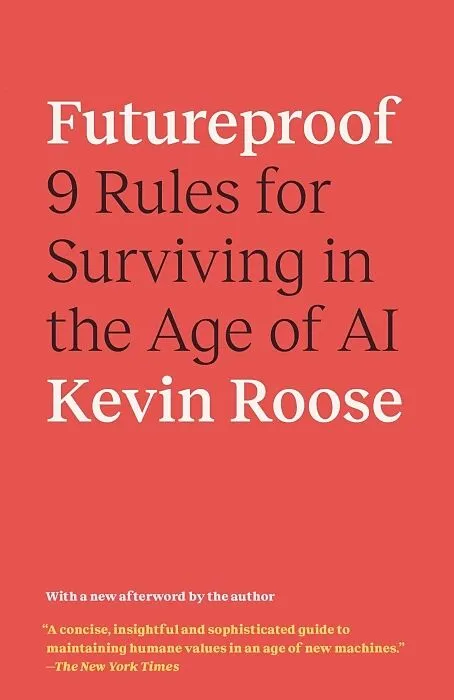
Futureproof
Beschreibung
“Engaging . . . Roose delves into this crisis with an accessible touch that nicely explains how AI is infiltrating every part of our society and workforce.”—The Times “Artificial intelligence—and robots themselves&m...Format auswählen
- Kartonierter EinbandCHF 21.90

Wird oft zusammen gekauft
Andere Kunden kauften auch
Beschreibung
“Engaging . . . Roose delves into this crisis with an accessible touch that nicely explains how AI is infiltrating every part of our society and workforce.”—The Times
“Artificial intelligence—and robots themselves—can be terrifying, but Kevin Roose provides a clear, compelling strategy for surviving the next wave of technology with our jobs—and souls—intact. Whether you’re an optimist or a pessimist about the future, Futureproof is the survival guide you need.”—Charles Duhigg, author of The Power of Habit
“While I think that Skynet is still going to send the Terminator back to try to kill humanity someday, it’s worth your time and attention—if that is still a thing in the addled Internet age—to read Kevin Roose’s bracing book now. Why? Because it’s a primer on the future and how to deal with the incoming today, from AI to automation to robotics and more, by using the tools of creativity and just being human. Whether the digital threat comes from a cybernetic organism from 2459 arriving in a big ball of lightning or from that innocent-looking mobile supercomputer in your hand, I do know that you need to prepare for the next tech age. And there’s no better way to do it than to futureproof yourself by letting Roose show you how.”—Kara Swisher, host of Sway and Pivot, New York Times contributing opinion writer
Autorentext
Kevin Roose is a technology columnist for The New York Times. He is the host of the Rabbit Hole podcast and a regular guest on The Daily. He writes and speaks frequently about topics including automation and AI, social media, disinformation and cybersecurity, and digital wellness. Previously, he was a writer at New York magazine and the co–executive producer of Real Future, a documentary TV series about technology. He is the New York Times bestselling author of two previous books, Young Money and The Unlikely Disciple. He lives in Oakland, California.
Klappentext
"The machines are here. After decades of sci-fi doomsaying and marketing hype, advanced A.I. and automation technologies have leapt out of research labs and Silicon Valley engineering departments and into the center of our lives. Robots once primarily threatened blue-collar manufacturing jobs, but today's machines are being trained to do the work of lawyers, doctors, investment bankers, and other white-collar jobs previously considered safe from automation's reach. The world's biggest corporations are racing to automate jobs, and some experts predict that A.I could put millions of people out of work. Meanwhile, runaway algorithms have already changed the news we see, the politicians we elect, and the ways we interact with each other. But all is not lost. With a little effort, we can become futureproof. In Futureproof: 9 Rules for Machine-Age Humans, New York Times technology columnist Kevin Roose lays out an optimistic vision of how people can thrive in the machine age by rethinking their relationship with technology, and making themselves irreplaceably human. In nine pragmatic, accessible lessons, Roose draws on interviews with leading technologists, trips to the A.I. frontier, and centuries' worth of history to prepare readers to live, work, and thrive in the coming age of intelligent machines. He shares the secrets of people and organizations that have successfully survived technological change, including a 19th-century rope-maker and a Japanese auto worker, and explains how people, organizations, and communities can apply their lessons to safeguard their own futures. The lessons include: Do work that is surprising, social, and scarce (the types of work machines can't do), break your phone addiction with the help of a rubber band, work in an office, treat A.I. like the office gorilla, resist "hustle porn" and efficiency culture and do less, slower Roose's examination of the future rejects the conventional wisdom that in order to compete with machines, we have to become more like them -- hyper-efficient, data-driven, code-writing workhorses. Instead, he says, we should let machines be machines, and focus on doing the kinds of creative, inspiring, and meaningful work only humans can do"--
Zusammenfassung
A practical, deeply reported survival guide for the age of AI, written by the New York Times tech columnist who has introduced millions to the promise and pitfalls of artificial intelligence—now featuring a new afterword.
“Artificial intelligence can be terrifying, but Kevin Roose provides a clear, compelling strategy for surviving the next wave of technology with our jobs—and souls—intact.”—Charles Duhigg, author of The Power of Habit
It’s time to get real about AI.
After decades of hype and sci-fi fantasies, AI—artificial intelligence—is leaping out of research labs and into the center of our lives. Millions of people now use tools like ChatGPT and DALL-E 2 to write essays, create art and finish coding projects. AI programs are already beating humans in fields like law, medicine and entertainment, and they’re getting better every day.
But AI doesn’t just threaten our jobs. It shapes our entire human experience, steering our behavior and influencing our choices about which TV shows to watch, which clothes to buy, and which politicians to vote for.
And while many experts argue about whether a robot apocalypse is near, one critical question has gone unanswered:
In a world where AI is ascendant, how can humans survive and thrive?
In Futureproof: 9 Rules for Surviving in the Age of AI, New York Times technology columnist Kevin Roose shares the secrets of people and organizations that have successfully navigated waves of technological change, and explains what skills are necessary to stay ahead of the curve today, with lessons like
• Be surprising, social, and scarce
• Resist machine drift
• Leave handprints
• Demote your devices
• Treat AI like a chimp army
Roose rejects the conventional wisdom that in order to compete with AI, we have to become more like robots ourselves—hyper-efficient, data-driven workhorses. Instead, he says, we should focus on being more human, and doing the kinds of creative, inspiring, and meaningful things even the most advanced algorithms can’t do.
Leseprobe
Recently, I was at a party in San Francisco when a man approached me and introduced himself as the founder of a small AI start-up. As soon as the founder figured out that I was a technology writer for The New York Times, he launched into a pitch for his company, which he said was trying to revolutionize the manufacturing sector using a new AI technique called “deep reinforcement learning.” Modern factories, he explained, were struggling with what is called “production planning”—the complex art of calculating which machines should be making which things on which days. Today, he said, most factories employ humans to look at thick piles of data and customer orders to figure out whether the plastic-molding machines should be making X-Men figurines on Tuesdays and TV remotes on Thursdays, or vice versa. It’s one of those dull-but-essential tasks without which modern capitalism would probably grind to a halt, and companies spend billions of dollars a year trying to get it right. The founder explained that his company’s AI could run millions of virtual simulations for any given factory, eventually arriving at the exact sequence of processes that would allow it to produce goods most efficiently. This AI, he said, would allow factories to replace entire t…