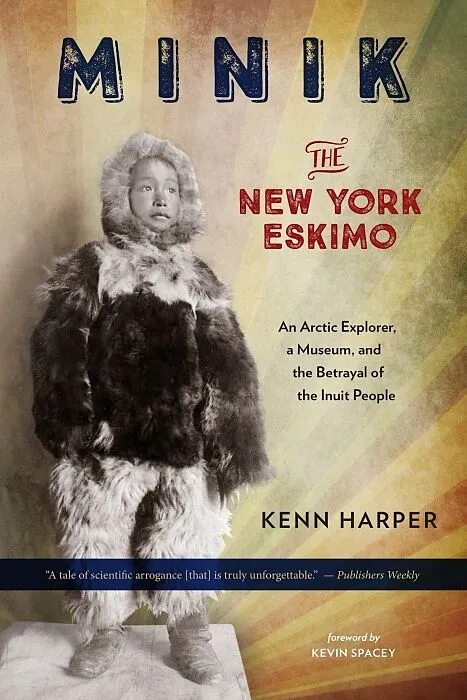
Minik: The New York Eskimo
Beschreibung
A true story from the great age of Arctic exploration of an Inuit boy's struggle for dignity against Robert Peary and the American Museum of Natural History in turn-of-the-century New York City. Sailing aboard a ship called Hope in 1897, celebrated Arctic expl...Format auswählen
- Kartonierter EinbandCHF 20.00

Wird oft zusammen gekauft
Andere Kunden kauften auch
Beschreibung
A true story from the great age of Arctic exploration of an Inuit boy's struggle for dignity against Robert Peary and the American Museum of Natural History in turn-of-the-century New York City. Sailing aboard a ship called Hope in 1897, celebrated Arctic explorer Robert Peary entered New York Harbor with peculiar "cargo": Six Polar Inuit intended to serve as live "specimens" at the American Museum of Natural History. Four died within a year. One managed to gain passage back to Greenland. Only the sixth, a boy of six or seven with a precociously solemn smile, remained. His name was Minik. Although Harper's unflinching narrative provides a much needed corrective to history's understanding of Peary, who was known among the Polar Inuit as "the great tormenter", it is primarily a story about a boy, Minik Wallace, known to the American public as "The New York Eskimo." Orphaned when his father died of pneumonia, Minik never surrendered the hope of going "home," never stopped fighting for the dignity of his father's memory, and never gave up his belief that people would come to his aid if only he could get them to understand.
"A story of cultural collision, deep misunderstandings and willful arrogance by people in power. It’s one small chapter in the long history of mistreatment of Native peoples by Americans who saw them as inferiors. It’s also something of an adventure story, albeit one that ends tragically . . . an absolutely captivating narrative. ” — The Fairbanks Daily News-Miner
"A tale of scientific arrogance [that] is truly unforgettable." – Publishers Weekly
"A heart-rending narrative." — Nunatsiaq News
"Impeccably researched and gracefully written, this is an essential book." – Andrea Barrett, author of Ship Fever and The Air We Breathe
"White men have had lots of chances to override the rights of other people with indifference . . . Writing about this state of affairs can be risky . . . Kenn Harper walks this tightrope with grace." – **Patricia Nelson Limerick, past president of the Organization of American Historians, in *The New York Times Book Review
**A “fascinating and sad story . . . well researched and simply told.” – USA Today
- “Richly sensitive and totally gripping.” ****– Parade Magazine
** A “smartly paced, deeply informative and moving book.” ****– The Cleveland Plain Dealer
“An exposé of the intellectual arrogance that permeated the race to explore the Arctic region.” ****– Library Journal (starred review)
“Minik’s tale is a stinging indictment of the arrogance of some of the most prominent scientists and philanthropists of the time . . . But, as Harper concedes, the scientists’ behavior was hardly outrageous when viewed through the lens of the era. Perhaps that is the bigger tragedy.” ****– The Associated Press
"Kenn Harper interprets the tale with elegance and compassion. His narrative does more than represent the experiment as the inhumane and exploitive pseudo-science it was, he offers insight into turn-of-the-century American society and its admiration and reverence for polar exploration." — UpHere Magazine
“Minik’s saga is at once riveting and repulsive, enlightening and horrifying. Harper intertwines history, legend, anthropology, racism, greed and good intentions – the best and worst of human nature. . . . don’t wait for the movie to discover this astonishing tale for yourself.” ****– The Toronto Sun
“In 1897, the story of Minik was passed off as science. But it didn’t take long for people to recognize it for what it truly was: a tale of kidnapping, exploitation and heartless abandonment. . . . For Harper, telling Minik’s tale has clearly been a labor of love. . . . [his book] is a graceful reconstruction of Minik’s biography . . . letting the facts speak for themselves.” ****– Newsday
“A moving account of science devastatingly and thoughtlessly misapplied, one of the countless tragedies visited on Native America.” ****– Kirkus Reviews
“Well-done and sympathetic . . . an incredible tale. “ ****– The El Paso Times
Minik “contains valuable historical lessons about often well intentioned but nonetheless destructive (museum) administrators and scientists . . . Harper is to be congratulated for diligent scholarship at the service of a strong sense of historical justice.” ****– The Journal of American History
Minik “paints a different picture of Robert Peary than that offered by history books and the encyclopedia . . . But Minik is not just a bitter tale of an Inuit boy and the terrible injustices that he experienced at the hands of so-called civilization. It is full of the better side of humanity . . . This book captures a snapshot of the era surrounding the foundation of the American Museum of Natural History.” **– The Seattle Times
Minik is “a startling success for a macabre tale of looted skeletons, of freebooting rapacity by prominent figures of Arctic exploration, and of the conquest of the polar north as seen through the eyes of the Inuit . . . Most controversially, the book paints an unlovely portrait of two American icons: the widely respected museum, and Peary, who in 1909 led the first expedition to the North Pole.” **– The Boston Globe
**
Autorentext
Kenn Harper lived in the Arctic for fifty years in Inuit communities in the Baffin region and in Qaanaaq, Greenland. He has worked as a teacher, development officer, historian, linguist, and businessman. He speaks Inuktitut, the Inuit language of the eastern Canadian Arctic, and has written extensively on northern history and language. He is a Fellow of the Royal Geographical Society and the Royal Canadian Geographical Society, and a recipient of Queen Elizabeth's Diamond Jubilee Medal. He lives in Ottawa.
Leseprobe
Robert Peary’s chartered ship, the Hope, a three-masted sealer, had made a brief stop for fuel in Sydney on the northern tip of Nova Scotia. Now, heavy in the water on the last day of September, 1897, she was gliding past the Statue of Liberty and heading toward the East River, where she would soon be fast to Excursion Wharf at the foot of Dock Street in Brooklyn.
From Sydney, Peary had wired New York the news of the ship’s imminent arrival, and the city’s newspapers were only too pleased to print it.
Robert Peary needed no introduction to reporters or the American public. A seasoned explorer, his adventures had been reported to an eager public for a decade. He had made sure that his expeditions were well covered in the press, for he depended on favorable publicity for his funding and ultimately for his success. This last foray had been a summer excursion to Greenland.
Peary had been to Greenland before—that was hardly news anymore. But what set the city abuzz this time was news of the cargo he carried: a large meteorite and six Inuit—“Eskimos” to the curious people of New York—as well as the sealskins, furs, kayaks, and harpoons they brought with them, all tools and clothing that New Yorkers would find exotic.
As the vessel drew close to the Brooklyn Bridge, the Inuit, “curious, long-haired individuals, clad in furs and skins,” were on deck, awed by the sight of the city’s skyline. Suddenly they began to gesticulate wildly. The closer the ship came to the bridge, …