
IHR WARENKORB IST AKTUELL LEER.
Haben Sie noch nichts passendes gefunden? Stöbern Sie durch unser komplettes Sortiment.
Oder melden Sie sich an bzw. registrieren Sie sich.
- Kostenlose Lieferung
- Kauf auf Rechnung
- Ex Libris Tiefpreis
- Filiallieferung und 650+ Abholorte
- Rabatt-Bons als Club-Mitglied
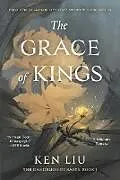
The Grace of Kings
Beschreibung
"The Grace of Kings is grand, mythic and epic, but Liu’s “silk-punk” world of trickster gods and giant horned whales is also a delight." Autorentext Ken Liu is an award-winning American author of speculative fiction. His collection, The Paper...Format auswählen
- Kartonierter EinbandCHF 28.40

Wird oft zusammen gekauft
Andere Kunden kauften auch
Beschreibung
"The Grace of Kings is grand, mythic and epic, but Liu’s “silk-punk” world of trickster gods and giant horned whales is also a delight."
Autorentext
Ken Liu is an award-winning American author of speculative fiction. His collection, The Paper Menagerie and Other Stories, has been published in more than a dozen languages. Liu’s other works include The Grace of Kings, The Wall of Storms, The Veiled Throne, a second collection The Hidden Girl and Other Stories, and the forthcoming Julia Z series. He has been involved in multiple media adaptations of his work, including the short story "Good Hunting," adapted as an episode in Netflix’s animated series Love, Death + Robots; and AMC’s Pantheon, adapted from an interconnected series of short stories. "The Hidden Girl," "The Message," and "The Oracle" have also been optioned for development. Liu previously worked as a software engineer, corporate lawyer, and litigation consultant. He frequently speaks at conferences and universities on topics including futurism, machine-augmented creativity, the history of technology, and the value of storytelling. Liu lives with his family near Boston, Massachusetts.
Klappentext
"The Grace of Kings, the first book in this epic series, tells the story of two men who become friends through rebelling against tyranny and then turn against each other in defense of irreconcilable ideals. Wily, charming Kuni Garu, a bandit, and stern, fearless Mata Zyndu, the son of a deposed duke, seem like polar opposites. Yet, in the uprising against the emperor, the two quickly become the best of friends after a series of adventures fighting against vast conscripted armies, silk-draped airships, soaring battle kites, underwater boats, magical books, shapeshifting gods, and scaled whales who seem to prophesy the future. Once the emperor has been overthrown, however, the two find themselves the leaders of two sides with very different ideas about how the world should be run and the meaning of justice"--
Zusammenfassung
Wily, charming Kuni Garu, a bandit, and stern, fearless Mata Zyndu, the son of a deposed duke, seem like polar opposites. Yet, in the uprising against the emperor, the two quickly become the best of friends after a series of adventures fighting against vast conscripted armies, silk-draped airships, and shapeshifting gods. Once the emperor has been overthrown, however, they each find themselves the leader of separate factionstwo sides with very different ideas about how the world should be run and the meaning of justice. Fans of intrigue, intimate plots, and action will find a new series to embrace in the Dandelion Dynasty.
Leseprobe
Grace of Kings
CHAPTER ONE
AN ASSASSIN
ZUDI: THE SEVENTH MONTH IN THE FOURTEENTH YEAR OF THE REIGN OF ONE BRIGHT HEAVEN.
A white bird hung still in the clear western sky and flapped its wings sporadically.
Perhaps it was a raptor that had left its nest on one of the soaring peaks of the Er-Mé Mountains a few miles away in search of prey. But this was not a good day for hunting—a raptor’s usual domain, this sun-parched section of the Porin Plains, had been taken over by people.
Thousands of spectators lined both sides of the wide road out of Zudi; they paid the bird no attention. They were here for the Imperial Procession.
They had gasped in awe as a fleet of giant Imperial airships passed overhead, shifting gracefully from one elegant formation to another. They had gawped in respectful silence as the heavy battle-carts rolled before them, thick bundles of ox sinew draping from the stone-throwing arms. They had praised the emperor’s foresight and generosity as his engineers sprayed the crowd with perfumed water from ice wagons, cool and refreshing in the hot sun and dusty air of northern Cocru. They had clapped and cheered the best dancers the six conquered Tiro states had to offer: five hundred Faça maidens who gyrated seductively in the veil dance, a sight once reserved for the royal court in Boama; four hundred Cocru sword twirlers who spun their blades into bright chrysanthemums of cold light that melded martial glory with lyrical grace; dozens of elegant, stately elephants from wild, sparsely settled Écofi Island, painted with the colors of the Seven States—the largest male draped in the white flag of Xana, as one would expect, while the others wore the rainbow colors of the conquered lands.
The elephants pulled a moving platform on which stood two hundred of the best singers all the Islands of Dara had to offer, a choir whose existence would have been impossible before the Xana Conquest. They sang a new song, a composition by the great imperial scholar Lügo Crupo to celebrate the occasion of the Imperial tour of the Islands:
To the north: Fruitful Faça, green as the eyes of kind Rufizo,
Pastures ever kissed by sweet rain, craggy highlands shrouded in mist.
Soldiers walking next to the moving platform tossed trinkets into the crowd: Xana-style decorative knots made with bits of colorful string to represent the Seven States. The shapes of the knots were meant to evoke the logograms for “prosperity” and “luck.” Spectators scrambled and fought one another to catch a memento of this exciting day.
To the south: Castled Cocru, fields of sorghum and rice, both pale and dark,
Red, for martial glory, white, like proud Rapa, black, as mournful Kana.
The crowd cheered especially loudly after this verse about their homeland.
To the west: Alluring Amu, the jewel of Tututika,
Luminous elegance, filigreed cities surround two blue lakes.
To the east: Gleaming Gan, where Tazu’s trades and gambles glitter,
Wealthy as the sea’s bounty, cultured like the scholars’ layered gray robes.
Walking behind the singers, other soldiers held up long silk banners embroidered with elaborate scenes of the beauty and wonder of the Seven States: moonlight glinting from snowcapped Mount Kiji; schools of fish sparkling in Lake Tututika at sunrise; breaching crubens and whales sighted off the shores of Wolf’s Paw; joyous crowds lining the wide streets in Pan, the capital; serious scholars debating policy in front of the wise, all-knowing emperor. . . .
To the northwest: High-minded Haan, forum of philosophy,
Tracing the tortuous paths of the gods on Lutho’s yellow shell.
In the middle: Ring-wooded Rima, where sunlight pierces ancient
Forests to dapple the ground, as sharp as Fithowéo’s black sword.
Between each verse, the crowd bellowed out the chorus along with the singers:
We bow down, bow down, bow down to Xana, Zenith, Ruler of Air,
Why resist, why persist against Lord Kiji in strife that we can’t bear?
If the servile words bothered those in this Cocru crowd who had probably taken up arms against the Xana invaders scarcely more than a dozen years ago, any mutterings were drowned out by the full-throated, frenzied singing of the men and women around them. The hypnotic chant held a power of its own, as if by mere repetition the words gained weight, became more true.
But the crowd wasn’t close to being satisfied by the spectacle thus far. They hadn’t seen the heart of the Procession yet: the emperor.
The white bird glided closer. Its wings seemed to be as wide and long as the spinning vanes of the windmills in Zudi that drew water from deep wells and piped it into the houses of the wealthy—too big to be an ordinary eagle or vulture. A few spectators looked up and idly wondered if it was a giant Mingén falcon, taken more than a thousand miles from its home in faraway Rui Island and released here by the emperor’s trainers to impress the crowd. …