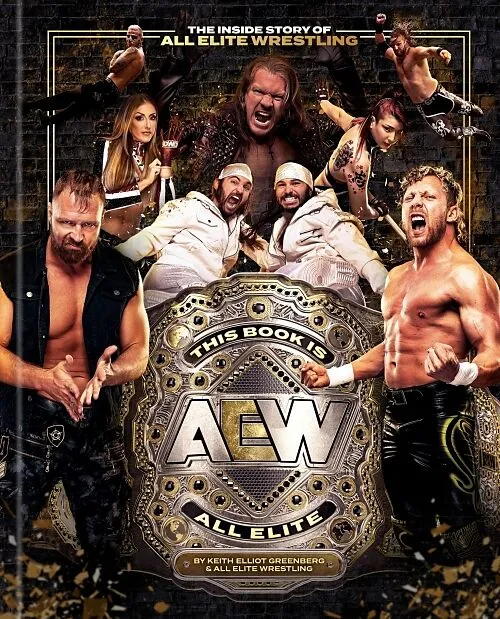
This Book Is All Elite: The Inside Story of All Elite Wrestling
Beschreibung
An upcoming book to be published by Penguin Random House. Autorentext Keith Elliot Greenberg is a New York Times bestselling author and television producer who has written more than forty books on a variety of topics. Many of today’s wrestling stars grew...Format auswählen
- Fester EinbandCHF 41.20

Wird oft zusammen gekauft
Andere Kunden kauften auch
Beschreibung
An upcoming book to be published by Penguin Random House.
Autorentext
Keith Elliot Greenberg is a New York Times bestselling author and television producer who has written more than forty books on a variety of topics. Many of today’s wrestling stars grew up reading his articles about the profession. The lifetime New Yorker co-authored the autobiographies of Freddie Blassie, Ric Flair, and Superstar Billy Graham. Later, in addition to co-authoring two editions of the WWE Encyclopedia of Sports Entertainment, he wrote such books as Too Sweet: Inside the Indie Wrestling Revolution, Follow the Buzzards, and Bigger! Better! Badder! WrestleMania III and the Year It All Changed. He is currently a monthly columnist for Inside the Ropes Magazine.
Klappentext
Score a front-row seat for the thrilling story of the icons and iconoclasts that revolutionized professional wrestling, packed with exclusive interviews and explosive action shots of your favorite stars.
The year is 2019. It is the dawn of All Elite Wrestling . . . and you know what that means.
It means that a group of hungry, innovative wrestlers are about to revolutionize professional wrestling under the visionary eye of Tony Khan. It means pulse-pounding, death-defying, high-flying action. It means that the world of the squared circle will never be the same.
Jam-packed with dazzling photography and written with exclusive access to the cast and crew of AEW, this definitive history dives deep into the innovative storytelling, inclusive ethos, and passionate fanbase which propelled the company to compete with industry giants. From the triumphant final run of the icon Sting alongside his firebrand protégé Darby Allin, to the madcap melee of the first Stadium Stampede, to AEW’s record-breaking Wembley Stadium debut, the epic moments that defined the first five years of All Elite Wrestling are all here.
Whether you’re a die-hard AEW supporter or curious about the company’s revolutionary impact, This Book Is All Elite offers an in-depth look at how the promotion nobody saw coming changed the world of professional wrestling forever.
Leseprobe
1
Fantasy Booking Into Action
In the mid-1990S, before Tony Khan was even in high school, he was envisioning the uprising that would redefine professional wrestling.
“I’d been watching wrestling since I was seven years old,” he said. “When I was twelve, I went online—they didn’t have Google yet—and I started asking questions about how professional wrestling really worked.”
It was the first time he learned about the entertainment aspects of the art form, receiving a glossary of insider terminology and a list of popular performers’ actual names.
“I’d never had everything explained to me like that,” he continued. “Then, on the dial-up internet, I found a group of fans who loved wrestling as much as I did. We became friends. And some of them, I’m still in contact with to this day.”
Khan had reached a point of no return. “I started writing a newsletter that only my friend and myself really read. And we found a game called Rampage Wrestling that we played on MS-DOS. There was no video, not even pictures. But we had ratings for agility, size, skill, even for people who fought dirty. There was a singles class and a tag team class. A tag team specialist would have a higher rating in that class than a singles specialist.”
In the back of the classroom, he’d compile lists of the competitors he’d seen on Extreme Championship Wrestling (ECW), Jim Cornette’s Smoky Mountain Wrestling (SMW), and other edgy promotions, booking them into fantasy matches, allegiances, and longterm storylines. He even invented an episodic TV show.
Its name: Dynamite.
While others outgrow their childhood obsessions, Khan’s became more intense. After graduating from the University of Illinois Urbana-Champaign in 2007, he realized that he was uniquely qualified to fulfill his dream of starting a wrestling promotion.
The son of Shad Khan, owner of the NFL’s Jacksonville Jaguars and London’s Fulham Football Club, Tony became an integral part of the family business. As a sports executive, he’d work with both the Jags and Fulham FC in operations and recruiting, using his unique vantage point to assess the pro wrestling landscape.
“I built a good reputation as an expert in sports analytics and team management,” he said, “as well as working with sports media partners around the world.”
As he busied himself with his responsibilities for Fulham and the Jaguars, Khan watched the steady growth of indie wrestling, smaller promotions generally perceived as an alternative to the commercial fare most fans saw each week on World Wrestling Entertainment (WWE) broadcasts.
“Wrestling had sort of become monotonous,” said referee Aubrey Edwards. “There was only one major company (in North America). They were doing their thing and that was it.” And she wasn’t alone. Kenny Omega, who held the prestigious IWGP Heavyweight Championship in Japan for the latter part of 2018, had also been a childhood fan but became “disenchanted” with the product widely viewed in North America. “I felt that with all the varieties of wrestling throughout the world, something new and diverse could be created and universally enjoyed,” he said, “something that would combine all types of styles, like the techniques of Mexican lucha libre, British strong style, and what was available in Japan, where the strikes were harder and it was more martial arts based. You just had to take the journey.”
Unbeknownst to Omega, Khan was already on that path, strongly relating to those fans who regularly packed arenas for Pro Wrestling Guerrilla (PWG) in Los Angeles, DEFY in Seattle, and Revolution Pro (RevPro) in the United Kingdom, among other leagues, while closely following the industry across the Pacific, particularly Japan’s largest pro wrestling organization, New Japan Pro-Wrestling.
“I’d use the word ‘starved’ to describe how the fan base felt about an alternative,” said future AEW World Champion Maxwell Jacob Friedman, or MJF. “But AEW would end up doing it at a much higher level than I think anyone could have anticipated.
“I think it’s fair to say that, in many ways, AEW would bring back pro wrestling.”
The process began in earnest in 2018 when Khan began turning the fantasy booking of his youth into a viable business plan. By this stage, he was enough of a student of the game to understand why past upstart promotions had failed. By contrast, the organization he hoped to create would not be a vanity project—launched by a “money mark,” the derogatory term for a fan who falls into money and throws it away on a league that instantly flames out—but a serious, revenuegenerating venture.
“I’d built connections and friendships, so when the opportunity crystallized, I was in a position to capitalize on my ideas,” Khan said. “The business model for pro wrestling had really changed when the TV rights fees increased. You could sell a show for tens of millions of dollars, sign a roster of wrestlers, and air fifty-two weeks a year.
“There was a new opportunity to launch a promotion profitably and internationally that hadn’t really existed until then. The idea was to build a TV show and develop a franchise of pay-per-views.”
By sheer circumstance, in April 2018, he happened to attend a party in Beverly Hills, where he ran into a friend, Kevin Reilly, an important executive at WarnerM…