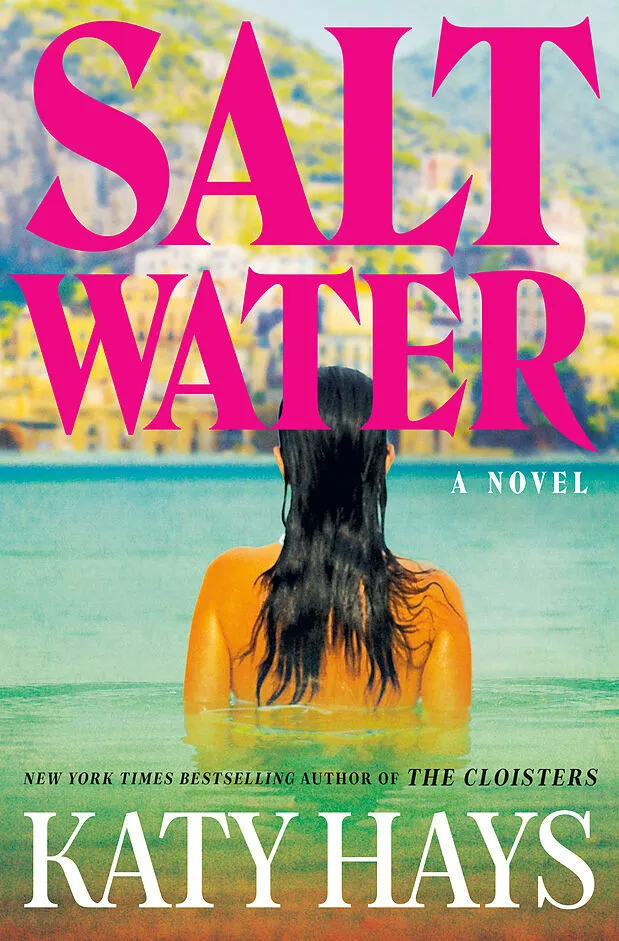
Saltwater
Beschreibung
In 1992 Sarah Lingate is found dead below the cliffs of Capri, leaving behind her three-year-old daughter, Helen. Despite suspicions that the old-money Lingates are involved, Sarah’s death is ruled an accident. And every year, the family returns to prove...Format auswählen
- Kartonierter EinbandCHF 20.30

Wird oft zusammen gekauft
Andere Kunden kauften auch
Beschreibung
In 1992 Sarah Lingate is found dead below the cliffs of Capri, leaving behind her three-year-old daughter, Helen. Despite suspicions that the old-money Lingates are involved, Sarah’s death is ruled an accident. And every year, the family returns to prove it’s true. But on the thirtieth anniversary of Sarah’s death, the Lingates arrive at the villa to find a surprise waiting for them--the necklace Sarah was wearing the night she died. Haunted by the specter of that night, the legendary Lingate family unity is pushed to a breaking point, and Helen seizes the opportunity. Enlisting the help of Lorna Moreno, a family assistant, the two plot their escape from Helen’s paranoid, insular family. But when Lorna disappears and the investigation into Sarah’s death is reopened, Helen has to confront the fact that everyone who was on Capri thirty years ago remains a suspect--her controlling father Richard, rarely-lucid aunt Naomi, distant uncle Marcus, and their circle of friends, visitors, and staff. Even Lorna, her closest ally, may not be who she seems. As long-hidden secrets about that night boil to surface, one thing becomes clear: not everyone will leave the island alive.
Autorentext
Katy Hays is the New York Times bestselling author of The Cloisters. She is an art history adjunct professor and holds an MA in art history from Williams College and pursued her PhD at UC Berkeley. Having previously worked at major art institutions, including the Clark Art Institute and SFMOMA, she now lives with her husband and their dog in Olympic Valley, California.
Klappentext
From the New York Times bestselling author of The Cloisters comes a slow-burn psychological drama about an opulent family that unravels when a decades-old crime resurfaces.
**“Full of chills and darkness.”*—Oprah Daily
**“Fans of family dramas and thrillers will devour this tense, suspenseful novel.”*—Woman’s World
In 1992, Sarah Lingate is found dead below the cliffs of Capri, Italy, leaving behind her three-year-old daughter, Helen. Despite suspicions that the old-money Lingates are involved, Sarah’s death is ruled an accident. And every year, the family returns to prove it’s true. But on the thirtieth anniversary of her death, the Lingates arrive at the villa to find a surprise waiting for them—the necklace Sarah was wearing the night she died.
Haunted by the specter of that night, the paranoid, insular Lingate family begins to crack, and Helen seizes the opportunity with the help of Lorna Moreno, the family assistant. But then Lorna disappears, and the investigation into Sarah’s death is reopened. Everyone who was on Capri thirty years ago remains a suspect—Helen’s controlling father, Richard; her rarely lucid aunt, Naomi; her distant uncle, Marcus; and their circle of friends, visitors, and staff. Even Lorna, her closest ally, may not be who she seems. As long-hidden secrets about that night boil to surface, one thing becomes clear: Not everyone will leave the island alive.
Combining a glittering, dark atmosphere, morally-gray characters, and mind-bending twists, Saltwater is an exploration of the corrupting effects of generational privilege and the lengths people go to protect a legacy—and how no one can hold a grudge like family.
Leseprobe
Helen Lingate
Now
Money is my phantom limb. It was part of my body once. I know this because I feel its loss like an ambient current that runs up my spine, an occasional, sudden shock. Money is metabolic, a universal part of our constitution. Lorna taught me that.
Before her, I didn’t have the vocabulary for money. I changed the subject, I demurred, I shifted my weight, brushed my hair behind my ear, smiled. I twisted the Cartier bracelet on my left wrist again and again until the skin turned strawberry.
What I’m saying is, I lied.
Money has always made me uncomfortable, both having a lot and not enough.
That ends now. I saw how heavy the bag was when Lorna lifted it. Bulky with our cash. I still don’t remember whose idea it was. Hers or mine, it doesn’t matter. After today, we’ll whisper the story to each other like an incantation. Do you remember? They never knew. Then, I hope, we will laugh.
Good stories are like that. They become a reflex, as automatic as breathing. I know this because my body was built—bone by bone—out of stories like that.
Stories about money.
They were also lies.
Every week my father recited them to me, their outlines as familiar as my own hands. That my great-grandfather had struck oil while prospecting for gold. That it had happened not far from our house in Bel Air. That the exact site had been paved over but was near the intersection of Glendale and Beverly Boulevards.
My great-grandfather never wanted the oil. That part, my father emphasized, was a mistake. All he wanted was gold. What he got was better: property, mineral rights, imported hand-painted French pillows. A name—Lingate.
What a mix-up! A surprise! A moment of aw-shucks luck. It could have happened to anyone. That’s America’s promise—that it still could.
It’s a good story, right?
But even in my childhood, the contours of the lie were visible. The landscape of that Los Angeles couldn’t be occupied by mortals. It was prelapsarian—tangled bean fields and sweet orange blossoms, oil running like foamy soda up to meet the derricks, streams that could still be panned for gold.
In college, I learned the truth. For twenty years they kept it from me. I don’t blame them. To us it was more than a story; it was a myth. Our own family heirloom. We passed it down the way some families hold on to a piece of silver, insisting to each subsequent generation that it’s early American. Maybe forged by Paul Revere himself. A sign of the family’s ancient, unshakable commitment to the Revolutionary cause. They show it off at DAR luncheons, they’re a Mayflower family. Only later, when they go to sell it, do they discover it’s from the nineteenth century, a reproduction.
In the end, it’s just a story.
The truth was, my family had swindled their way into the largest oil lease in California—the Wilson Oil Field—at the dawn of the twentieth century. We had done so by promising the original leaseholder, a wildcatter’s widow, that the family would split the profits if oil was found in the first five years. Five years and one day later, the first oil derrick was drilled.
She sued, but lost.
You can understand why they preferred the story.
These days, it’s rare anyone thinks about the oil. Instead, it’s the events that happened on this island thirty years ago that get top billing. My mother’s death. Whether or not my father got away with her murder. My family resents that she tarnished their myth, that they can’t polish her blood off their silver.
But I’m grateful. Because it’s her story I can use. After all, shouldn’t I be able to profit from family stories, too? Isn’t that a fair exchange for never having known her, for being back on this island, in this villa, every anniversary of her death?
I think so.
My phone tells me it’s noon. Anywhere else, noon might be considered late, but not here, not on Capri. My tongue is thick, my vision jumpy in the sunlight. It’s my hangover, cresting, punishing.
I pull back the sheets and swing my legs over the side of the empty bed. I only remember pieces of last night. The sheets tangled around our legs, Freddy’s back slick with sweat. He went directly to the pool this morning; I heard the splash.
I make it to the bathroom, where I cup wate…