
IHR WARENKORB IST AKTUELL LEER.
Haben Sie noch nichts passendes gefunden? Stöbern Sie durch unser komplettes Sortiment.
Oder melden Sie sich an bzw. registrieren Sie sich.
- Kostenlose Lieferung
- Kauf auf Rechnung
- Ex Libris Tiefpreis
- Filiallieferung und 650+ Abholorte
- Rabatt-Bons als Club-Mitglied
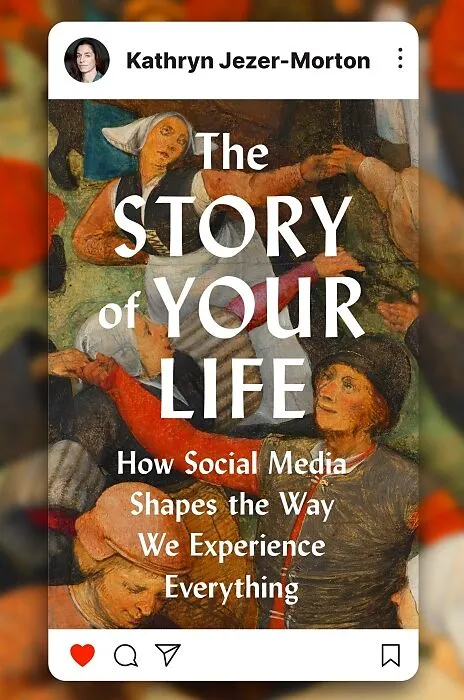
The Story of Your Life
Beschreibung
An eye-opening look at how social media shapes the stories we tell and the lives we lead Over the past two decades, platforms like Instagram, Facebook, and TikTok have revolutionized how we document and share our lives. We once archived our experiences in phot...Format auswählen
- Fester EinbandCHF 27.60

Wird oft zusammen gekauft
Andere Kunden kauften auch
Beschreibung
An eye-opening look at how social media shapes the stories we tell and the lives we lead Over the past two decades, platforms like Instagram, Facebook, and TikTok have revolutionized how we document and share our lives. We once archived our experiences in photo albums, and now we capture our most significant moments in reels and photo dumps. Whether we prefer to admit it or not, social media is where our history lives now. In Through rigorous research and intimate interviews with everyday people, Jezer-Morton explores how the platforms on which we have told our life stories for the past twenty years have determined what those stories have come to look and sound like. Today our attention spans are short, and our stories reflect that, with spectacle and exaggeration playing ever-larger roles in our accounts of everyday life. By examining how we share, talk, and post about our milestones, vacations, homes, relationships, hardships, politics, and more, Jezer-Morton shows just how pervasive and influential our social media platforms have become in how we view ourselves and what we consider to be a life well lived. Smart, funny, and sharply observant, <The Story of Your Life< delivers an original and revealing look at our lives online and off and offers us a fresh perspective on the ways social media shapes the very arcs of our lives.
Autorentext
Kathryn Jezer-Morton is the author of the biweekly Brooding column at The Cut, in which she explores topics surrounding modern family life. She has written about domestic life and digital culture for The New York Times, The Nation, The Guardian, and Jezebel, among many other publications. She holds a PhD in sociology from Concordia University and lives with her family in Montreal.
Leseprobe
I love social media. Not only is it a welcome distraction during life’s many dull hours, but it’s also a world-historically essential archive of our recent history. This is both a very obvious, uncontroversial position and an uncomfortable one. One of the first things I learned when I started researching social media use in 2016 was that talking about it made a lot of people uncomfortable. We use social media all the time, and we do it in public, but we’d rather not talk about what we’ve been doing. “Your research is so cringe,” a dear friend once admitted to me. “No one wants to talk about what they do in their feeds.” Which seems like a good reason to keep asking.
So I did. In 2022, I completed a doctorate in sociology, for which I researched momfluencers. Part of why I chose to do this research was that in momfluencers—women who turn their domestic lives into content, for which they are paid by corporate sponsors—I saw traces of what I had begun seeing among everyday people: a disciplinary sort of storytelling, freighted with meaning and intentionality, that was taking the place of other kinds of experiential accounting.
Studying momfluencers was good preparation for writing this book. I learned to suspend judgment (for the most part) and wait for the data to come in. Toward the end of my PhD, I started building out a research plan for this undertaking, and once I completed my degree, it was time to break free of the constraints of academic writing and apply some of the skills I’d gained to a bigger, weirder, more ambitious project. Steeped in momfluencer and influencer content, I found that the everyday people I followed were sounding more and more like people with brand partnerships. The lines between how brands were telling stories and how individuals were telling stories had been steadily blur-ring for a decade—to the point that they eventually fused entirely. Understanding how that happened, and how it might be making all of us feel, is what I set out to do in this book.
We’ve all heard that “social media is the highlight reel,” and we all know it’s true. But I’ve never been quite satisfied with that line. Just because it’s a highlight reel doesn’t mean it isn’t full of meaningful in-formation. What are the highlights trying to tell us? If we scratch at the enamel, what will we find beneath?
I have always been in awe of the power that storytelling has to shape the directions of our lives. I don’t mean the gather-round-little-children kind of storytelling. I mean the everyday stories we tell about ourselves and our surroundings, the stories that accumulate and come to define our realities. These stories aren’t always told deliberately. They accrete through gossip and observation and reputation, and in the last twenty years, they have coalesced in people’s telling of their lives on social media, on their highlight reels.
People’s ideas about themselves, and the way they express those ideas, have always seemed as significant as—if not more so than—their material circumstances. The power of storytelling is what ennobles grifters and the sad delusions of liars. It’s what fuels motivation and romance and keeps grudges alive. It’s how we are given identities by our parents and how, as we grow up, we negotiate new identities of our own.
You probably understand my reverence for storytelling if you grew up in an intentional community, or perhaps a close-knit faith community. These are places where storytelling forms the scaffolding for reality. I was raised on a southern Vermont commune that was once called Total Loss Farm. The stories of the farm and its cast of characters were what held the place together through its fifty years (and counting) of existence. Here we had a canon of tales that were told time and again, reminding us who we were, how we were different from most other people in the community, and why we needed one another. Even aftermost of the communards had moved away, the stories lived on among those who remained. As a teenager, I became known around the farm’s kitchen for a snide remark I made about the place’s history being “the story that never dies.” Even my critique was swallowed by the narrative river. Someone repeats it back to me every time I’m in that kitchen. There’s no escape.
To grow up in a commune is to experience narration as an existential necessity. Without our stories, we were just a group of random people sharing a filthy living space. But thanks to the myths spun over decades, I was raised with the belief that I was born among visionaries who had the courage to approach life as an art project, while most other people settled for nine-to-five drudgery. In hindsight, and with the perspective of adulthood, I can see that there was more than a little bit about this narrative that was self-serving. But I don’t begrudge the old commune its stories and delusions; when I grew up and moved away, I realized that all families, not just chosen communal ones, share this practice.
The way we tell our stories is part of how culture manifests. In stories, the outlines of collective aspirations, fears, and fantasies emerge. The commune taught me that how we tell the stories of our lives is a choice. There are infinite narrative frames to choose from.
Yet even as storytelling offers us myriad possible frames for thinking about ourselves, the stories we choose and the way we choose to tell them can also narrow the frame around what we consider desirable, acceptable, and even possible. Once a narrative takes hold, it can draw the very boundaries of your life—he’s the joker, she’s the good girl, all Johnstons play sports, “that’s not the way we do things around here.”
The first form of social media I ever used was a spiral-bound notebook kept on the big cluttered coffee table in the commune’s living room. It was a group journal, open to anyone who hap…