
IHR WARENKORB IST AKTUELL LEER.
Haben Sie noch nichts passendes gefunden? Stöbern Sie durch unser komplettes Sortiment.
Oder melden Sie sich an bzw. registrieren Sie sich.
- Kostenlose Lieferung
- Kauf auf Rechnung
- Ex Libris Tiefpreis
- Filiallieferung und 650+ Abholorte
- Rabatt-Bons als Club-Mitglied
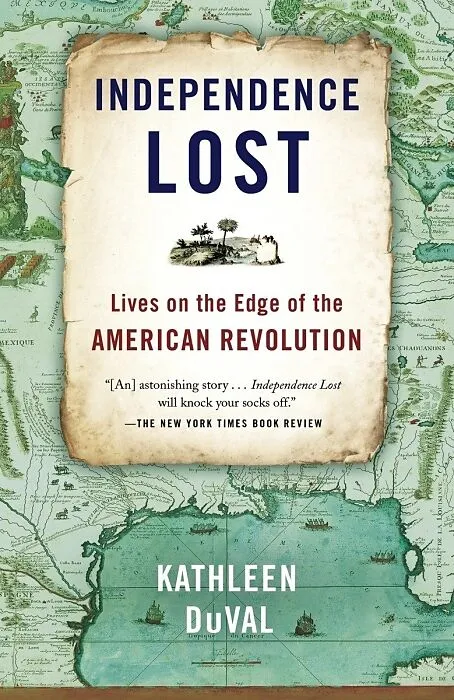
Independence Lost
Beschreibung
Zusatztext [An] astonishing story . . . Paint yourself a mental picture of the American War of Independence. If all you see are British redcoats battling minutemen and Continentals, Kathleen DuVal's Independence Lost will knock your socks off. . . . To read [t...Format auswählen
- Kartonierter EinbandCHF 26.70

Wird oft zusammen gekauft
Andere Kunden kauften auch
Beschreibung
Zusatztext [An] astonishing story . . . Paint yourself a mental picture of the American War of Independence. If all you see are British redcoats battling minutemen and Continentals, Kathleen DuVal's Independence Lost will knock your socks off. . . . To read [this book] is to see the task of recovering the entire American Revolution has barely begun. The New York Times Book Review [DuVal] has produced a richly documented and compelling account . . . to form a layered history of connected, sometimes shared, experiences. The Wall Street Journal A remarkable, necessaryand entirely newbook about the American Revolution. DuVal's history reminds us that if we celebrate a more inclusive vision of the United States this Fourth of July, one that seems ascendant these days, it is not the one the founding generation had in mind. The Daily Beast Declaring that the American Revolution was fought in the name of empire almost seems blasphemous. However, DuVal excellently details how the event was actually a war for empire along the Gulf Coast of the United States. . . . Highly recommended for students and scholars of the revolution, American South, borderlands, and forgotten theaters of war; along with those looking for a solid read in history. Library Journal (starred review) With deep research and lively writing, Kathleen DuVal musters a compelling cast to recover the dramatic story of the American Revolution in borderlands uneasily shared by rival empires, enslaved people, and defiant natives. She deftly reveals powerful but long-hidden dimensions of a revolution rich with many possible alternatives to the triumph of the United States. Alan Taylor, Pulitzer Prizewinning author of The Internal Enemy In a completely new take on the American Revolution and a riveting contribution to history, Kathleen DuVal explains how an unexpected cast of Gulf Coast characters fought for their own version of self-determination. The story is gripping, rife with pathos, double-dealing, and intrigue. The outcome is compelling, reverberating through American history to the present. Elizabeth A. Fenn, Pulitzer Prizewinning author of Encounters at the Heart of the World Independence Lost is an extraordinary achievement. Rooting compelling personal stories in deep original research, Kathleen DuVal brings to life a war for American independence that will be utterly new to most readers. Daniel K. Richter, Pulitzer Prize finalist and author of Before the Revolution Kathleen DuVal has found an exciting and accessible way to convey this history without sacrificing the richness and intricacy of a part of North America where multiple Indian nationsas well as Britain, France, Spain, and the emerging United Statescompeted with one another for power. Andrés Reséndez, author of A Land So Strange A superb example of how the familiar becomes unfamiliar when viewed from a fresh angle, Independence Lost is a work of stunning scholarship with which anyone interested in the origins of the United States will have to contend. Andrew Cayton, co-author of The Dominion of War With stirring prose and through inventive, indefatigable research, Kathleen DuVal recovers a place in time and a cast of compelling characters that seldom feature in our accounts of the wars that created the United States. The result is an important, original, and entirely unforgettable book. Jane Kamensky, author of The Exchange Artist Informationen zum Autor Pulitzer Prizewinning historian Kathleen DuVal is a professor of history at the University of North Carolina at Chapel Hill, where she teaches early American and American Indian history. Her works include Native Nations, which was aw...
Autorentext
Pulitzer Prize–winning historian Kathleen DuVal is a professor of history at the University of North Carolina at Chapel Hill, where she teaches early American and American Indian history. Her works include Native Nations, which was awarded the Pulitzer Prize, Independence Lost, which was a finalist for the George Washington Prize, and The Native Ground: Indians and Colonists in the Heart of the Continent. She is a coauthor of Give Me Liberty! and coeditor of Interpreting a Continent: Voices from Colonial America.
Klappentext
A Pulitzer Prize–winning historian tells the “astonishing” (The New York Times Book Review) story of the Revolutionary War through the eyes of the outsiders of colonial society—including enslaved people, American Indians, women, and British loyalists—in a revised edition with a new preface and afterword.
Kathleen DuVal is featured in the new Ken Burns documentary The American Revolution.
Winner of the Journal of the American Revolution Book of the Year Award • Winner of the Society of the Cincinnati in the State of New Jersey History Prize • Finalist for the George Washington Book Prize
Over the last decade, Kathleen DuVal has revitalized the study of early America’s marginalized voices. Here, she recounts an untold story as significant as that of the Founding Fathers: the history of the Revolutionary Era as experienced by those living on Florida’s Gulf Coast.
While citizens of the thirteen rebelling colonies came to blows with the British Empire over tariffs and parliamentary representation, the situation on the rest of the continent was even more fraught. In the Gulf of Mexico, Spanish forces clashed with Britain’s strained army to carve up the Gulf Coast, as both sides competed for allegiances with the powerful Chickasaw, Choctaw, and Creek nations who inhabited the region. Meanwhile, African American slaves had little control over their own lives, but some individuals found opportunities to expand their freedoms.
Independence Lost reveals that individual motives counted as much as the ideals of liberty and freedom the Founders espoused: Independence had a personal as well as national meaning. The choices of individuals outside the colonies were crucial to the war's outcome. DuVal introduces us to the Mobile slave Petit Jean, who organized militias to fight the British at sea; the Chickasaw diplomat Payamataha, who worked to keep his people out of war; New Orleans merchant Oliver Pollock and his wife, who organized funds and garnered Spanish support for the American Revolution; and the half-Scottish-Creek leader Alexander McGillivray, who fought to protect indigenous interests from imperial encroachment. Their lives illuminate the fateful events along the Gulf of Mexico that changed the history of North America itself.
Leseprobe
Chapter One
The Gulf Coast
When the letter from Congress arrived, West Florida Governor Peter Chester was building himself a new house. Most of Pensacola’s buildings had log frames with sides of bark and plaster and thatched roofs made of palmetto leaves, but the governor’s would be made of brick with a balcony and a shingle roof. It was a sign of British permanence in their relatively new colony, and West Florida’s leaders hoped that more development would follow.
From their town, Pensacolans could look out onto a place of striking colors—white sand beaches, water in hues from icy blue to gelatinous green to deep indigo, dark green sea grasses, and tall yellow sea oats. To European explorers in previous centuries, this coast had been a confusing array of inlets and barrier islands, but eighteenth-century merchant sailors knew the region well and skillfully navigated its shoreline to enter its harbors and approach its port towns. Pensacola Bay was a large deepwater port, its narrow entryway well protected by the Santa Rosa barrier island. Nearby Mobile Bay was much shallower, so ships had to unload at Dauphin Island onto smaller sailboats and canoes, which then traveled the forty miles across the bay to the town of Mobile. In the same manner, large ships approaching New Orleans stopped …