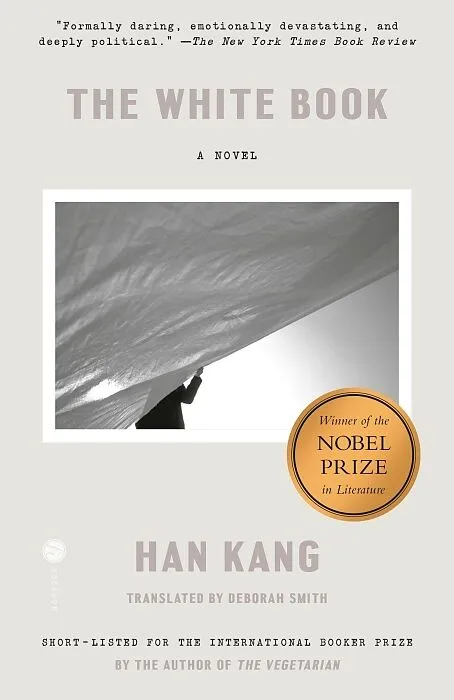
The White Book
Beschreibung
FROM HAN KANG, WINNER OF THE 2024 NOBEL PRIZE IN LITERATURE “[Han Kang writes in] intense poetic prose that . . . exposes the fragility of human life.”--from the Nobel Prize citation SHORTLISTED FOR THE INTERNATIONAL BOOKER PRIZE • A “fo...Format auswählen
- Kartonierter EinbandCHF 17.00

Wird oft zusammen gekauft
Andere Kunden kauften auch
Beschreibung
FROM HAN KANG, WINNER OF THE 2024 NOBEL PRIZE IN LITERATURE “[Han Kang writes in] intense poetic prose that . . . exposes the fragility of human life.”--from the Nobel Prize citation SHORTLISTED FOR THE INTERNATIONAL BOOKER PRIZE • A “formally daring, emotionally devastating, and deeply political” ( “Stunningly beautiful. . . one of the smartest reflections on what it means to remember those we’ve lost.”--NPR Shortlisted for the International Booker Prize, Han Kang’s In captivating, starkly beautiful language, <The White Book< is a letter from Kang to her sister, offering a multilayered exploration of color and its absence, and of the tenacity and fragility of the human spirit.
Autorentext
Han Kang
Klappentext
**FROM HAN KANG, WINNER OF THE 2024 NOBEL PRIZE IN LITERATURE
“[Han Kang writes in] intense poetic prose that . . . exposes the fragility of human life.”—from the Nobel Prize citation
SHORTLISTED FOR THE INTERNATIONAL BOOKER PRIZE • A “formally daring, emotionally devastating, and deeply political” (The New York Times Book Review) exploration of personal grief through the prism of the color white, from the internationally bestselling author of The Vegetarian
“Stunningly beautiful. . . one of the smartest reflections on what it means to remember those we’ve lost.”—NPR**
Shortlisted for the International Booker Prize, Han Kang’s The White Book is a meditation on color, as well as an attempt to make sense of her older sister’s death, who died in her mother’s arms just a few hours after she was born.
In captivating, starkly beautiful language, The White Book is a letter from Kang to her sister, offering a multilayered exploration of color and its absence, and of the tenacity and fragility of the human spirit.
Leseprobe
1
In the spring, when I decided to write about white things, the first thing I did was make a list.
Swaddling bands
Newborn gown
Salt
Snow
Ice
Moon
Rice
Waves
Yulan
White bird
“Laughing whitely”
Blank paper
White dog
White hair
**
Shroud
**
With each item I wrote down, a ripple of agitation ran through me. I felt that yes, I needed to write this book and that the process of writing it would be transformative, would itself transform into something like white ointment applied to a swelling, like gauze laid over a wound. Something I needed.
But then, a few days later, running my eyes over that list again, I wondered what meaning might lie in this task, in peering into the heart of these words.
If I sift those words through myself, sentences will shiver out, like the strange, sad shriek the bow draws from a metal string. Could I let myself hide between these sentences, veiled with white gauze?
This was difficult to answer, so I left the list as it was and put off anything more. I came abroad in August, to this country I’d never visited before, got a short-term lease on an apartment in its capital, and learned to draw out my days in these strange environs. One night almost two months later, when the season’s chill was just beginning to bite, a migraine set in, viciously familiar. I washed down some pills with warm water and realized (quite calmly) that hiding would be impossible.
Now and then, the passage of time seems acutely apparent. Physical pain always sharpens the awareness. The migraines that began when I was twelve or thirteen swoop down without warning, bringing with them agonizing stomach cramps that stop daily life in its tracks. Even the smallest task is left suspended as I concentrate on simply enduring the pain, sensing time’s discrete drops as razor-sharp gemstones, grazing my fingertips. One deep breath drawn in and this new moment of life takes shape as distinctly as a bead of blood. Even once I have stepped back into the flow, one day melding seamlessly into another, that sensation remains ever there in that spot, waiting, breath held.
Each moment is a leap forward from the brink of an invisible cliff, where time’s keen edges are constantly renewed. We lift our foot from the solid ground of all our life lived thus far and take that perilous step out into the empty air. Not because we can claim any particular courage, but because there is no other way. Now, in this moment, I feel that vertiginous thrill course through me. As I step recklessly into time I have not yet lived, into this book I have not yet written.
Door
This was something that happened a long time ago.
Before signing the contract for the lease, I went to look at the apartment again.
Its metal door had once been white, but that brightness had faded over time. It was a mess when I saw it, paint flaking off in patches to reveal the rust beneath. And if that had been all, I would have remembered it as nothing more than a scruffy old door. But there was also the way its number, 301, had been inscribed.
Someone—perhaps another in a long line of temporary occupants—had used some sharp implement, maybe a drill bit, to scratch the number into the door’s surface. I could make out each individual stroke: 3, itself three hand spans high; 0, smaller, yet gone over several times, a fierce scrawl that attracted attention. Finally, 1, a long, deep-gouged line, taut with the effort of its making. Along this collection of straight and curved wounds rust had spread, a vestige of violence, like long-dried bloodstains, hardened, reddish-black. I hold nothing dear. Not the place where I live, not the door I pass through every day, not even, damn it, my life. Those numbers were glaring at me, clenching their teeth shut tight.
That was the apartment I wanted that winter, the apartment where I’d chosen to spin out my days.
As soon as I’d unpacked, I bought a can of white paint and a good-size paintbrush. Neither the kitchen nor the bedroom had been repapered, and their walls were spotted with stains large and small. These dark splotches were especially conspicuous around any electrical switches. I wore pale gray tracksuit pants and an old white sweater, so the splatters wouldn’t show up too badly. Even before I’d started to paint, I was unconcerned with achieving a neat, even finish. It would be enough, I reasoned, just to paint over the stains—surely white splotches are better than dirty ones? I swept my brush over the large patches on the ceiling where the rain must have seeped through at one time, watching gray disappear beneath white. I gave the sink’s grubby bowl a wipe with a washcloth before painting it that same bright white, never mind that its pedestal was brown.
Finally, I stepped out into the corridor to paint the front door. With each swish of the brush over the scar-laced surface, its imperfections were erased. Those deep-gouged numbers disappeared, those rusted bloodstains vanished. I went back inside the apartment to take a break and get warm, and when I came back out an hour later I saw that the paint had run. It looked untidy, probably because I was using a brush rather than a roller. After painting an extra coat over the top so the streaks were less visible, I went back inside to wait. Another hour went by before I shuffled out in my slippers. Snow had begun to scatter down. Outside, the alley had darkened; the streetlights were not yet on. Paint can in one hand, brush in the other, I stood unmoving, a dumb witness to the snowflakes’ slow descent, like hundreds of feathers feathering down.
Swaddling bands
Swaddling bands white as snow are wound around the newborn baby. The womb will have been such a snug fit, so the nurse binds the body tight, to mitigate the shock of its abrupt pr…