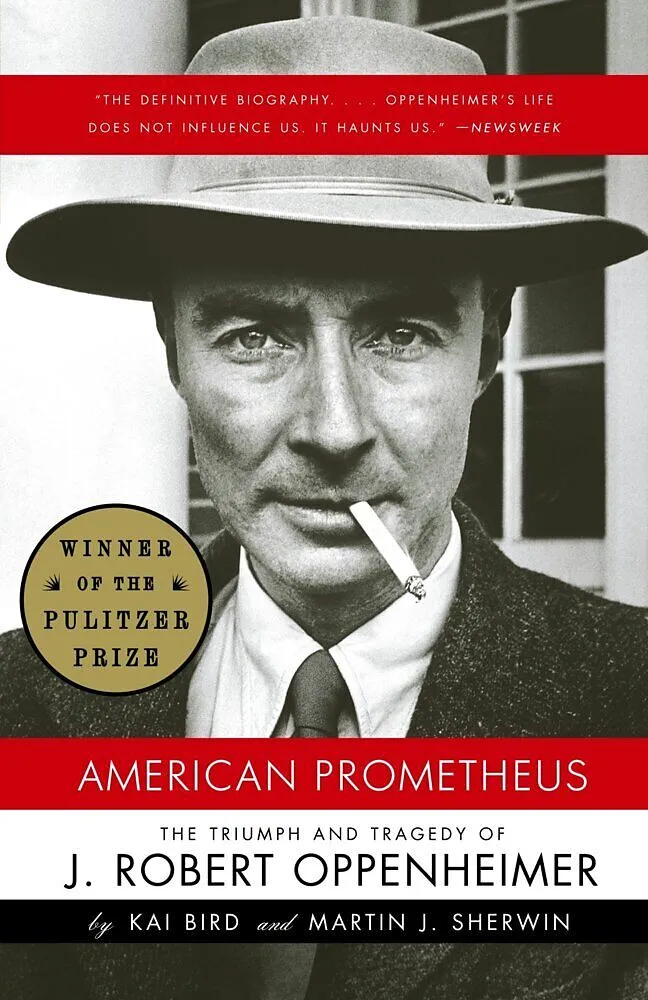

American Prometheus
Beschreibung
A definitive portrait of legendary scientist J. Robert Oppenheimer, the "father" of the atomic bomb, discusses his seminal role in the twentieth-century scientific world, as well as his lesser-known roles as family man, supposed communist, and head o...Format auswählen
- Kartonierter EinbandCHF 17.00
- Fester EinbandCHF 68.40
Wird oft zusammen gekauft
Andere Kunden kauften auch
Beschreibung
A definitive portrait of legendary scientist J. Robert Oppenheimer, the "father" of the atomic bomb, discusses his seminal role in the twentieth-century scientific world, as well as his lesser-known roles as family man, supposed communist, and head of Princeton's Institute for Advanced Studies.
Zusatztext The definitive biography. . . . Oppenheimer's life doesn't influence us. It haunts us. Newsweek A masterful account of Oppenheimer's rise and fall, set in the context of the turbulent decades of America's own transformation. It is a tour de force. Los Angeles Times Book Review A work of voluminous scholarship and lucid insight, unifying its multifaceted portrait with a keen grasp of Oppenheimer's essential nature. . . . It succeeds in deeply fathoming his most damaging, self-contradictory behavior. The New York Times There have been numerous books about Oppenheimer but they can't touch this extraordinary book's impressive breadth and scope. The Miami Herald The first biography to give full due to Oppenheimer's extraordinary complexity . . . Stands as an Everest among the mountains of books on the bomb project and Oppenheimer, and is an achievement not likely to be surpassed or equaled. The Boston Globe Informationen zum Autor Kai Bird and Martin Sherwin Klappentext J. Robert Oppenheimer is one of the iconic figures of the twentieth century, a brilliant physicist who led the effort to build the atomic bomb for his country in a time of war, and who later found himself confronting the moral consequences of scientific progress. In this magisterial, acclaimed biography twenty-five years in the making, Kai Bird and Martin Sherwin capture Oppenheimer's life and times, from his early career to his central role in the Cold War. This is biography and history at its finest, riveting and deeply informative.Chapter 1 In the first decade of the twentieth century, science initiated a second American revolution. A nation on horseback was soon transformed by the internal combustion engine, manned flight and a multitude of other inventions. These technological innovations quickly changed the lives of ordinary men and women. But simultaneously an esoteric band of scientists was creating an even more fundamental revolution. Theoretical physicists across the globe were beginning to alter the way we understand space and time. Radioactivity was discovered on March 1, 1896, by the French physicist Henri Becquerel. Max Planck, Marie Curie and Pierre Curie and others provided further insights into the nature of the atom. And then, in 1905, Albert Einstein published his special theory of relativity. Suddenly, the universe appeared to have changed. Around the globe, scientists were soon to be celebrated as a new kind of hero, promising to usher in a renaissance of rationality, prosperity and social meritocracy. In America, reform movements were challenging the old order. Theodore Roosevelt was using the bully pulpit of the White House to argue that good government in alliance with science and applied technology could forge an enlightened new Progressive Era. Into this world of promise was born J. Robert Oppenheimer, on April 22, 1904. He came from a family of first- and second-generation German immigrants striving to be American. Ethnically and culturally Jewish, the Oppenheimers of New York belonged to no synagogue. Without rejecting their Jewishness they chose to shape their identity within a uniquely American offshoot of Judaismthe Ethical Culture Societythat celebrated rationalism and a progressive brand of secular humanism. This was at the same time an innovative approach to the quandaries any immigrant to America facedand yet for Robert Oppenheimer it reinforced a lifelong ambivalence about his Jewish identity. As its name suggests, Ethical Culture was not a religion but a way of life that promoted social justice over self-aggrandizement. It was no accident that the young boy who would become known as the father of the atomic era was reared in a culture that valued independent inquiry, empirical exploration and the free-thinking mindin short, the values ...
“The definitive biography. . . . Oppenheimer’s life doesn’t influence us. It haunts us.” –Newsweek
“A masterful account of Oppenheimer’s rise and fall, set in the context of the turbulent decades of America’s own transformation. It is a tour de force.” –Los Angeles Times Book Review
“A work of voluminous scholarship and lucid insight, unifying its multifaceted portrait with a keen grasp of Oppenheimer’s essential nature. . . . It succeeds in deeply fathoming his most damaging, self-contradictory behavior.” –The New York Times
“There have been numerous books about Oppenheimer but they can't touch this extraordinary book's impressive breadth and scope.” –The Miami Herald
“The first biography to give full due to Oppenheimer’s extraordinary complexity . . . Stands as an Everest among the mountains of books on the bomb project and Oppenheimer, and is an achievement not likely to be surpassed or equaled.”–The Boston Globe
Autorentext
Kai Bird and Martin Sherwin
Klappentext
J. Robert Oppenheimer is one of the iconic figures of the twentieth century, a brilliant physicist who led the effort to build the atomic bomb for his country in a time of war, and who later found himself confronting the moral consequences of scientific progress. In this magisterial, acclaimed biography twenty-five years in the making, Kai Bird and Martin Sherwin capture Oppenheimer's life and times, from his early career to his central role in the Cold War. This is biography and history at its finest, riveting and deeply informative.
Zusammenfassung
THE INSPIRATION FOR THE ACADEMY AWARD®-WINNING MAJOR MOTION PICTURE OPPENHEIMER • "A riveting account of one of history’s most essential and paradoxical figures.”—Christopher Nolan
#1 NEW YORK TIMES BESTSELLER • PULITZER PRIZE WINNER • The definitive biography of J. Robert Oppenheimer, one of the iconic figures of the twentieth century, a brilliant physicist who led the effort to build the atomic bomb for his country in a time of war, and who later found himself confronting the moral consequences of scientific progress.
A Kirkus Reviews Best Nonfiction Book of the Century
In this magisterial, acclaimed biography twenty-five years in the making, Kai Bird and Martin Sherwin capture Oppenheimer’s life and times, from his early career to his central role in the Cold War. This is biography and history at its finest, riveting and deeply informative.
“A masterful account of Oppenheimer’s rise and fall, set in the context of the turbulent decades of America’s own transformation. It is a tour de force.” —Los Angeles Times Book Review
“A work of voluminous scholarship and lucid insight, unifying its multifaceted portrait with a keen grasp of Oppenheimer’s essential nature.... It succeeds in deeply fathoming his most damaging, self-contradictory behavior.” —The New York Times
Leseprobe
Chapter 1
In the first decade of the twentieth century, science initiated a second American revolution. A nation on horseback was soon transformed by the internal combustion engine, manned flight and a multitude of other inventions. These technological innovations quickly changed the lives of ordinary men and women. But simultaneously an esoteric band of scientists was creating an even more fundamental revolution. Theoretical physicists across the globe were beginning to alter the way we understand space and time. Radioactivity was discovered on March 1, 1896, by the French physicist Henri Becquerel. Max Planck, Marie Curie and Pierre Curie and others provided further insights i…