Haben Sie noch nichts passendes gefunden? Stöbern Sie durch unser komplettes Sortiment.
Oder melden Sie sich an bzw. registrieren Sie sich.


Beschreibung
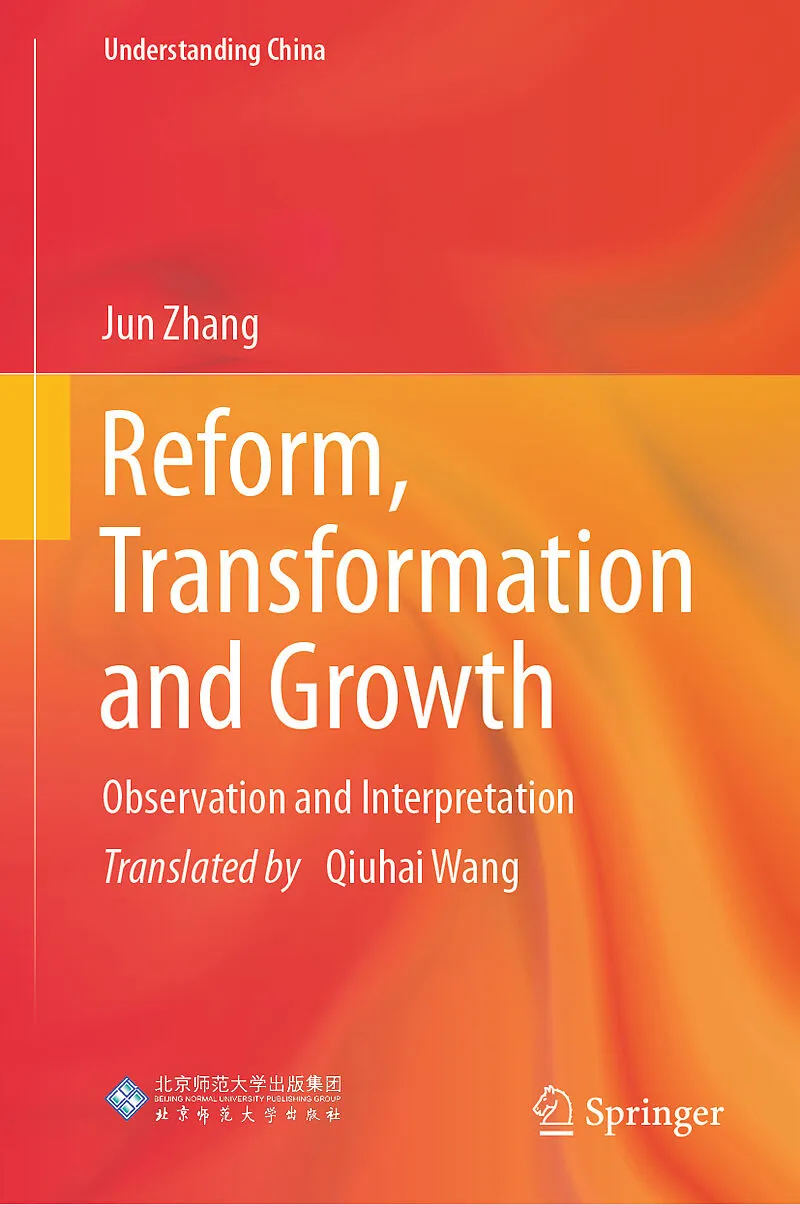
This book aims to present the observation and Interpretation for China's economic growth since Reform and Opening-up from a Chinese economist's view. The book is divided into 5 sections, including the research of traditional socialist economic structure, China...This book aims to present the observation and Interpretation for China's economic growth since Reform and Opening-up from a Chinese economist's view. The book is divided into 5 sections, including the research of traditional socialist economic structure, China's transformation from planned economy to market economy, reform of Chinese industrial economy, economic growth and political economy. Key topics are covered over the past 40 years including strategies for economic transformation, dual-track pricing, industrial transformation and enterprise reform, capital formation and economic growth, structural changes and productivity growth, macroeconomics, fiscal relations between central and local governments, and the political economy of growth.
Is authored by Chinese distinguished economist Jun Zhang Analyzes the impact of China's industrial reform on productivity and profitability of the enterprises Studies the mode of the transformation of Chinese economic system and mechanism of enterprise privatization
Autorentext
Xianghao Yu received his B.Eng. degree in Information Engineering from Southeast University, Nanjing, China, in 2014, and his Ph.D. degree in Electronic and Computer Engineering from the Hong Kong University of Science and Technology (HKUST), Kowloon, Hong Kong, in 2018. His research interests include millimeter wave communications, MIMO systems, mathematical optimization, and stochastic geometry. He was the recipient of the IEEE GLOBECOM 2017 Best Paper Award. Chang Li received his B.Eng. degree in Information and Communication Engineering from Xi'an Jiaotong University, Xi'an, China, in 2010, and his Ph.D. degree in Electrical and Computer Engineering from the Hong Kong University of Science and Technology (HKUST), Kowloon, Hong Kong, in 2016. From February 2015 to January 2016, he was a Visiting Student at the Laboratory for Information and Decision Systems (LIDS), Massachusetts Institute of Technology (MIT), Cambridge, MA, USA. He is currently a guest researcher with the Advanced Network Technologies Division (ANTD), National Institute of Standards and Technology (NIST). His research interests include network localization and navigation, heterogeneous networks, MIMO systems, green communications, and the application of stochastic geometry. Jun Zhang received his Ph.D. degree in Electrical and Computer Engineering from the University of Texas at Austin. He is currently an Assistant Professor at the Department of Electronic and Information Engineering at the Hong Kong Polytechnic University. Dr. Zhang co-authored the book Fundamentals of LTE (Prentice-Hall, 2010). He is a co-recipient of the 2016 Marconi Prize Paper Award in Wireless Communications, the 2014 Best Paper Award for the EURASIP Journal on Advances in Signal Processing, an IEEE GLOBECOM Best Paper Award in 2017, an IEEE ICC Best Paper Award in 2016, and an IEEE PIMRC Best Paper Award in 2014. One paper he co-authored received the 2016 IEEE Signal Processing Society Young Author Best Paper Award. He also received the 2016 IEEE Communications Society Asia-Pacific Best Young Researcher Award. His research interests include wireless communications and networking, mobile edge computing and edge learning, distributed optimization and learning, and big data analytics systems. Khaled B. Letaief received his B.S. degree with distinction, M.S. and Ph.D. degrees in Electrical Engineering from Purdue University, USA. He is an internationally recognized leader in wireless communications and networks and has served as a consultant for various organizations. From 1990 to 1993, he was a faculty member at the University of Melbourne, Australia. Since 1993, he has been with HKUST, Hong Kong. While at HKUST, he has held various administrative positions, including the Dean of Engineering and Director of the Hong Kong Telecom Institute of Information Technology. He is the founding Editor-in-Chief of the prestigious IEEE Transactions on Wireless Communications. He is also the recipient of numerous distinguished awards and honors including the 2016 IEEE Marconi Prize Award in Wireless Communications, 2011 IEEE Communications Society Harold Sobol Award, 2010 Purdue University Outstanding Electrical and Computer Engineer Award, 2007 IEEE Communications Society Joseph LoCicero Publications Exemplary Award, and over 15 IEEE Best Paper Awards. Dr. Letaief is a Fellow of IEEE and a Fellow of HKIE. He is recognized by Thomson Reuters as an ISI Highly Cited Researcher. He is also known for his dedicated service to professional societies and in particular IEEE, where he has served in various leadership positions, including President of the IEEE Communications Society.
Klappentext
This book aims to present the observation and Interpretation for China's economic growth since Reform and Opening-up from a Chinese economist's view. The book is divided into 5 sections, including the research of traditional socialist economic structure, China's transformation from planned economy to market economy, reform of Chinese industrial economy, economic growth and political economy. Key topics are covered over the past 40 years including strategies for economic transformation, dual-track pricing, industrial transformation and enterprise reform, capital formation and economic growth, structural changes and productivity growth, macroeconomics, fiscal relations between central and local governments, and the political economy of growth.
Inhalt
Chapter 1. Information Costs, Limited Reasoning Ability and Simplifying Planning: A Theoretical Explanation of Traditional Chinese Planning.- Chapter 2. Socialist Government and Enterprise: An Analysis from the Perspective of Exit.- Chapter 3. Monetary Incentive and Property Rights Structure of Socialist Enterprises: China's Experience.- Chapter 4. Privileges Sustained by Central Planning: An Analytical Method of Property Rights.- Chapter 5. The Growth of China's Industrial Output Since the Reform: Double-Track Pricing and Border Competition.- Chapter 6. Technology, Classification of Scale and Industrial Organization: Why Can China's Large Enterprises Make Higher Profit Margins?.- Chapter 7.Industrial Reform and Efficiency Change in China: Methods, Data, Literatures and Existing Results.- Chapter 8. Decline of China's Investment Efficiency and the Aggregate Characteristics of Capital Formation.- Chapter 9. Growth, Capital Formation and Technological Choice: Explanation of Long-Term Factors for Recent Decline of Economic Growth in China.- Chapter 10. Decentralization and Growth: The Story of China.- Chapter 11. Why Have China Had A Good Infrastructure: Decentralization Competition, Governance and Infrastructure Investment Decisions.- Chapter 12. Irregular Financial Sector in Rural China after the Reform: A Case Study of Wenzhou.- Postscript.
Tief- preis