
IHR WARENKORB IST AKTUELL LEER.
Haben Sie noch nichts passendes gefunden? Stöbern Sie durch unser komplettes Sortiment.
Oder melden Sie sich an bzw. registrieren Sie sich.
- Kostenlose Lieferung
- Kauf auf Rechnung
- Ex Libris Tiefpreis
- Filiallieferung und 650+ Abholorte
- Rabatt-Bons als Club-Mitglied
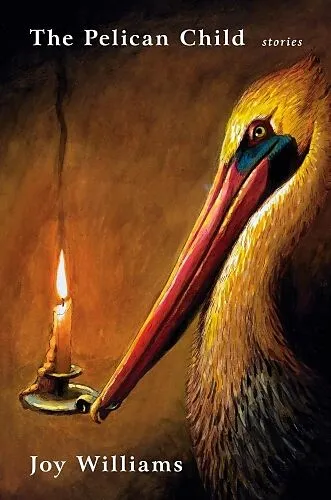
The Pelican Child
Beschreibung
A razor-sharp new collection of stories of visionary childhood misfits and struggling adult dreamers from this legendary writer of “perfectly indescribable fiction . . . To read Williams is to look into the abyss” (<The Atlantic<) ...Format auswählen
- Fester EinbandCHF 25.55

Wird oft zusammen gekauft
Andere Kunden kauften auch
Beschreibung
A razor-sharp new collection of stories of visionary childhood misfits and struggling adult dreamers from this legendary writer of “perfectly indescribable fiction . . . To read Williams is to look into the abyss” (<The Atlantic<)
“Night was best, for, as everyone knows, but does not tell, the sobbing of the earth is most audible at night.” “Men are but unconscious machines and they perform their cruelties so effortlessly.” “Caring was a power she’d once possessed but had given up freely.” The sentences of Joy Williams are like no other—the coiled wit, the sense of a confused and ruined landscape, even the slight chortle of hope that lurks between the words—for the scrupulous effort of telling, in these eleven stories, has a ravishing beauty that belies their substance. We meet lost souls like the twin sister heiresses of a dirty industrial fortune in “After the Haiku Period,” who must commit a violent act in recompense for their family''s deeds; in “Nettle,” a newly grown man who still revolves in a dreamscape of his childhood boarding-school innocence; the ghost of Georges Gurdieff, on an obsessive visit to the Arizona birthplace of the shining Susan Sontag; the “pelican child” who lives with the bony, ill-tempered Baba Iaga in a little hut on chicken legs.
All of these characters insist on exploring, often at their peril, an indifferent and caustic world: they struggle against our degradation of the climate, of each other, and of honest human experience (“I try to relate only to what is immediately verifiable,” says one narrator ruefully), possibly in vain. But each brief, haunted triumph of understanding is celebrated by Williams, a writer for our time and all time.
Autorentext
JOY WILLIAMS is the author of five previous novels—including Harrow, a finalist for the PEN/Jean Stein and the Los Angeles Times book prizes, and The Quick and the Dead, a finalist for the Pulitzer Prize—as well as four collections of stories. Her book of essays, Ill Nature, was a finalist for the National Book Critics Circle Award. Among her many honors are the Rea Award for the Short Story and the Strauss Living Award from the American Academy of Arts and Letters. She was elected to the Academy in 2008. She lives in Tucson, Arizona, and Laramie, Wyoming.
Klappentext
**LONGLISTED FOR THE NATIONAL BOOK AWARD • FINALIST FOR THE PEN/JEAN STEIN BOOK AWARD • LONGLISTED FOR THE STORY PRIZE • NAMED A NOTABLE BOOK OF THE YEAR BY THE WASHINGTON POST • A razor-sharp new collection of stories of visionary childhood misfits and struggling adult dreamers from this legendary writer of “perfectly indescribable fiction . . . To read Williams is to look into the abyss” (The Atlantic).
“An American master is back with crystalline stories that map the personal and political minefields of her unmoored characters. Williams blends everyday dramas with surreal imagery, her voice and range inspiring awe.” —Boston Globe**
“Night was best, for, as everyone knows but does not tell, the sobbing of the earth is most audible at night.” “Men are but unconscious machines and they perform their cruelties so effortlessly.” “Caring was a power she’d once possessed but had given up freely.” The sentences of Joy Williams are like no others—the coiled wit, the sense of a confused and ruined landscape, even the slight whisper of hope that lurks between the words—for the scrupulous effort of telling, in these stories, has a ravishing beauty that belies their subjects. We meet lost souls such as the twin sister heiresses of a dirty industrial fortune in “After the Haiku Period,” who must commit a violent act in recompense for their family’s deeds; in “Nettle,” we encounter a newly grown man who still revolves in a dreamscape of his childhood boarding-school innocence; and in the final story, we learn of the “pelican child” who lives with the “bony, ill-tempered” Baba Iaga “in a little hut on chicken legs.”
All of these characters insist on exploring an indifferent and caustic world. They struggle against our degradation of the climate and of each other, possibly in vain. But each brief, haunted triumph of understanding is celebrated by Williams, a writer for our time and all time.
Leseprobe
Flour
The driver and I got a late start. I usually decide on these excursions the night before, but it was late in the morning when I informed the friend who was coming to visit me for the weekend that I had to cancel, it was absolutely necessary for me to cancel. I had got it in my head that in her presence some calamity or another would arise and she would have to assist me in some way, rush me to a physician or something. She would be grateful she was there for me perhaps, but I would find it a terrific annoyance and embarrassment. I gave some other excuse for the disinvitation of course. Pipes. I think it was broken pipes. I should have written it down so I don’t use it again.
I cleaned the house, which was very much in need of cleaning, for I had been putting it off. Still, my commitment was not great and I neglected the windows as usual. The dogs had pressed against them day and night for years. Their breaths are etched in the glass now, very lightly etched.
By departing so late, we could not make our customary first stop. The driver and I usually spend two nights in lodgings on our route. This time three nights would be necessary. We take separate rooms, of course. If by chance we should come across one another in the restaurant or the hallways, we offer no acknowledgment.
The car is a big one, encompassing three rows, three tiers behind the driver. It amuses me to think of them as the celestial, the terrestrial, and the chthonic. In fact, I quite believe that all things—every moment, every vision, every departure and arrival—possess the celestial, the terrestrial, and the chthonic.
The dogs had pretty much stayed in the terrestrial section where their beds were, as well as a few empty plastic bottles. They liked to play with them, make them crackle and clatter. Sometimes I ride in the chthonic with the luggage, the boots and coats, the boxes of fruit and gin and books. It smells strangely good back there, coolly hopeful and warmly worn at once. But usually I stretch out in the seat behind the driver and watch the landscape change as we rise from the desert floor.
Shockingly, it is almost two o’clock in the afternoon. We will not get far today!
When the driver and I first met—when I was interviewing him, you might say—he told me that he was studying Coptic.
Naturally, I did not believe this for one moment.
Without any encouragement from me he said, “The verb forms and tenses of Coptic are interesting. For example, some tenses that we English speakers do not have are the circumstantial, the habitual, the third future, the fourth future, the optative, and tenses of unfulfilled action signifying until and not yet. I am working now on translating and interpreting the story about the woman carrying flour to her home in a jar that is broken.”
“The flour all pours out?” I said.
“Why yes.” He seemed pleased.
Everyone knows the story of the woman and the flour. Who did he think he was kidding? Still, you’re never drawn to a person for the reasons you think. Besides, he was the only one who applied for the position I sought, which I had kept purposefully vague, and parsing every nuance of the woman and…