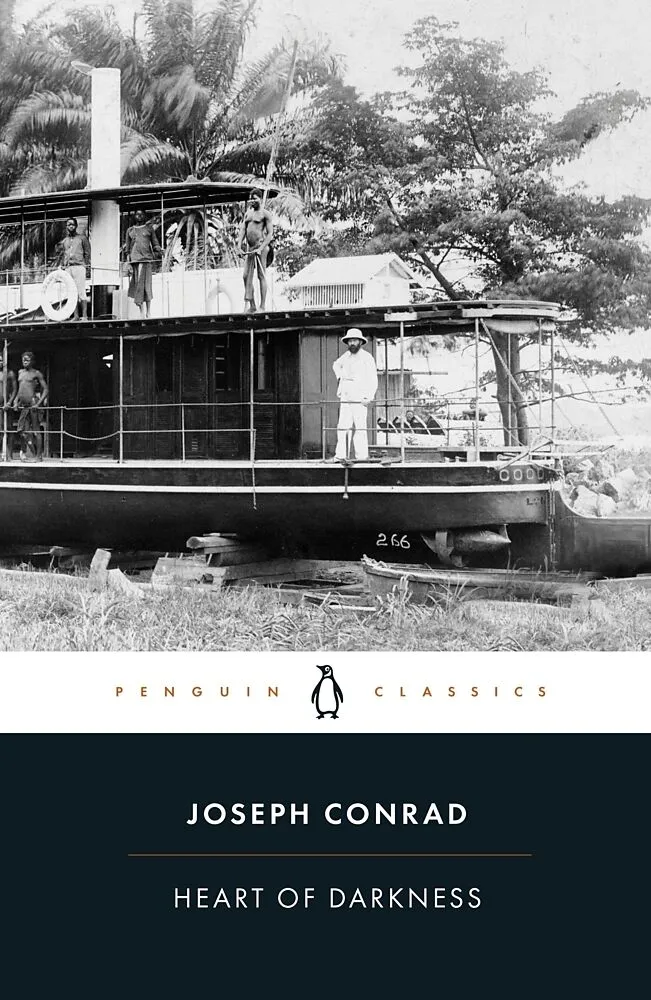
Heart of Darkness
Beschreibung
"Herz der Finsternis" beschreibt die letzte Reise Joseph Conrads, die er ins Innere Afrikas unternahm, ein Abenteuer, das ums Haar tödlich ausgegangen wäre. "Es ist der Bericht eines im wachen Leben erlittenen Albs, den Conrad nur mit Glück und ...Format auswählen
- Kartonierter EinbandCHF 14.60
- E-Book (epub)CHF 6.00
- Fester EinbandCHF 25.90

Wird oft zusammen gekauft
Andere Kunden kauften auch
Beschreibung
"Herz der Finsternis" beschreibt die letzte Reise Joseph Conrads, die er ins Innere Afrikas unternahm, ein Abenteuer, das ums Haar tödlich ausgegangen wäre.
"Es ist der Bericht eines im wachen Leben erlittenen Albs, den Conrad nur mit Glück und für sein restliches Leben angeschlagen überstand." Urs Widmer
Informationen zum Autor Joseph Conrad Klappentext A haunting Modernist masterpiece and the inspiration for Francis Ford Coppola's Oscar-winning film Apocalypse Now , Heart of Darkness explores the limits of human experience and the nightmarish realities of imperialism. Conrad's narrator Marlow, a seaman and wanderer, recounts his physical and psychological journey in search of the infamous ivory trader Kurtz: dying, insane, and guilty of unspeakable atrocities. Travelling upriver to the heart of the African continent, he gradually becomes obsessed by this enigmatic, wraith-like figure. Marlow's discovery of how Kurtz has gained his position of power over the local people involves him in a radical questioning, not only of his own nature and values, but also those of western civilisation. Part of a major series of new editions of Conrad's most famous works in Penguin Classics, this volume contains Conrad's Congo Diary , a chronology, further reading, notes, a map of the Congo, a glossary and an introduction discussing the author's experiences in Africa, the narrative and symbolic complexities of Heart of Darkness and critical responses to the novel. Edited with an introduction by Owen Knowles 'Seems to reach into the heart of Conrad himself' Peter Ackroyd Introduction Mention the name of Joseph Conrad and the answering response will commonly invoke his celebrated African novella of 1899, 'Heart of Darkness'. If the work has acquired an iconic status comparable to that of Edvard Munch's painting The Scream (1893), its title has by contrast become something of a tired cliché in being so repeatedly used by newspaper headline-makers. Conrad, who modestly hoped that the work might have a continuing 'vibration', would have been astonished by these contemporary reverberations. The story's emergence as a twentieth-century 'classic' forms a first stage in the history of its remarkable after-life. A key moment arrived with T. S. Eliot's use of a fragment from 'Heart of Darkness' as an epigraph to his poem, 'The Hollow Men' (1925). Eliot's epigraph signals a temporary kinship and establishes a bridge between two works, but it also probably signifies a more intangible sense of indebtedness -- to Conrad as an important founder-member of a tradition of British Modernist writing. The story's major re-discovery dates from the 1950s when its apocalyptic symbolism and existentialist uncertainty seem to have entered the collective consciousness of a generation who lived through the Second World War or were coming to terms with its legacy. As one critic of the time put it, the story had become 'a Pilgrim's Progress for our pessimistic and psychologizing age' (Guerard, p. 33). Its more recent impact has been equally dramatic, if more controversial. Now standing at the centre of a wider contemporary debate about race, imperialism and feminism, its æsthetic dimensions and experimental character have almost been left behind. It has acquired the character of an awkward problem-novel, a standard text in the classroom and -- for better or worse -- a litmus-test for a variety of theoretical preoccupations. As a modern quest parable translated into many languages, it has simultaneously had a powerful generative effect upon twentieth-century writers and film-makers, inspiring emulations, adaptations and counter-versions. I Conrad's direct and indirect engagement with things African has a long pre-history. It extends as far back as his childhood, when the young Pole pored over maps of the continent, devoured tales of the first European explorers in Africa and vicariously shared the perils of Dr Livingstone's travels. Like all dreams of heroic adventure, this one was destined to meet with a rude awakening. In 1890, towards the end of his career as a merchant seaman, the thirty-three-year-old Conrad signed a lon...
Autorentext
Joseph Conrad
Klappentext
A haunting Modernist masterpiece and the inspiration for Francis Ford Coppola's Oscar-winning film Apocalypse Now, Heart of Darkness explores the limits of human experience and the nightmarish realities of imperialism.
Conrad's narrator Marlow, a seaman and wanderer, recounts his physical and psychological journey in search of the infamous ivory trader Kurtz: dying, insane, and guilty of unspeakable atrocities. Travelling upriver to the heart of the African continent, he gradually becomes obsessed by this enigmatic, wraith-like figure. Marlow's discovery of how Kurtz has gained his position of power over the local people involves him in a radical questioning, not only of his own nature and values, but also those of western civilisation.
Part of a major series of new editions of Conrad's most famous works in Penguin Classics, this volume contains Conrad's Congo Diary, a chronology, further reading, notes, a map of the Congo, a glossary and an introduction discussing the author's experiences in Africa, the narrative and symbolic complexities of Heart of Darkness and critical responses to the novel.
Edited with an introduction by Owen Knowles
'Seems to reach into the heart of Conrad himself' Peter Ackroyd
Zusammenfassung
Marlow, a seaman and wanderer, recounts his physical and psychological journey in search of the infamous ivory trader Kurtz: dying, insane, and guilty of unspeakable atrocities. Travelling upriver to the heart of the African continent, he gradually becomes obsessed by this enigmatic, wraith-like figure.
Leseprobe
Introduction
Mention the name of Joseph Conrad and the answering response will commonly invoke his celebrated African novella of 1899, ‘Heart of Darkness’. If the work has acquired an iconic status comparable to that of Edvard Munch’s painting The Scream (1893), its title has by contrast become something of a tired cliché in being so repeatedly used by newspaper headline-makers. Conrad, who modestly hoped that the work might have a continuing ‘vibration’, would have been astonished by these contemporary reverberations.
The story’s emergence as a twentieth-century ‘classic’ forms a first stage in the history of its remarkable after-life. A key moment arrived with T. S. Eliot’s use of a fragment from ‘Heart of Darkness’ as an epigraph to his poem, ‘The Hollow Men’ (1925). Eliot’s epigraph signals a temporary kinship and establishes a bridge between two works, but it also probably signifies a more intangible sense of indebtedness -- to Conrad as an important founder-member of a tradition of British Modernist writing.
The story’s major re-discovery dates from the 1950s when its apocalyptic symbolism and existentialist uncertainty seem to have entered the collective consciousness of a generation who lived through the Second World War or were coming to terms with its legacy. As one critic of the time put it, the story had become ‘a Pilgrim’s Progress for our pessimistic and psychologizing age’ (Guerard, p. 33). Its more recent impact has been equally dramatic, if more controversial. Now standing at the centre of a wider contemporary debate about race, imperialism and feminism, its Æsthetic dimensions and experimental character have almost been left behind. It has acquired the character of an awkward problem-novel, a standard text in the classroom and -- for better or worse -- a litmus-test for a variety of theoretical preoccupations. As a modern quest parable translated into many languages, it has simultaneously had a powerful generative effect upon twentieth-century writers and f…