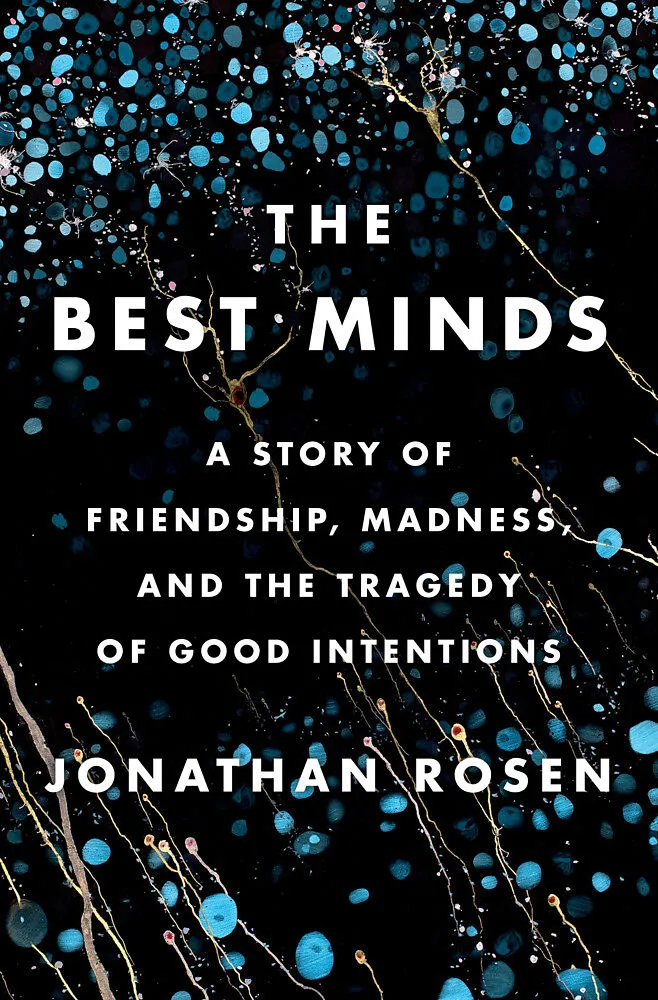
The Best Minds
Beschreibung
Acclaimed author Jonathan Rosen’s haunting investigation of the forces that led his closest childhood friend, Michael Laudor, from the heights of brilliant promise to the forensic psychiatric hospital where he has lived since killing the woman he loved. ...Format auswählen
- Fester EinbandCHF 35.90

Wird oft zusammen gekauft
Andere Kunden kauften auch
Beschreibung
Acclaimed author Jonathan Rosen’s haunting investigation of the forces that led his closest childhood friend, Michael Laudor, from the heights of brilliant promise to the forensic psychiatric hospital where he has lived since killing the woman he loved. A story about friendship, love, and the price of self-delusion, When the Rosens moved to New Rochelle in 1973, Jonathan Rosen and Michael Laudor became inseparable.;The boys, both children of college professors, grew up on the same short street sharing a love of basketball, standup comedy, ;;;;Leaving Jonathan behind, Michael blazed through college in three years, graduating summa cum laude and landing a top-flight consulting job for far more money than their parents had ever made. But all wasn’t as it seemed. One day, Jonathan received the fateful call: Michael had suffered a serious psychotic break and was institutionalized at a New York City psychiatric hospital where he was diagnosed with paranoid schizophrenia. He would stay there for nine months before transitioning to a halfway house.; Fearing the prospect of a life spent bagging groceries, Michael decided to play the one card left to him:;just before his break, he had been accepted to Yale Law School, and now, against all odds, he planned to enroll. Still struggling mightily with schizophrenia, Michael made it through the top law school in the country. His extraordinary story was featured in the < ;;;The Best Minds< is Jonathan Rosen''s brilliant and heartbreaking account of an American tragedy. His exploration is rooted in the dramatic transformation of American culture in the second half of the twentieth century, society’s shifting relationship to mental illness and the marriage of law and psychiatry. It is a story about the bonds of family, friendship, and community, the promise of intellectual achievement and the lure of utopian solutions. At times tender and hilarious, and at times harrowing and almost unbearably sad, <The Best Minds< is an extreme version of a story that is tragically familiar to all too many.;In the hands of a writer of Jonathan Rosen''s gifts and dedication, its significance will echo widely....
Autorentext
Jonathan Rosen is the author of two novels: Eve’s Apple and Joy Comes in the Morning, and two non-fiction books: The Talmud and the Internet: A Journey Between Worlds and The Life of the Skies: Birding at the End of Nature. His essays and articles have appeared in The New York Times, The New Yorker, The Atlantic, The Wall Street Journal, and numerous anthologies. He lives with his family in New York City.
Klappentext
********Named a Top 10 Best Book of the Year by The New York Times, The Wall Street Journal, and The Atlantic
A Washington Post Notable Book**
“Brave and nuanced…an act of tremendous compassion and a literary triumph.” ***—***The New York Times
“Immensely emotional and unforgettably haunting.” ***—***Wall Street Journal
Acclaimed author Jonathan Rosen’s haunting investigation of the forces that led his closest childhood friend, Michael Laudor, from the heights of brilliant promise to the forensic psychiatric hospital where he has lived since killing the woman he loved. A story about friendship, love, and the price of self-delusion, The Best Minds explores the ways in which we understand—and fail to understand—mental illness.
When the Rosens moved to New Rochelle in 1973, Jonathan Rosen and Michael Laudor became inseparable. Both children of college professors, the boys were best friends and keen competitors, and, when they both got into Yale University, seemed set to join the American meritocratic elite.
Michael blazed through college in three years, graduating summa cum laude and landing a top-flight consulting job. But all wasn’t as it seemed. One day, Jonathan received the call: Michael had suffered a serious psychotic break and was in the locked ward of a psychiatric hospital.
Diagnosed with paranoid schizophrenia, Michael was still in the hospital when he learned he'd been accepted to Yale Law School, and still battling delusions when he decided to trade his halfway house for the top law school in the country. He not only managed to graduate, but after his extraordinary story was featured in The New York Times, sold a memoir for a large sum. Ron Howard bought film rights, completing the dream for Michael and his tirelessly supportive girlfriend Carrie. But then Michael, in the grip of an unshakeable paranoid fantasy, stabbed Carrie to death with a kitchen knife and became a front-page story of an entirely different sort.
The Best Minds is Jonathan Rosen's brilliant and heartbreaking account of an American tragedy. It is a story about the bonds of family, friendship, and community; the promise of intellectual achievement; and the lure of utopian solutions. Tender, funny, and harrowing by turns, at times almost unbearably sad, The Best Minds is an extreme version of a story that is tragically familiar to all too many. In the hands of a writer of Jonathan Rosen's gifts and dedication, its significance will echo widely.
Leseprobe
Chapter One
The Suitable Playmate
When you were a small boy, the aim of the suitable playmate could not have been more perfectly fulfilled: across the street was Michael Laudor, the ideal friend. A
brilliant peer.
-Cynthia Ozick, letter to the author
My family moved to New Rochelle in 1973. There were good schools, green lawns, and quaint signs painted in the 1920s bearing legends like only forty-five minutes from broadway and city of homes, churches and schools, though there were four synagogues and Metro North got you to Manhattan-the rock around which all life revolved-in thirty-three minutes. But the real reason we moved to New Rochelle was so that I could meet Michael.
That, at least, is what my mother's best friend, the writer Cynthia Ozick, told me:
I heard much of Michael Laudor when you were growing up. And in a way even before you knew of his existence, in this sense: that Michael, or someone like him, was always the goal in choosing where to buy a house.
Michael, in other words, was inevitable. I was destined to meet him, or at least someone like him, because friendship cannot actually be foretold any more than madness or the day of your death. Can it?
I met Michael soon after we moved in, as I was examining a heap of junk that the previous owners had left in a neat pile at the edge of our lawn. I was looking for relics of the three athletic boys who had lived there, and wondering if a small aquarium was worth salvaging, when a boy with shaggy red-brown hair and large tinted aviator glasses walked over to welcome me to the neighborhood.
He was taller even than I was, gawky but with a lilting stride that was oddly purposeful for a kid our age, as if he actually had someplace to go. His habit of launching himself up and forward with every step, gathering height in order to achieve distance, was so distinctive that it earned him the nickname Toes.
I didn't learn he was called Toes until fifth grade started, when I learned he was also called Big. The shortest kid in class was called Small, and when they lined us up in height order, Big and Small were bookends. Sensitive teachers sometimes let the short kids go first, which I'm sure did wonders for their self-esteem.
Big is less imaginative than Toes, but how many kids get two nicknames? And Michael was big. Not big like Hal, who appeared to be attending fifth grade on the GI bill, but through some subtle combination of height, intelligence, posture, and willpower.
In Brookline-the Boston suburb where my family had lived for three years before moving to New Rochelle-I'd been taller than all my friends, but nobody would have called me Bi…