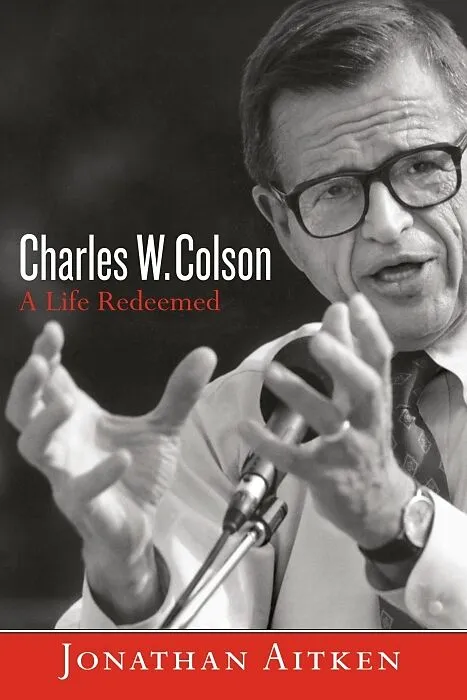
Charles W. Colson
Beschreibung
Praise for Jonathan Aitken’s Nixon: A Life “Aitken’s well-wrought biography achieves the difficult task of adding hundreds of brush strokes to the existing portraits of Richard Nixon.” —Washington Post “Readers all across th...Format auswählen
- Kartonierter EinbandCHF 18.15

Wird oft zusammen gekauft
Andere Kunden kauften auch
Beschreibung
Praise for Jonathan Aitken’s Nixon: A Life
“Aitken’s well-wrought biography achieves the difficult task of adding hundreds of brush strokes to the existing portraits of Richard Nixon.” —Washington Post
“Readers all across the political spectrum will reach for Aitken’s effective, interest-sustaining narrative.” —Booklist
“Aitken has unearthed a treasure trove of insights via letters and other communications. A human, if flawed, Nixon emerges from this fascinating account, which could not be more highly recommended.” —Library Journal
Autorentext
JONATHAN AITKEN, an Oxford graduate in both law and theology, is the author of the award-winning biography Nixon: A Life. A former British M.P. and cabinet member, his political career ended in 1999 when he served a seven-month prison term for perjury in a civil case. He is now a lecturer, author, columnis,t and broadcaster.
Klappentext
He was Nixon's hatchet man. A jailed felon. And now, one of the most significant Christian leaders of our time. Here is his life story.
Charles Colson has become one of the most revered leaders of our time. His ministry outreach, Prison Fellowship, has swelled to 40,000 volunteers working in 100 countries. His Angel Tree Christmas program provides presents to more than half a million children of prison inmates every year. His daily radio broadcast, BreakPoint, airs daily on more than 1,000 radio outlets across the country. And his twenty books have sold more than five million copies in the U.S.
But God had to work some mighty miracles to bring this unusual servant to this prominent place of service. After all, Colson was known as President Nixon's "hatchet man.” His involvement in the Watergate conspiracy led him to prison-and then to a life-changing encounter with God.
Now, noted author Jonathan Aitken has written the first biography that compellingly presents a first-rate understanding of the political, historical, and spiritual journeys of Charles W. Colson... a life redeemed.
Zusammenfassung
He was Nixon’s hatchet man. A jailed felon. And now, one of the most significant Christian leaders of our time. Here is his life story.
Charles Colson has become one of the most revered leaders of our time. His ministry outreach, Prison Fellowship, has swelled to 40,000 volunteers working in 100 countries. His Angel Tree Christmas program provides presents to more than half a million children of prison inmates every year. His daily radio broadcast, BreakPoint, airs daily on more than 1,000 radio outlets across the country. And his twenty books have sold more than five million copies in the U.S.
But God had to work some mighty miracles to bring this unusual servant to this prominent place of service. After all, Colson was known as President Nixon’s “hatchet man.” His involvement in the Watergate conspiracy led him to prison–and then to a life-changing encounter with God.
Now, noted author Jonathan Aitken has written the first biography that compellingly presents a first-rate understanding of the political, historical, and spiritual journeys of Charles W. Colson… a life redeemed.
Leseprobe
CHAPTER ONE
An Unsettled Upbringing
Parents and Childhood
In the beginning was the energy, a life force so enthusiastic that everyone noticed him as a boy with leadership qualities, who never did things by halves, and who rarely knew when to stop. Whether it was collecting nickels and dimes for the war effort, selling ads for the school magazine, or playing practical jokes on his friends, he had exceptional drive that combined zeal, ingenuity, and humor. Yet the levitas in his nature was balanced by a gravitas shown in the self-discipline he applied to achieving the academic goals of his schoolboy years. So even in his earliest days there were intriguingly polarized characteristics in the young Charles Colson. It did not need an expert in genetics to deduce that they flowed from his radically different parents.
No mother could have had a more appropriate nickname than Dizzy Colson. The nineteenth-century British prime minister Benjamin Disraeli, who acquired the same sobriquet, coined a phrase to describe his parliamentary opponent William Gladstone: "Inebriated by the exuberance of his own verbosity." It was a cap that would have fit well on Inez Ducrow Colson. For Dizzy Colson was a twentieth-century American eccentric who never stopped talking, showing off, spending money, or striking attitudes that she hoped would shock her friends and relatives. Colorful anecdotes of Dizzy abound throughout the story of her son's life.
When Dizzy made her first visit to the White House in 1969 to see Charlie, as she always called her son, in his office as special counsel to the president, she was unusually dressed for the occasion. She wore a light overcoat, but beneath it she was clad in nothing more than her underwear and a slip. When she explained to a startled cousin how she justified this bizarre ensemble, Dizzy declared: "But no one ever lets you take off your topcoat in the White House!" History does not record whether Mrs. Colson ever tested her theory of the disrobing customs at 1600 Pennsylvania Avenue in the Nixon years or whether she simply invented the story to shock her straitlaced relative. The latter seems more likely since Dizzy was not given to understatement either in dress or in words.
One post-White House occasion when Dizzy might have found it difficult to overstate her own role in the proceedings was the Washington movie premiere of the film of her son's best-selling autobiography, Born Again. Surrounded by Hollywood stars, Beltway celebrities, the sister of the president of the United States, and a theater full of heavyweight figures from the worlds of politics, journalism, and religion, most mothers might have been content to bask in reflected glory from a backseat. Not Dizzy. Although she was under strict instructions not to talk to the press and had even been assigned a minder to ensure her silence, Inez Ducrow Colson was not one to hide her light under a bushel. She escaped from her minder, Mrs. Beth Loux, by slipping into a stall in the ladies' rest room and slipping out again underneath one of the partitions separating the toilets. By the time Mrs. Loux had discovered that her charge had bolted even though her toilet door was still closed, Dizzy was in full flow, giving an interview to the style correspondent of the Washington Post. The main feature of the interview was Mrs. Colson's ethically incorrect opinion of her son's role in Watergate and of his efforts to blacken the character of Daniel Ellsberg. "I'm proud of what Chuck tried to do to that communist Ellsberg. . . . I wish he would get up and say, 'I'm proud.' . . . I never want to hear Chuck saying, 'I'm sorry,'" she declared. Apparently oblivious to the new Colson message of Christian contrition and change, Dizzy professed to be mystified by the book's title. "I born him first. I had him baptized as a baby. I don't understand this 'Born Again' business," she told reporters.
It was not the first or last time that Charles Colson found himself at loggerheads with his mother. "The problem was that he and Dizzy banged smack into the middle of each other's energy fields," was how one member of the family summarized their turbulent relationship. The collisions between filial chalk and maternal cheese sometimes had awkward consequences. With the looks of a Bette Davis and the effervescence of a Goldie Hawn, Dizzy had a flamboyance in her character that was the antithesis of her son's self-discipline. Immensely attractive in her expansive personality, she combined generosity of spirit toward underdogs with financial recklessness about overdrafts. One of …