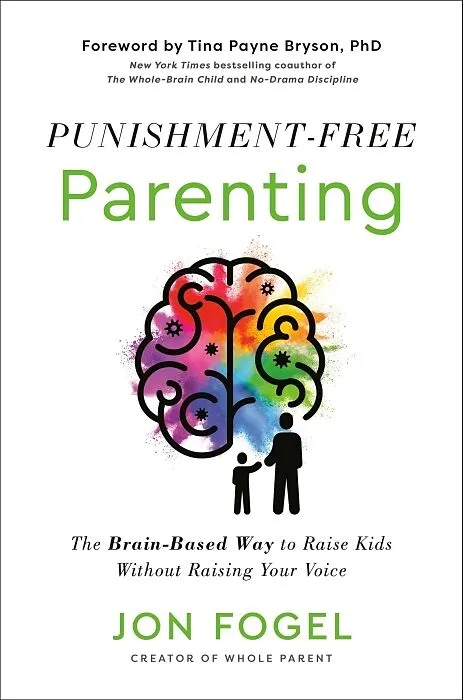
Punishment-Free Parenting
Beschreibung
A no-judgment, simple-to-follow step-by-step parenting guide to help you manage your emotions, meet your child’s needs with empathy, and create a calmer home--without ever resorting to threats or punishment Every parent has had that painful moment they r...Format auswählen
- Fester EinbandCHF 28.40
Wird oft zusammen gekauft
Andere Kunden kauften auch
Beschreibung
A no-judgment, simple-to-follow step-by-step parenting guide to help you manage your emotions, meet your child’s needs with empathy, and create a calmer home--without ever resorting to threats or punishment Every parent has had that painful moment they realize there must be a For Jon Fogel, that realization set him on a path toward wholeness: understanding himself, learning about the brain, and empowering parents to raise kids who live physically, mentally, and emotionally healthy lives. In just a few short years, he became an inspiration to more than a million people around the world who were also striving to do better and become the best parents they can be. Now, with In pages packed with the most helpful research findings from child developmental psychology, neurology, and pediatric medicine, readers will meet other parents just like them and children just like their own who have learned to use the tools and tips that Fogel provides.
Autorentext
Jon Fogel is a husband, a father of four beautiful children, and a parenting educator. His goal is to teach how to parent more effectively—with less stress and more success. In his teaching, Jon combines modern neuroscience, developmental psychology, counseling, and positive, gentle parenting wisdom, distilling the science into terms every parent can understand. Fogel is the senior pastor at Hope Covenant Church in Orland Park, Illinois. Previously, he served as a hospital chaplain in the greater Chicago area. He holds a Master of Divinity degree from North Park Theological Seminary.
Leseprobe
1
The Problem with Punishment
Too often we forget that discipline really means to teach, not to punish. A disciple is a student, not a recipient of behavioral consequences. —Daniel J. Siegel, MD, and Tina Payne Bryson, PhD
If there seems to be one prevailing myth that defines old-school parenting, it is that punishment is the most effective way to control children’s behavior and it is necessary for their development. It’s most often my opposition to punishment that stops parents in their tracks. Most of us cannot imagine a world where parents discipline children effectively without punishing them. But I’m living proof that we live in that world.
Punishment, by definition, is a retributive action leveraged by an authority against someone who has done something that the authority believes is wrong. Punishments are used so that the offender is motivated not to offend in the future. Punishment looks back at a person’s “bad behavior” and says, “I’m going to hurt you or (at least) make you uncomfortable to make sure you don’t do that bad thing again.”
The punishments parents use have taken many forms throughout human history. Here are a few of the most common:
• Corporal punishment (spanking, whupping, paddling, pinching, or otherwise physically hurting)
• Shame and disappointment (“You are a bad kid for doing that bad thing” or “I am disappointed in you”)
• Yelling and/or scaring (Why would you do that! I’m so mad at you right now!)
• Love withdrawal (“I’m so mad at you right now, I don’t want to be near you, go take a time-out!”)
• Removal of positive reinforcement (“I’m taking away your tablet for a week!” or “You’re grounded!”)
I’ve listed these in order of most problematic to least, but make no mistake, they are all punishment. They all seek to harm or inconvenience a child in order to teach them a lesson.
If you want evidence as to how universal the authoritarian sentiment is that punishment is synonymous with teaching, consider how we tend to use the word “discipline.” When I say discipline, people raised in authoritarian households, that is to say most people, immediately assume that I’m talking about punishment. “I was disciplined for taking my mom’s lipstick and writing all over the bathroom mirror” means to most people, “I was punished for taking my mom’s lipstick and writing all over the bathroom mirror.” Ultimately, this is a misuse of the word “discipline.” To discipline, coming from ancient Greek, means “to teach,” not “to punish.” Yet we have come to think of these words as synonymous because we have been convinced that punishment is not only an effective form of teaching, but the most effective form of teaching.
Psychologists and mental health experts have known for more than twenty years, for example, that corporal punishment—inflicting physical pain as a punishment—doesn’t work. During the 1990s, research increasingly showed that inflicting pain on children as a means of discipline was both ineffective and had negative developmental outcomes.
That said, most parents, especially in the United States, were seemingly either unaware of this research or didn’t trust these findings. A composite of surveys conducted by the National Opinion Research Center shows that in the year 2000, U.S. parents who believed spanking was a necessary form of discipline outnumbered those who did not nearly three to one. Six years later, the numbers had barely changed, with 72 percent of parents still convinced spanking was necessary. Even more shocking is that another six years after that, the last time the survey was conducted, the number had shifted only slightly, with a whopping 70 percent of parents still believing that hitting children was a necessary part of parenting. Let that sink in.
In 2012, when more than twenty countries had already made spanking illegal, 70 percent of American parents still believed it was not only permissible but necessary to spank children. Sweden, the first country to entirely ban corporal punishment, did so in 1979, over thirty years before that final survey was conducted. They did this because of the well-documented damaging effects violent punishments have on children. Ironically, far from yielding positive long-term behavioral change, research consistently identifies that corporal punishment in childhood is linked to antisocial behavior, poor mental health, and even violence.
If you take nothing else away from this book, let it be that, at the very least, corporal punishment is never an example of effective parenting and is, in fact, harmful to children.
What we rarely admit these days is that all punishments, including those that do not rely on physical pain, by definition, still rely on discomfort or psychological pain for the person being punished. While it seems the cultural tide is finally moving away from corporal punishment, we don’t often consider that many other punishment techniques are also painful.
When a parent shames, humiliates, or otherwise intentionally causes their child emotional distress (through isolation or insensitivity), the very same parts of their child’s brain that would be activated by physical pain are activated by that emotional pain. And what about grounding? That, too, creates social pain, which the brain also processes similarly.
In fact, all punishment, at its core, is attempted discipline by means of pain.
The Impact of Punishment on Stress Response
To understand why punishment is not only an unproductive way to discipline kids but is, in fact, counterproductive, you first have to understand the body’s stress response.
You have absolutely experienced this stress response phenomenon before, and you may even know it by its street names: “fight or flight” or “survival mode.” What you might not know is that this response is triggered in our bodies by actual physiological processes.
One of the f…