
IHR WARENKORB IST AKTUELL LEER.
Haben Sie noch nichts passendes gefunden? Stöbern Sie durch unser komplettes Sortiment.
Oder melden Sie sich an bzw. registrieren Sie sich.
- Kostenlose Lieferung
- Kauf auf Rechnung
- Ex Libris Tiefpreis
- Filiallieferung und 650+ Abholorte
- Rabatt-Bons als Club-Mitglied
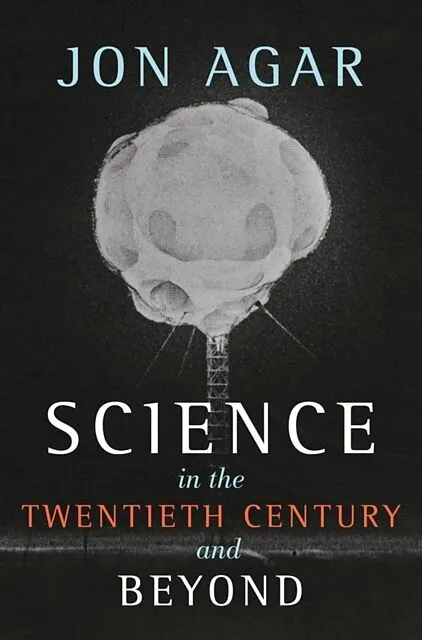
Science in the Twentieth Century and Beyond
Beschreibung
Much-needed overview of the history of science from 1900 to the present day. Emphasises the crucial part that science has played in the bigger picture of twentieth century history, from Einstein's new physics to the Human Genome Project. Informationen zu...Format auswählen
- Kartonierter EinbandCHF 27.90

Wird oft zusammen gekauft
Andere Kunden kauften auch
Beschreibung
Much-needed overview of the history of science from 1900 to the present day.
Emphasises the crucial part that science has played in the bigger picture of twentieth century history, from Einstein's new physics to the Human Genome Project.
Informationen zum Autor Jon Agar is a lecturer in the Department of History and Philosophy of Science at the University of Cambridge. Klappentext A compelling history of science from 1900 to the present day, this is the first book to survey modern developments in science during a century of unprecedented change, conflict and uncertainty. The scope is global. Science's claim to access universal truths about the natural world made it an irresistible resource for industrial empires, ideological programs, and environmental campaigners during this period. Science has been at the heart of twentieth century history - from Einstein's new physics to the Manhattan Project, from eugenics to the Human Genome Project, or from the wonders of penicillin to the promises of biotechnology. For some science would only thrive if autonomous and kept separate from the political world, while for others science was the best guide to a planned and better future. Science was both a routine, if essential, part of an orderly society, and the disruptive source of bewildering transformation. Jon Agar draws on a wave of recent scholarship that explores science from interdisciplinary perspectives to offer a readable synthesis that will be ideal for anyone curious about the profound place of science in the modern world. "Agar has abstracted and made manageable a range of rich and informed analysis. Anyone who thinks seriously about science will find it a very useful source." The Economist "Global in scope and fresh in approach, this monumental history lays out the evolution of science during a tumultuous century." Nature "Truly extraordinary in its depth breadth, it makes significant contributions to the history of science and more broadly to our understanding of twentieth-century history. It is also remarkable in that, while written primarily with a scholarly audience in mind, it's nevertheless accessible and of interest to a wider audience, and an excellent advertisement for the discipline." British Society for the History of Science "Judging by the majestic scope of Jon Agar's new volume, we still have fertile big-picture approaches to guide us through the untidily evolving and multiplying plurality of the natural sciences. Generations of students might take great pride in critiquing the book, just as scholars have done for fifty years with Kuhn's (in)famously challenging The Structure of Scientific Revolutions ." Reviews in History "Agar's approach focuses on the relationship of science to external ideas and practices, thus tying it more tightly to broader histories; it also emphasises patterns of discovery over the individual flashes of insight. Both are useful correctives, and scientists, historians and those who aspire to be either will all benefit from them." Prospect - picked for 'What to read this summer' "A masterful, yet eminently readable, synthesis, which is unquestionably an essential addition to the library of historians of science. I suggest it would also be of wider relevance to teachers of A-level science, giving us a little of the breadth occasionally." School Science Review "All technology has its genesis, but everyone seems to have been too busy to synthesise the elements and tell the full story. Jon Agar has set this to rights with this book, which will interest the scholar, the historian and the enquiring mind of any discipline." Network Computing "A synthetic history of a subject as big, broad and diverse as twentieth-century science is a major achievement. But Agar has given us something more than that: his book is an innovative model of how one might think about scientific practices at temporal and institutional scales much larger than those to which modern historical writing has become accustomed." Steven Shapin, Harvard University, and author of The Scientific Life: A Moral History of a Late Modern Vocation "Science in the Twentieth Century and Beyond is the book historians...
Klappentext
A compelling history of science from 1900 to the present day, this is the first book to survey modern developments in science during a century of unprecedented change, conflict and uncertainty. The scope is global. Science's claim to access universal truths about the natural world made it an irresistible resource for industrial empires, ideological programs, and environmental campaigners during this period. Science has been at the heart of twentieth century history - from Einstein's new physics to the Manhattan Project, from eugenics to the Human Genome Project, or from the wonders of penicillin to the promises of biotechnology. For some science would only thrive if autonomous and kept separate from the political world, while for others science was the best guide to a planned and better future. Science was both a routine, if essential, part of an orderly society, and the disruptive source of bewildering transformation.
Jon Agar draws on a wave of recent scholarship that explores science from interdisciplinary perspectives to offer a readable synthesis that will be ideal for anyone curious about the profound place of science in the modern world.
Inhalt
- Acknowledgements
- Introduction
- Part 1: Science after 1900
- New Physics
- New Sciences of Life
- New Sciences of the Self
- Part 2: Sciences in a World of Conflict
- Science and the First World War
- Crisis: Quantum Theories and Other Weimar Sciences
- Science and Imperial Order
- Expanding Universes: Private Wealth and American Science
- Revolutions and Materialism
- Nazi Science
- Scaling Up, Scaling Down
- Part 3: Second World War and Cold War
- Science and the Second World War
- Trials of Science in the Atomic Age
- Cold War Spaces
- Cold War Sciences (1): Sciences from the Working World of Atomic Projects
- Cold War Sciences (2): Sciences from Information Systems
- Part 4: Sciences of Our World
- Transition: Sea Change in the Long Sixties
- Networks
- Connecting Ends
- Part 5: Conclusions
- Science in the Twentieth Century and Beyond