Beschreibung
This book explores research around reciprocal participation in care activities across a variety of everyday settings from the perspective of HCI researchers. It challenges traditional conceptions of caregiving in which care is provided and received and highli...
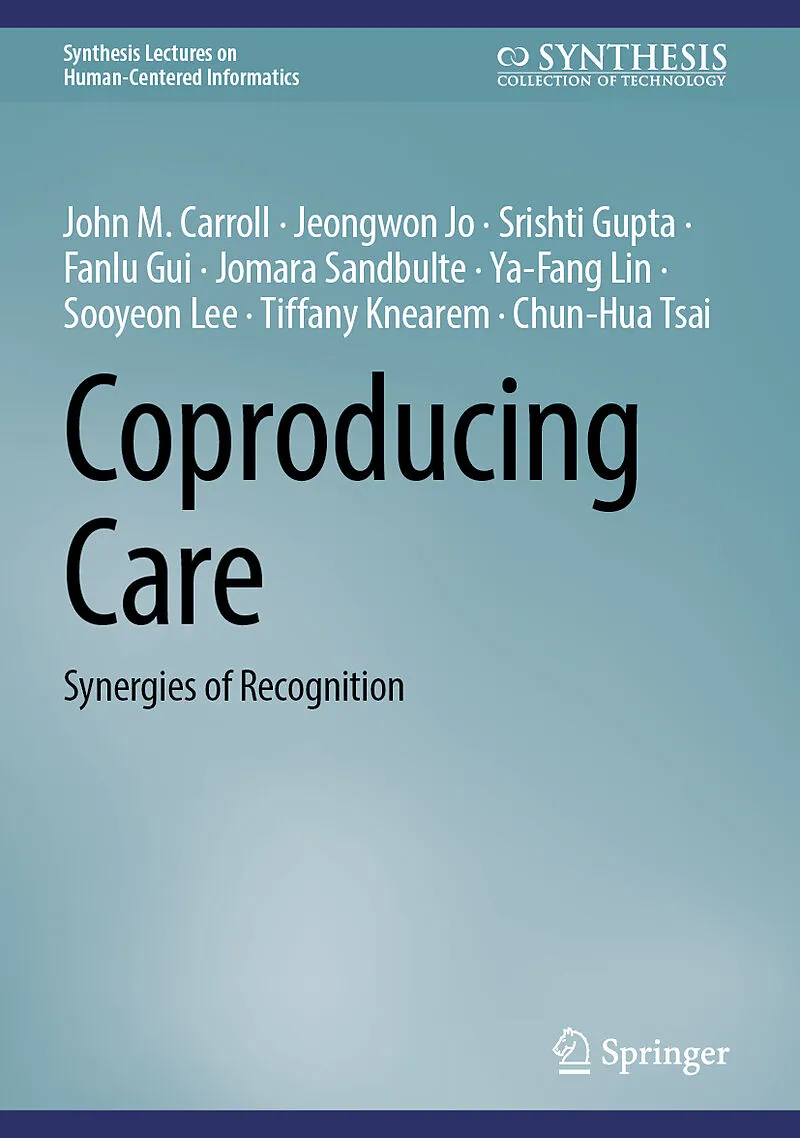
This book explores research around reciprocal participation in care activities across a variety of everyday settings from the perspective of HCI researchers. It challenges traditional conceptions of caregiving in which care is provided and received and highlights the synergistic outcomes that can be obtained when all participants are active contributors. Through diverse case studies, including family and local community dynamics, the book illustrates how coproduction can enhance the efficacy of care while also increasing the personal empowerment, community engagement, and social capital of those receiving, providing, and designing care services. The research posits that recognizing and leveraging the capacities of all stakeholders, including marginalized members, can lead to more effective and inclusive care system design and implementation. The book suggests that coproduction can reshape how care is perceived and delivered, and it proposes research practices for HCI practitioners and beyond for designing to facilitate such coproduction of care.
Seven case studies relating to a wide range of coproducing care situations are examined, including examining how stakeholders with different capacities coproduced overall well-being and childcare support in family dynamics and relating to local water quality, volunteer efforts, disaster relief programs, food security initiatives, and even beer-brewing events with collective settings. The book provides a comprehensive framework for understanding coproduced care, highlighting its benefits in fostering equality and agency among individuals and generating synergistic collective outcomes as a contrast to the traditional care delivery.
Provides a comprehensive framework for understanding coproduced care in contrast to the traditional care delivery model Emphasizes recognizing stakeholder needs and contributions to leverage the capacities of otherwise marginalized groups Explores care coproduction through case studies to showcase effective practices to maximize positive well-being outcomes
Autorentext
Janet E. Burge is an Assistant Professor at Miami University Computer Science and Systems Analysis Department. Her major research interests are in Software Engineering and Artificial Intelligence. Her primary research area is in Design Rationale, with a focus on Design Rationale for Software Maintenance. She received her PhD in Computer Science from WPI in 2005, her M.S in Computer Science from WPI in 1999, and her B.S. in Computer Science from Michigan Technological University in 1984. John M. Carroll is the Edward M. Frymoyer Chair Professor of Information Sciences and Technology at the Pennsylvania State University. His research interests include methods and theory in human-computer interaction, particularly as applied to networking tools for collaborative learning and problem solving, and the design of interactive information systems. He serves on several editorial boards for journals, handbooks, and series and is Editor-in-Chief of the ACM Transactions on Computer-Human Interactions. He received the Rigo Award and the CHI Lifetime Achievement Award from ACM, the Silver Core Award from IFIP, and the Alfred N. Goldsmith Award from IEEE. He is a fellow of the ACM, IEEE, and HFES. Raymond McCall is an Associate Professor in the Department of Planning and Design at the University of Colorado, Denver. His major areas of research are in design rationale methods and systems. Since 1992, most of his research has concentrated on the use of rationale to support the design of artifacts for human exploration of space. For much of this time he collaborated with NASA contractors and with employees of the Johnson Space Center in Houston. He has nearly 30 years of experience in design rationale usage in architectural design, planning, policy making and software design. He created the first hypertext systems for support of design rationale in the 1970s and 1980s and was the first to integrate support for rationale capture and delivery into 3Dcomputer-aided design systems. Ivan Mistrík is an independent consultant for software-intensive systems engineering. He has 40 years experience in both software and systems engineering as an information systems developer, R&D leader, research analyst, and ICT management consultant. He is the author or co-author of more than 80 articles and papers in international journals, conferences, books and workshops and was an editor of the Special Issue on "Relating Software Requirements and Architectures" published in 2005.
Klappentext
Introduction.- Coproducing Care in Everyday Life.- Discussion.
Inhalt
Introduction.- Coproducing Care in Everyday Life.- Discussion.