
IHR WARENKORB IST AKTUELL LEER.
Haben Sie noch nichts passendes gefunden? Stöbern Sie durch unser komplettes Sortiment.
Oder melden Sie sich an bzw. registrieren Sie sich.
- Kostenlose Lieferung
- Kauf auf Rechnung
- Ex Libris Tiefpreis
- Filiallieferung und 650+ Abholorte
- Rabatt-Bons als Club-Mitglied
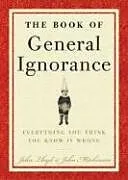
The Book of General Ignorance
Beschreibung
Zusatztext Trivia buffs and know-it-alls alike will exult to find so much repeatable wisdom gathered in one place. New York Times The Book of General Ignorance won't make you feel dumb. It's really a call to be more curious. The Associated Press Ignorance may ...Format auswählen
- Fester EinbandCHF 31.60

Wird oft zusammen gekauft
Andere Kunden kauften auch
Beschreibung
Zusatztext Trivia buffs and know-it-alls alike will exult to find so much repeatable wisdom gathered in one place. New York Times The Book of General Ignorance won't make you feel dumb. It's really a call to be more curious. The Associated Press Ignorance may be bliss! but so is learning surprising information. Hartford Courant You! too! can banish social awdwardness by having its endless count of facts and factoids at the ready. Or you could just read it and keep what you learned to yourself. Betcha can't. New York Daily News To impress friends with your cleverness! beg! borrow or buy John Lloyd and John Mitchinson's The Book of General Ignorance! an extraordinary collection of 230 common misperceptions compiled for the BBC panel game QI (Quite Interesting). Financial Times This book would make even Edison feel small and silly! for it offers answers to questions you never thought to ask or had no need of asking as you already knew! or thought you knew! the answer. The Economist Trivia books! like any kind of mental or physical addiction! are both irresistible and unsatisfying. By the standards of the genre! this one has something approaching the force of revelation. Answering silly questions suddenly seems less important than taking the trouble to ask a few. Melbourne Age Eye-watering! eyebrow-raising! terrific . . . moving slightly faster than your brain does! so that you haven't quite absorbed the full import of one blissful item of trivial information before two or three more come along. Such fine and creative research genuinely deserves to be captured in print. Daily Mail This UK bestseller redefines 'common knowledge' with factoids that will inform and entertain (or at least liven up your next cocktail party). OK! Magazine Informationen zum Autor JOHN LLOYD is the producer of the hit British comedy shows Not the Nine O'Clock News , Blackadder , and Spitting Image .JOHN MITCHINSON writes for the British television show QI , and drinks in the same pub as John Lloyd. Leseprobe What's the name of the tallest mountain in the world? Mauna Kea, the highest point on the island of Hawaii. The inactive volcano is a modest 13,799 feet above sea level, but when measured from the seabed to its summit, it is 33,465 feet high--about three-quarters of a mile taller than Mount Everest. As far as mountains are concerned, the current convention is that "highest" means measured from sea level to summit; "tallest" means measured from the bottom of the mountain to the top. So, while Mount Everest, at 29,029 feet is the highest mountain in the world, it is not the tallest. Measuring mountains is trickier than it looks. It's easy enough to see where the top is, but where exactly is the bottom of a mountain? For example, some argue that Mount Kilimanjaro in Tanzania--at 19,340 feet--is taller than Everest because it rises straight out of the African plain, whereas Everest is merely one of many peaks topping the enormous base of the Himalayas, shared by the world's next thirteen highest mountains. Others claim that the most logical measure ought to be the distance of a mountain's peak from the center of the Earth. Because the Earth is a flattened rather than a perfect sphere, the equator is about thirteen miles further from the center of the Earth than the poles. This is good news for the reputation of those mountains that are very close to the equator--like Mount Chimborazo in the Andes--but it also means accepting that even the beaches in Ecuador are higher than the Himalayas. Though massive, the Himalayas are surprisingly young. When they were formed, the dinosaurs had been dead f...
Autorentext
JOHN LLOYD is the producer of the hit British comedy shows Not the Nine O’Clock News, Blackadder, and Spitting Image.JOHN MITCHINSON writes for the British television show QI, and drinks in the same pub as John Lloyd.
Klappentext
The #1 British bestseller reveals all of the hugely entertaining misconceptions, mistakes, and misunderstandings in common knowledge.
Zusammenfassung
**NEW YORK TIMES BESTSELLER • A shockingly counterintuitive book of trivia that cuts through the misconceptions that most of us call “facts” to show how wrong we are about . . . well, everything.
**
“Trivia buffs and know-it-alls alike will exult to find so much repeatable wisdom gathered in one place.”—The New York Times
Think Magellan was the first man to circumnavigate the globe, baseball was invented in America, Henry VIII had six wives, Mount Everest is the tallest mountain? Wrong, wrong, wrong, and wrong again.
Challenging commonly held assumptions in areas like history, literature, science, nature, and more, The Book of General Ignorance is a witty “gotcha” compendium of verifiably true answers to seemingly easy questions, like:
**Who was the first American president?
**Peyton Randolph.
**How long can a chicken live without its head?
About two years.
How many legs does a centipede have?
Not a hundred.
How many toes does a two-toed sloth have?
**It’s either six or eight.
Check out The Book of General Ignorance for fun entries and complete answers to these and many more questions. You’ll be surprised at how much you don’t know!
Leseprobe
What's the name of the tallest mountain in the world?
Mauna Kea, the highest point on the island of Hawaii.
The inactive volcano is a modest 13,799 feet above sea level, but when measured from the seabed to its summit, it is 33,465 feet high--about three-quarters of a mile taller than Mount Everest.
As far as mountains are concerned, the current convention is that "highest" means measured from sea level to summit; "tallest" means measured from the bottom of the mountain to the top.
So, while Mount Everest, at 29,029 feet is the highest mountain in the world, it is not the tallest.
Measuring mountains is trickier than it looks. It's easy enough to see where the top is, but where exactly is the bottom of a mountain?
For example, some argue that Mount Kilimanjaro in Tanzania--at 19,340 feet--is taller than Everest because it rises straight out of the African plain, whereas Everest is merely one of many peaks topping the enormous base of the Himalayas, shared by the world's next thirteen highest mountains.
Others claim that the most logical measure ought to be the distance of a mountain's peak from the center of the Earth.
Because the Earth is a flattened rather than a perfect sphere, the equator is about thirteen miles further from the center of the Earth than the poles.
This is good news for the reputation of those mountains that are very close to the equator--like Mount Chimborazo in the Andes--but it also means accepting that even the beaches in Ecuador are higher than the Himalayas.
Though massive, the Himalayas are surprisingly young. When they were formed, the dinosaurs had been dead for twenty-five million years.
In Nepal, Everest is known as Chomolungma (Mother of the Universe). In Tibet, it is called Sagamartha (Forehead of the Sky). Like any healthy youngster, it is still growing, at the not very exciting rate of less than a quarter of an inch a year.
How do moths feel about flames?
They're not attracted to them. They are disoriented by them.
Apart from the odd forest fire, artificial light sources have been in existence for an extremely short time in comparison with the age of the relationship between moths and the sun and moon. Many insects use these light sources to navigate by day and night.
Because the moon and sun are a long way away, insects have evolved to expect the light from them to strike their eyes in the same place at different times of day or night, enabling them to calculate how to fly in a straight line.
When people come along with their…