
IHR WARENKORB IST AKTUELL LEER.
Haben Sie noch nichts passendes gefunden? Stöbern Sie durch unser komplettes Sortiment.
Oder melden Sie sich an bzw. registrieren Sie sich.
- Kostenlose Lieferung
- Kauf auf Rechnung
- Ex Libris Tiefpreis
- Filiallieferung und 650+ Abholorte
- Rabatt-Bons als Club-Mitglied
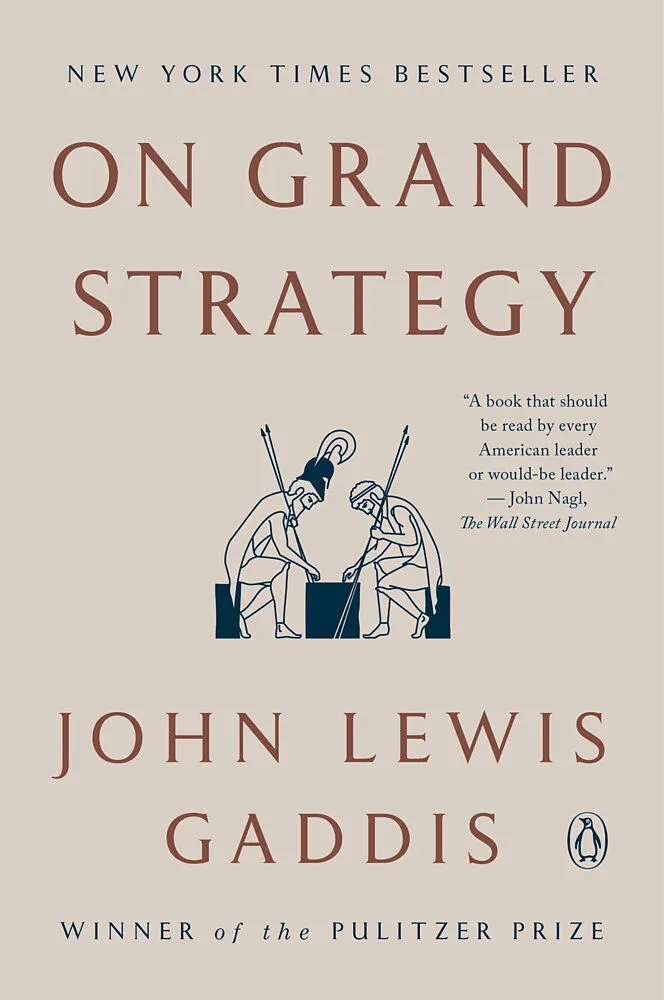
On Grand Strategy
Beschreibung
A master class in strategic thinking, distilled from the legendary program the author has co-taught at Yale for decades For almost two decades, Yale students have competed for admission each year to the "Studies in Grand Strategy" seminar taught by John Lewis ...Format auswählen
- Kartonierter EinbandCHF 17.95
- Fester EinbandCHF 29.85

Wird oft zusammen gekauft
Andere Kunden kauften auch
Beschreibung
A master class in strategic thinking, distilled from the legendary program the author has co-taught at Yale for decades For almost two decades, Yale students have competed for admission each year to the "Studies in Grand Strategy" seminar taught by John Lewis Gaddis, Paul Kennedy, and Charles Hill. Its purpose has been to prepare future leaders for responsibilities they will face, through lessons drawn from history and the classics. Now Gaddis has distilled that teaching into a succinct, sharp and potentially transformational book, surveying statecraft from the ancient Greeks to Franklin D. Roosevelt and beyond. An unforgettable guide to the art of leadership, On Grand Strategy is, in every way, its own master class.
Autorentext
John Lewis Gaddis is the Robert A. Lovett Professor of History at Yale University, and was the founding director of the Brady-Johnson Program in Grand Strategy. His previous books include The United States and the Origins of the Cold War; Strategies of Containment; The Long Peace; We Now Know; The Landscape of History; Surprise, Security, and the American Experience; and The Cold War: A New History. Professor Gaddis teaches courses on Cold War history, grand strategy, biography, and historical methodology. He has won two undergraduate teaching awards at Yale and was a 2005 recipient of the National Humanities Medal. His George F. Kennan: An American Life won the 2012 Pulitzer Prize in Biography.
Zusammenfassung
**“The best education in grand strategy available in a single volume . . . a book that should be read by every American leader or would-be leader.”—The Wall Street Journal
A master class in strategic thinking, distilled from the legendary program the author has co-taught at Yale for decades**
John Lewis Gaddis, the distinguished historian of the Cold War, has for almost two decades co-taught grand strategy at Yale University with his colleagues Charles Hill and Paul Kennedy. Now, in On Grand Strategy, Gaddis reflects on what he has learned. In chapters extending from the ancient world through World War II, Gaddis assesses grand strategic theory and practice in Herodotus, Thucydides, Sun Tzu, Octavian/Augustus, St. Augustine, Machiavelli, Elizabeth I, Philip II, the American Founding Fathers, Clausewitz, Tolstoy, Lincoln, Wilson, Franklin D. Roosevelt, and Isaiah Berlin. On Grand Strategy applies the sharp insights and wit readers have come to expect from Gaddis to times, places, and people he’s never written about before. For anyone interested in the art of leadership, On Grand Strategy is, in every way, a master class.
Leseprobe
CROSSING THE HELLESPONT
The date is 480 B.C.E. The place is Abydos, the town on the Asian side of the Hellespont where it narrows to just over a mile in width. The scene is worthy of Hollywood in its heyday. Xerxes, Persia’s King of Kings, ascends a throne on a promontory from which he can see armies assembled, the historian Herodotus tells us, of over a million and a half men. Had the number been only a tenth of that, as is more likely, it would still have approximated the size of Eisenhower’s forces on D-day in 1944. The Hellespont has no bridge now, but Xerxes had two then: one rested on 360 boats lashed together, the other on 314, both curved to accommodate winds and currents. For after an earlier bridge had broken apart in a storm, the furious king beheaded the builders and ordered the waters themselves whipped and branded. Somewhere on the bottom there presumably lie, to this day, the iron fetters he had thrown in for good measure.
On that day, though, the waters are calm and Xerxes is content— until he bursts into tears. His adviser and uncle Artabanus asks why. “Here are all these thousands,” the king replies, “and not one of them will be alive a hundred years from now.” Artabanus consoles his master by reminding him of all the calamities that can make life intolerable and death a relief. Xerxes acknowledges this, but demands: “Tell me the very truth.” Would Artabanus have favored the task at h and—a second Persian invasion of Greece in just over a d ecade— had they not both had the same frightening dream? Now it’s Artabanus who shudders: “I am still full, nay overfull, of fear.”
Xerxes’ dream had come twice after Artabanus dissuaded him from avenging the Greeks’ humiliation of Darius, Xerxes’ father, at Marathon ten years earlier. As if in anticipation of Hamlet— still two millennia into the f uture—a n apparition, regal in aspect, paternal in attitude, had issued an ultimatum: “[I]f you do not launch your war at o nce, . . . just as a short while raised you to be great and mighty, so with speed again shall you be humble.” Artabanus at first scoffed at the dream’s significance, whereupon Xerxes made him trade clothes and sleep in the royal bed. The specter reappeared, so terrifying Artabanus that he woke up screaming, instantly urging the new invasion. Xerxes then gave the orders, the great force gathered at Sardis, sacrificed a thousand heifers at the ruins of Troy, arrived at the Hellespont, found the bridges ready, and was preparing to cross them when the king allowed his uncle one last chance to voice whatever reservations he might yet have.
Artabanus, despite his nightmare, can’t resist. The enemies ahead, he warns, will not just be Greeks, formidable fighters though they are: they’ll also include the land and the sea. The march around the Aegean will traverse territories incapable of feeding so large an army. There won’t be enough harbors to shelter ships if storms arise.
Exhaustion, even starvation, could set in before fighting a single battle. The prudent leader “dreads and reflects on everything that can happen to him but is bold when he is in the thick of action.” Xerxes listens patiently, but objects that “if you were to take account of e. . . , you would never do anything. It is better to have a brave heart and endure one half of the terrors we dread than to [calculate] all of the terrors and suffer nothing at all. . . . Big things are won by big dangers.”
That settles it. Xerxes sends Artabanus back to rule the existing empire, while turning his own attention to doubling its extent. He prays to the sun for the strength to conquer not just Greece, but all of Europe. He has myrtle branches strewn before the bridges. He orders his priests to burn incense. And he rewards the Hellespont by pouring into it a libation, followed by the golden cup that contained it, followed by the golden bowl in which it was mixed, followed as well by a sword. This clears the way for the crossing, which takes seven days and nights to complete. As Xerxes himself reaches the European shore, an awed bystander is heard asking why Zeus has disguised himself as the Persian monarch, bringing along “all the people of the world?” Could the god not have destroyed Greece on his own?
I.
Two thousand four hundred and nineteen years later, an Oxford don took a break from tutorials to go to a party. Thirty at the time, Isaiah Berlin had been born in Riga, brought up in St. Petersburg, and, after witnessing the Bolshevik Revolution at the age of eight, emigrated with his family to England. There he thrived, mastering the new language through a thicket of accents that never left him, triumphing in his Oxford examinations, and becoming the first Jew ever elected to an All Souls College fellowship. By 1939 he was teaching philosophy at New College (established in 1379), developing an aversion to logical positivism (nothing means anything without reproducible verification), and hugely enjoying life.
A glittering conversationalist w…