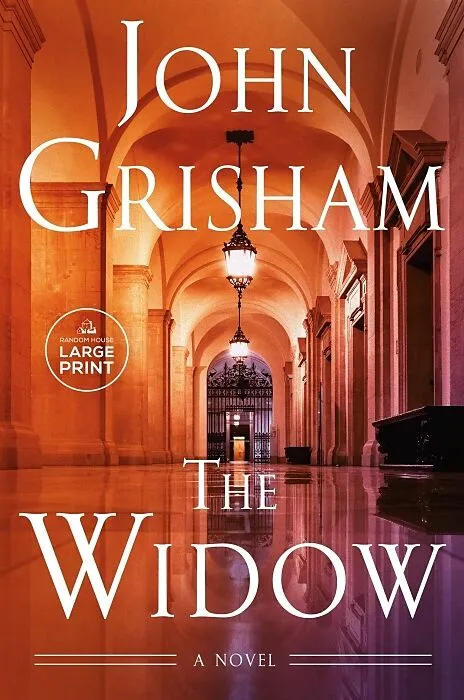
The Widow
Beschreibung
Coming this Fall from Doubleday, and imprint of the Knopf Doubleday Publishing Group. Autorentext John Grisham Klappentext #1 NEW YORK TIMES BESTSELLER • John Grisham is the acclaimed master of the legal thriller. Now, he’s back with his first-ever ...Format auswählen
- Kartonierter EinbandCHF 36.40
Wird oft zusammen gekauft
Andere Kunden kauften auch
Beschreibung
Coming this Fall from Doubleday, and imprint of the Knopf Doubleday Publishing Group.
Autorentext
John Grisham
Klappentext
#1 NEW YORK TIMES BESTSELLER • John Grisham is the acclaimed master of the legal thriller. Now, he’s back with his first-ever whodunit, even more suspenseful than his courtroom dramas, as a small-time lawyer accused of murder races to find the real killer to clear his name.
“A classic, compulsive, taut and thrilling novel from one of the great storytellers of our time. The Widow is John Grisham at his irresistible, unforgettable best.”—Chris Whitaker, author of All the Colors of the Dark
Simon Latch is a lawyer in rural Virginia, making just enough to pay his bills while his marriage slowly falls apart. Then into his office walks Eleanor Barnett, an elderly widow in need of a new will. Apparently, her husband left her a small fortune, and no one knows about it.
Once he hooks the richest client of his career, Simon works quietly to keep her wealth under the radar. But soon her story begins to crack. When she is hospitalized after a car accident, Simon realizes that nothing is as it seems, and he finds himself on trial for a crime he swears he didn’t commit: murder.
Simon knows he’s innocent. But he also knows the circumstantial evidence is against him, and he could spend the rest of his life behind bars. To save himself, he must find the real killer….
Leseprobe
Chapter 1
The clients drawn to the quaint little law office at the corner of Main and Maple brought problems that Simon was tired of. Bankruptcies, drunk driving charges, delinquent child support, foreclosures, nickel-and-dime car wrecks, suspicious slip-and-falls, dubious claims of disabilities—the stock-in-trade of a run-of-the-mill street lawyer whose law school dreams of riches had faded so dim they were almost gone. Eighteen years into the grind and Simon F. Latch, Attorney and Counselor (both) at Law, was burning out. He was weary of other people’s problems.
Occasionally there was a break in the misery when an aging client needed some estate work, like an updated last will and testament. These were almost always uncomplicated matters that any first-year law student could handle, regardless of how somber Simon tried to make them. For only $250, he could write, or “draft” as he preferred to say, a three-page simple will, print it on heavy gold bond paper, get it notarized by his “staff,” and convey the impression that the client was “executing” something profound.
The truth was half of them didn’t even need a will, regardless of how simple, though no lawyer in the history of American jurisprudence had ever said so to a paying client. It was also true that the $250 fee was a rip-off because the internet was filled with free simple wills that were just as binding. It was also true that Mr. Latch would hardly touch the will. Matilda, his secretary, filled in the blanks and printed the important documents.
The current client was Ms. Eleanor Barnett, age eighty-five, a widow who lived alone in a modest suburban home she and her late second husband had purchased ten years earlier. She had no children, though Harry Korsak, her last husband, had two sons from a bad first marriage and had tried for years to convince Eleanor, his beloved second wife, to adopt the pair for various reasons, none of which appealed to her because, as she confided to Matilda during their lengthy second phone chat, she loathed the boys. They were nothing but trouble.
“And do you have a mortgage on your home?” Matilda had asked, politely interrupting the beginning of what promised to be a windy narrative about the two sorry sons.
No. The house was paid for, as was the car. There were no debts. Harry Korsak had been quite frugal, a child of Depression-era parents, you know, and simply hated the idea of debt. Between phone calls, Matilda did her usual internet checking and learned that the home, as assessed by the county for $280,000, was indeed free of liens, and the car, a fifteen-year-old Lincoln, was also unencumbered. Digging a bit deeper, she found a rap sheet for Clyde Korsak, the elder of the two un-adopted sons. Decades earlier he had been caught peddling cocaine and spent four years in prison.
Ms. Barnett would not discuss any more financial matters over the phone, said she’d rather wait until her meeting with Mr. Latch. She arrived promptly at 2 p.m., dressed like a mildly affluent old lady on her way to church. Matilda had seen a thousand of them come and go, and she sized her up immediately as she poured coffee into a fine china cup she kept around for the old gals. Most clients got paper cups. Ms. Barnett walked just fine, no cane, no tottering, a good stride and nice gait, and she sat properly in a reception chair and sipped her coffee, pinkie in the air, a clear sign of either good manners or a trace of snobbery. From all outward appearances, she was in good shape physically, probably had another decade to go before her new last will and testament would be called into action.
After a few minutes, Matilda announced that Mr. Latch was finished with his “judicial conference call” and would like to see her. She led Ms. Barnett down a short hallway and into the conference room where the dark walls were lined with thick law books Mr. Latch hadn’t touched in years.
Simon’s goal was to be rid of her in thirty minutes. Add another thirty next week when the new will was properly signed, and he would earn, in theory, his hourly rate of $250. A good friend from law school was currently billing four times that much in a Washington tax firm, but Simon tried not to think about such things. Over the years he had almost convinced himself that his quality of life in the small town of Braxton, Virginia, was far better, money be damned.
He turned on the charm, as he always did with the older women, and knew right away that she was smitten. “That’s a lovely necklace,” he said, fawning.
She smiled and flashed a mouth full of natural, yellow teeth. “Why, thank you.”
“I see from the notes that you are single, live alone, and have no children or grandchildren. Two husbands, both deceased.” He scanned Matilda’s report as if reading the Magna Carta.
“And you kept the name Barnett after you married Mr. Korsak.”
“Well, not exactly. After Harry died I decided to go back to ‘Barnett.’ I never really liked the name Korsak, you know? Between the two of us, I enjoyed Vince Barnett a lot more than Harry Korsak. Vince and I were childhood sweethearts, you know, married young and sort of grew up together. We were younger and more romantically active, know what I mean?”
Simon knew exactly what she meant and had no desire to explore further. “Do you have a current will?”
“They don’t expire, do they?”
“Well, no, they don’t.”
“Yes, but I have doubts about it. I’d like to do a new one, and I want to hire you as my attorney for other matters. On a retainer.”
“What other matters concern you?”
“Oh, well, one never knows, especially nowadays with so much fraud and scamming out there. Senior citizens are the favorite targets. It’s just awful how many of them lose everything. I want to be protected, and I want you kept on retainer to review things for me. My friend Doris always keeps a lawyer on retainer.”
At the moment, Simon could think of nothing worse than being at the beck and call of an elderly client who thought she was being scammed. But if she insisted, then $1,000 might be a fair arrangement.
“How much is her retainer?&rd…