
IHR WARENKORB IST AKTUELL LEER.
Haben Sie noch nichts passendes gefunden? Stöbern Sie durch unser komplettes Sortiment.
Oder melden Sie sich an bzw. registrieren Sie sich.
- Kostenlose Lieferung
- Kauf auf Rechnung
- Ex Libris Tiefpreis
- Filiallieferung und 650+ Abholorte
- Rabatt-Bons als Club-Mitglied
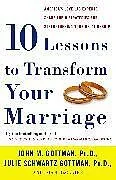
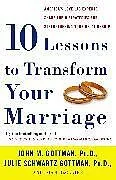
Ten Lessons to Transform Your Marriage
Beschreibung
Informationen zum Autor John M. Gottman, Ph.D., Julie Schwartz Gottman, Ph.D., and Joan DeClaire Klappentext In Ten Lessons to Transform Your Marriage, marital psychologists John and Julie Gottman provide vital tools-scientifically based and empirically verifi...Format auswählen
- BroschiertCHF 20.00

Wird oft zusammen gekauft
Andere Kunden kauften auch
Beschreibung
Informationen zum Autor John M. Gottman, Ph.D., Julie Schwartz Gottman, Ph.D., and Joan DeClaire Klappentext In Ten Lessons to Transform Your Marriage, marital psychologists John and Julie Gottman provide vital tools-scientifically based and empirically verified-that you can use to regain affection and romance lost through years of ineffective communication. In 1994, Dr. John Gottman and his colleagues at the University of Washington made a startling announcement: Through scientific observation and mathematical analysis, they could predict-with more than 90 percent accuracy-whether a marriage would succeed or fail. The only thing they did not yet know was how to turn a failing marriage into a successful one, so Gottman teamed up with his clinical psychologist wife, Dr. Julie Schwartz Gottman, to develop intervention methods. Now the Gottmans, together with the Love Lab research facility, have put these ideas into practice. What emerged from the Gottmans' collaboration and decades of research is a body of advice that's based on two surprisingly simple truths: Happily married couples behave like good friends, and they handle their conflicts in gentle, positive ways. The authors offer an intimate look at ten couples who have learned to work through potentially destructive problems-extramarital affairs, workaholism, parenthood adjustments, serious illnesses, lack of intimacy-and examine what they've done to improve communication and get their marriages back on track. Hundreds of thousands have seen their relationships improve thanks to the Gottmans' work. Whether you want to make a strong relationship more fulfilling or rescue one that's headed for disaster, Ten Lessons to Transform Your Marriage is essential reading.Introduction From Predicting Divorce to Preventing It: An Introductory Message from John and Julie Gottman It's been more than a decade since John and his colleagues at the University of Washington (UW) first announced their discovery: Through the power of careful observation and mathematical analysis, the team had learned to predict with more than 90 percent accuracy whether a married couple would stay together or eventually divorce. This discovery captured the imagination of many. If research psychologists could now pinpoint specific behaviors that lead to divorce, then perhaps people in troubled relationships could change those behaviors and save their marriages.But as any weatherman can tell you, the ability to predict trouble is not the same as the ability to prevent it. It's one thing to detect a storm brewing on radar; it's quite another to make those storm clouds disappear. And yet that's the kind of work we at the Gottman Institute have been doing. Since 1994 we've been developing tools to help couples identify problems that are proven to destroy relationshipsand to turn those problems around. By experimenting with various forms of therapy, we've been learning how to help husbands and wives improve their marriages and prevent divorce. Through our workshops, therapy sessions, and books, couples are gaining the tools they need to build stronger friendships and manage their conflicts. As a result, they are learning to work through a whole host of problems common to marriageproblems such as these: •the stress of caring for a new baby •exhaustion from working too hard •loss of interest in sex and romance •health problems •recovering from an extramarital affair •struggles with depression •arguments over housework and finances •changes that come with retirement •the loss of a job, an identity, or a lifelong dream And once again we're achieving some exciting results. Our studies show that 86 percent of people who complete our marriage workshops say they make si...
Autorentext
John M. Gottman, Ph.D., Julie Schwartz Gottman, Ph.D., and Joan DeClaire
Klappentext
In Ten Lessons to Transform Your Marriage, marital psychologists John and Julie Gottman provide vital tools-scientifically based and empirically verified-that you can use to regain affection and romance lost through years of ineffective communication.
In 1994, Dr. John Gottman and his colleagues at the University of Washington made a startling announcement: Through scientific observation and mathematical analysis, they could predict-with more than 90 percent accuracy-whether a marriage would succeed or fail. The only thing they did not yet know was how to turn a failing marriage into a successful one, so Gottman teamed up with his clinical psychologist wife, Dr. Julie Schwartz Gottman, to develop intervention methods. Now the Gottmans, together with the Love Lab research facility, have put these ideas into practice.
What emerged from the Gottmans' collaboration and decades of research is a body of advice that's based on two surprisingly simple truths: Happily married couples behave like good friends, and they handle their conflicts in gentle, positive ways. The authors offer an intimate look at ten couples who have learned to work through potentially destructive problems-extramarital affairs, workaholism, parenthood adjustments, serious illnesses, lack of intimacy-and examine what they've done to improve communication and get their marriages back on track.
Hundreds of thousands have seen their relationships improve thanks to the Gottmans' work. Whether you want to make a strong relationship more fulfilling or rescue one that's headed for disaster, Ten Lessons to Transform Your Marriage is essential reading.
Zusammenfassung
In Ten Lessons to Transform Your Marriage, marital psychologists John and Julie Gottman provide vital tools—scientifically based and empirically verified—that you can use to regain affection and romance lost through years of ineffective communication.
In 1994, Dr. John Gottman and his colleagues at the University of Washington made a startling announcement: Through scientific observation and mathematical analysis, they could predict—with more than 90 percent accuracy—whether a marriage would succeed or fail. The only thing they did not yet know was how to turn a failing marriage into a successful one, so Gottman teamed up with his clinical psychologist wife, Dr. Julie Schwartz Gottman, to develop intervention methods. Now the Gottmans, together with the Love Lab research facility, have put these ideas into practice.
What emerged from the Gottmans’ collaboration and decades of research is a body of advice that’s based on two surprisingly simple truths: Happily married couples behave like good friends, and they handle their conflicts in gentle, positive ways. The authors offer an intimate look at ten couples who have learned to work through potentially destructive problems—extramarital affairs, workaholism, parenthood adjustments, serious illnesses, lack of intimacy—and examine what they’ve done to improve communication and get their marriages back on track.
Hundreds of thousands have seen their relationships improve thanks to the Gottmans’ work. Whether you want to make a strong relationship more fulfilling or rescue one that’s headed for disaster, Ten Lessons to Transform Your Marriage is essential reading.
Leseprobe
Introduction
From Predicting Divorce to Preventing It: An Introductory Message from John and Julie Gottman
It’s been more than a decade since John and his colleagues at the University of Washington (UW) first announced their discovery: Through the power of careful observation and mathematical analysis, the team had learned to predict with more than 90 percent accuracy whether a married couple would stay together or eventually divorce. This discovery captured the imagination of many. If research psychologists could now pinpoint specific behaviors that lead to divorce, then perhaps people in troubled relationships could change those b…