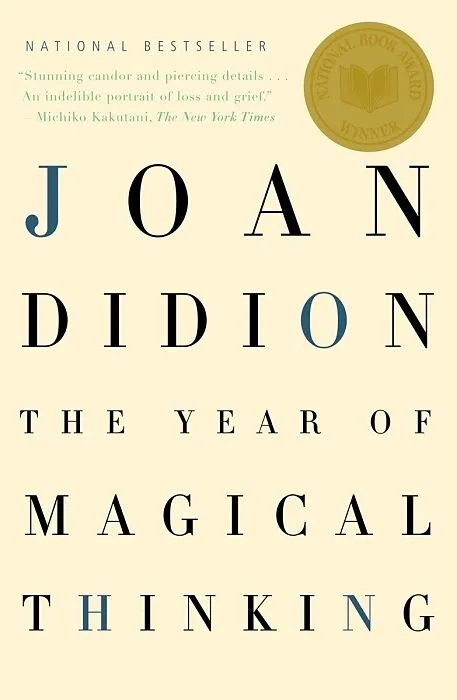
The Year of Magical Thinking
Beschreibung
Zusatztext Thrilling . . . a living! sharp! and memorable book. . . . An exact! candid! and penetrating account of personal terror and bereavement . . . sometimes quite funny because it dares to tell the truth. Robert Pinsky! The New York Times Book Review Stu...Format auswählen
- Kartonierter EinbandCHF 19.50
- Livre ReliéCHF 31.60

Wird oft zusammen gekauft
Andere Kunden kauften auch
Beschreibung
Zusatztext Thrilling . . . a living! sharp! and memorable book. . . . An exact! candid! and penetrating account of personal terror and bereavement . . . sometimes quite funny because it dares to tell the truth. Robert Pinsky! The New York Times Book Review Stunning candor and piercing details. . . . An indelible portrait of loss and grief. Michiko Kakutani! The New York Times I can't think of a book we need more than hers. . . . I can't imagine dying without this book. John Leonard! New York Review of Books Achingly beautiful. . . . We have come to admire and love Didion for her preternatural poise! unrivaled eye for absurdity! and Orwellian distaste for cant. It is thus a difficult! moving! and extraordinarily poignant experience to watch her direct such scrutiny inward. Gideon Lewis-Kraus! Los Angeles Times An act of consummate literary bravery! a writer known for her clarity allowing us to watch her mind as it becomes clouded with grief. . . . It also skips backward in time [to] call up a shimmering portrait of her unique marriage. . . . To make her grief real! Didion shows us what she has lost. Lev Grossman! Time Informationen zum Autor Joan Didion Klappentext NEW YORK TIMES BESTSELLER • NATIONAL BOOK AWARD WINNER • A landmark work about grief, love, and survival from one of America's most iconic writers One of The New York Times 's 100 Best Books of the 21st Century • One of The Guardian 's 100 Best Books of the 21st Century Joan Didion delivers a searing portrait of a marriage and a life in good times and bad that will speak to anyone who has ever loved and lost a husband or wife or child. In a work of electric honesty and passion, Didion explores how we all, somehow, will ourselves to survive. An utterly shattering portrait of loss and grief. The New York Times S everal days before Christmas 2003, John Gregory Dunne and Joan Didion saw their only daughter, Quintana Roo, fall ill with septic shock. She was put into an induced coma and placed on life support. Days later, the Dunnes were sitting down to dinner after visiting their daughter in the hospital when John suffered a fatal heart attack. In that one moment, their partnership of forty years came to an end. This powerful narrative is Didion's attempt to make sense of the weeks and then months that cut loose any fixed idea I ever had about death, about illnessabout marriage and children and memoryabout the shallowness of sanity, about life itself. Didion has transformed grief into literature. The Guardian Chapter 1 1. Life changes fast.Life changes in the instant.You sit down to dinner and life as you know it ends.The question of self-pity. Those were the first words I wrote after it happened. The computer dating on the Microsoft Word file (Notes on change.doc) reads May 20, 2004, 11:11 p.m., but that would have been a case of my opening the file and reflexively pressing save when I closed it. I had made no changes to that file in May. I had made no changes to that file since I wrote the words, in January 2004, a day or two or three after the fact.For a long time I wrote nothing else. Life changes in the instant.The ordinary instant. At some point, in the interest of remembering what seemed most striking about what had happened, I considered adding those words, the ordinary instant. I saw immediately that there would be no need to add the word ordinary, because there would be no forgetting it: the word never left my mind. It was in fact the ordinary nature of everything preceding the event that prevented me from truly believing it had happened, absorbing it, incorporating it, getting past it. I recognize now that there was nothing unusual in this: confronted with s...
#8220;Thrilling . . . a living, sharp, and memorable book. . . . An exact, candid, and penetrating account of personal terror and bereavement . . . sometimes quite funny because it dares to tell the truth.”
—Robert Pinsky, The New York Times Book Review
“Stunning candor and piercing details. . . . An indelible portrait of loss and grief.”
—Michiko Kakutani, The New York Times
“I can’t think of a book we need more than hers. . . . I can’t imagine dying without this book.”
—John Leonard, New York Review of Books
“Achingly beautiful. . . . We have come to admire and love Didion for her preternatural poise, unrivaled eye for absurdity, and Orwellian distaste for cant. It is thus a difficult, moving, and extraordinarily poignant experience to watch her direct such scrutiny inward.”
—Gideon Lewis-Kraus, Los Angeles Times
“An act of consummate literary bravery, a writer known for her clarity allowing us to watch her mind as it becomes clouded with grief. . . . It also skips backward in time [to] call up a shimmering portrait of her unique marriage. . . . To make her grief real, Didion shows us what she has lost.”
—Lev Grossman, Time
Autorentext
Joan Didion
Klappentext
NEW YORK TIMES BESTSELLER • NATIONAL BOOK AWARD WINNER • A landmark work about grief, love, and survival from one of America’s most iconic writers
One of The New York Times’s 100 Best Books of the 21st Century • One of The Guardian’s 100 Best Books of the 21st Century
Joan Didion delivers a searing portrait of a marriage and a life – in good times and bad – that will speak to anyone who has ever loved and lost a husband or wife or child. In a work of electric honesty and passion, Didion explores how we all, somehow, will ourselves to survive. “An utterly shattering portrait of loss and grief.” –The New York Times***
***Several days before Christmas 2003, John Gregory Dunne and Joan Didion saw their only daughter, Quintana Roo, fall ill with septic shock. She was put into an induced coma and placed on life support. Days later, the Dunnes were sitting down to dinner after visiting their daughter in the hospital when John suffered a fatal heart attack. In that one moment, their partnership of forty years came to an end.
This powerful narrative is Didion's “attempt to make sense of the weeks and then months that cut loose any fixed idea I ever had about death, about illness…about marriage and children and memory…about the shallowness of sanity, about life itself.”
“Didion has transformed grief into literature.” —The Guardian
Leseprobe
Chapter 1 1.*Life changes fast.Life changes in the instant.You sit down to dinner and life as you know it ends.The question of self-pity.*Those were the first words I wrote after it happened. The computer dating on the Microsoft Word file (“Notes on change.doc”) reads “May 20, 2004, 11:11 p.m.,” but that would have been a case of my opening the file and reflexively pressing save when I closed it. I had made no changes to that file in May. I had made no changes to that file since I wrote the words, in January 2004, a day or two or three after the fact.For a long time I wrote nothing else.*Life changes in the instant.The ordinary instant.*At some point, in the interest of remembering what seemed most striking about what had happened, I considered adding those words, “the ordinary instant.” I saw immediately that there would be no need to add the word “ordinary,” because there would be no forgetting it: the word never left my mind. It was in fact the ordinary nature of everything preceding the event that prevented me from truly believing it had happened, absorbing it, incorporating it, getting past it. I recognize now that there was nothing unusual in this: confronted with sudden disaster we all focus on how unremarkable the circumstances were in which the unthinkable occurred, the clear blue sky from which the plane fell, the routine errand that ended…