Beschreibung
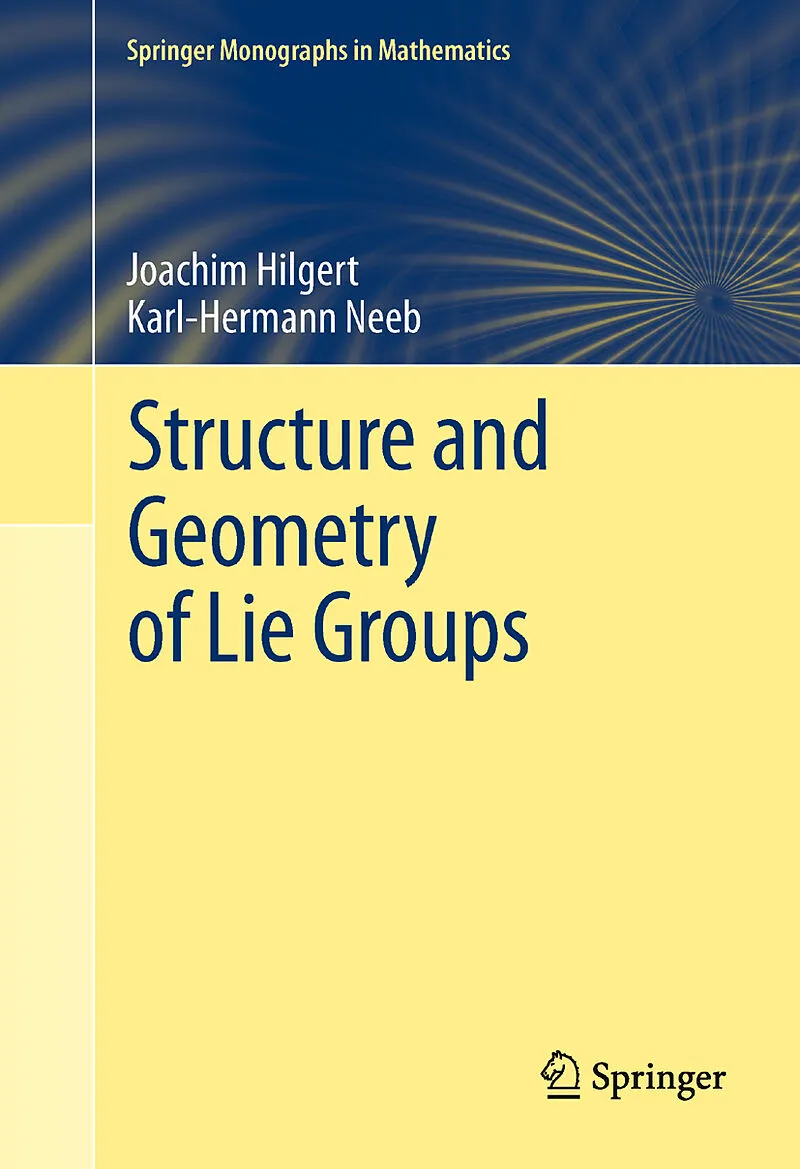
This book introduces Lie groups and their actions on manifolds and provides in-depth applications of fundamental principles, while remaining accessible to a range of mathematicians and graduate students. Includes appendices on theory and multilinear algebra. T...This book introduces Lie groups and their actions on manifolds and provides in-depth applications of fundamental principles, while remaining accessible to a range of mathematicians and graduate students. Includes appendices on theory and multilinear algebra.
This textbook is ideal for advanced undergraduate or first-graduate students who want to learn the fundamentals of Lie groups. It covers the principles behind the theory and includes numerous applications and examples. The author's approach is unique - where some texts develop Lie group theory from matrix groups, differential geometry plays a more prominent role in this book. Most students will not have a background in differential geometry and for that reason, the authors have included an introduction to the topic that begins at the ground level. Each section engages the reader in an in-depth instruction on some of the most important, yet basic principles of Lie theory. In addition to these core topics, the authors include more recent research.
Students gain the ability to work through problems following the basic principles of Lie theory, understand references to Lie theoretic concepts, and easily move on to more advanced topics.
Systematically presents the structure theory of general, unrestricted Lie groups Self-contained, with two appendices on covering theory and multilinear algebra Includes abundant classroom-tested exercises Useful as both a graduate text and as a research reference for a broad range of mathematicians Includes supplementary material: sn.pub/extras
Klappentext
This text is designed as an introduction to Lie groups and their actions on manifolds, one that is accessible both to a broad range of mathematicians and to graduate students. Building on the authors' Lie-Gruppen und Lie-Algebren textbook from 1991, it presents the fundamental principles of Lie groups while incorporating the past 20 years of the authors' teaching and research, and giving due emphasis to the role played by differential geometry in the field. The text is entirely self contained, and provides ample guidance to students with the presence of many exercises and selected hints.
The work begins with a study of matrix groups, which serve as examples to concretely and directly illustrate the correspondence between groups and their Lie algebras. In the second part of the book, the authors investigate the basic structure and representation theory of finite dimensional Lie algebras, such as the rough structure theory relevant to the theorems of Levi and Malcev, the fine structure of semisimple Lie algebras (root decompositions), and questions related to representation theory. In the third part of the book, the authors turn to global issues, most notably the interplay between differential geometry and Lie theory. Finally, the fourth part of the book deals with the structure theory of Lie groups, including some refined applications of the exponential function, various classes of Lie groups, and structural issues for general Lie groups. To round out the book's content, several appendices appear at the end of this last part.
Containing a wealth of useful information, including new results, Structure and Geometry of Lie Groups provides a unique perspective on the study of Lie groups and is a valuable addition to the literature. Prerequisites are generally kept to a minimum, and various pedagogical features make it an excellent supplemental text for graduate students. However, the work also contains much that will beof interest to more advanced audiences, and can serve as a useful research reference in the field.
Inhalt
Preface.- 1 Introduction.- Part I Matrix Groups.- 2 Concrete Matrix Groups.- 3 The Matrix Exponential Function.- 4 Linear Lie Groups.- Part II Lie Algebras.- 5 Elementary Structure Theory of Lie Algebras.- 6 Root Decomposition.- 7 Representation Theory of Lie Algebras.- Part III Manifolds and Lie Groups.- 8 Smooth Manifolds.- 9 Basic Lie Theory.- 10 Smooth Actions of Lie Groups.- Part IV Structure Theory of Lie Groups.- 11 Normal Subgroups, Nilpotemt and Solvable Lie Groups.- 12 Compact Lie Groups.- 13 Semisimple Lie Groups.- 14 General Structure Theory.- 15 Complex Lie Groups.- 16 Linearity of Lie Groups.- 17 Classical Lie Groups.- 18 Nonconnected Lie Groups.- Part V Appendices.- A Basic Covering Theory.- B Some Multilinear Algebra.- C Some Functional Analysis.- D Hints to Exercises.- References.- Index.