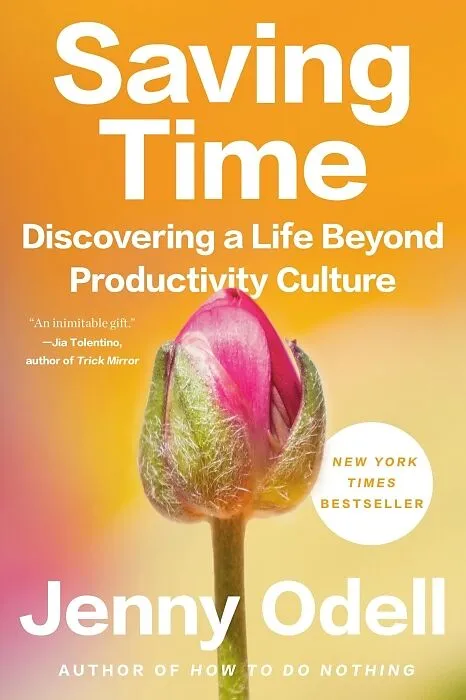
Saving Time
Beschreibung
Informationen zum Autor Jenny Odell is a multidisciplinary artist and author. Her first book How to Do Nothing: Resisting the Attention Economy was the New York Times bestseller. Her writing has appeared in The Atlantic, The New York Times, Sierra magazine, an...Format auswählen
- Kartonierter EinbandCHF 21.10
Wird oft zusammen gekauft
Andere Kunden kauften auch
Beschreibung
Informationen zum Autor Jenny Odell is a multidisciplinary artist and author. Her first book How to Do Nothing: Resisting the Attention Economy was the New York Times bestseller. Her writing has appeared in The Atlantic, The New York Times, Sierra magazine, and other publications. She lives in Oakland, California. Klappentext NEW YORK TIMES BESTSELLER • The visionary author of How to Do Nothing returns to challenge the notion that 'time is money.' . . . Expect to feel changed by this radical way of seeing. Esquire One of the most important books I've read in my life.Ed Yong, author of An Immense World A BEST BOOK OF THE YEAR: Harper's Bazaar, Esquire, Chicago Public Library, Electric Lit In her first book, How to Do Nothing, Jenny Odell wrote about the importance of disconnecting from the attention economy to spend time in quiet contemplation. But how can we reclaim our time? In order to answer this seemingly simple question, Odell took a deep dive into the fundamental structure of our society and found that the clock we live by was built for profit, not people. This is why our lives, even in leisure, have come to seem like a series of moments to be bought, sold, and processed ever more efficiently. Odell shows us how our painful relationship to time is inextricably connected not only to persisting social inequities but to the climate crisis, existential dread, and a lethal fatalism. This dazzling, subversive, and deeply hopeful book offers us different ways to experience timeinspired by pre-industrial cultures, ecological cues, and geological timescalesthat can bring within reach a more humane, responsive way of living. As planet-bound animals, we live inside shortening and lengthening days alongside gardens growing, birds migrating, and cliffs eroding; the stretchy quality of waiting and desire; the way the present may suddenly feel marbled with childhood memory; the slow but sure procession of a pregnancy; the time it takes to heal from injuries. Odell urges us to become stewards of these different rhythms of life in which time is not reducible to standardized units and instead forms the very medium of possibility. Saving Time tugs at the seams of reality as we know itthe way we experience time itselfand rearranges it, imagining a world not centered on work, the office clock, or the profit motive. If we can save time by imagining a life, identity, and source of meaning outside these things, time might also save us. Leseprobe Chapter 1 Whose Time, Whose Money? The Port of Oakland Time to me is about life-span and the ageing of individuals against the background of the history of our world, the universe, eternity. Dominique, a schoolteacher interviewed in Barbara Adam's Timewatch Moments are the elements of profit. A nineteenth-century British factory master, quoted in Karl Marx, Capital We've emerged westward from the Seventh Street tunnel into the Port of Oakland, in a sun-blasted sedan I have had since high school. The clock in this car went dark at some undetermined point long ago, but my phone tells us it's seven a.m., eight minutes after the sunrise. Ahead is a wide cement expanse punctuated by palm trees and pieces of things: trucks without containers; containers without trucks; chassis, tires, boxes, pallets. All of them lumped together, sometimes stacked, partitioned in ways not immediately legible to us. A landscape of work. As the BART train tracks and their chain-link fence disappear underground, soon to pass beneath the San Francisco Bay, they reveal a different kind of train, double-stacked with containers in serendipitous color combinations: white and gray, hot pink and navy blue, bright red and dark, dusty red. There are a few indications...
Autorentext
Jenny Odell is a multidisciplinary artist and author. Her first book How to Do Nothing: Resisting the Attention Economy was the New York Times bestseller. Her writing has appeared in The Atlantic, The New York Times, Sierra magazine, and other publications. She lives in Oakland, California.
Klappentext
NEW YORK TIMES BESTSELLER • “The visionary author of How to Do Nothing returns to challenge the notion that ‘time is money.’ . . . Expect to feel changed by this radical way of seeing.”—Esquire
**
“One of the most important books I’ve read in my life.”—Ed Yong, author of An Immense World**
A BEST BOOK OF THE YEAR: Harper’s Bazaar, Esquire, Chicago Public Library, Electric Lit
In her first book, How to Do Nothing, Jenny Odell wrote about the importance of disconnecting from the “attention economy” to spend time in quiet contemplation. But how can we reclaim our time?
In order to answer this seemingly simple question, Odell took a deep dive into the fundamental structure of our society and found that the clock we live by was built for profit, not people. This is why our lives, even in leisure, have come to seem like a series of moments to be bought, sold, and processed ever more efficiently. Odell shows us how our painful relationship to time is inextricably connected not only to persisting social inequities but to the climate crisis, existential dread, and a lethal fatalism.
This dazzling, subversive, and deeply hopeful book offers us different ways to experience time—inspired by pre-industrial cultures, ecological cues, and geological timescales—that can bring within reach a more humane, responsive way of living. As planet-bound animals, we live inside shortening and lengthening days alongside gardens growing, birds migrating, and cliffs eroding; the stretchy quality of waiting and desire; the way the present may suddenly feel marbled with childhood memory; the slow but sure procession of a pregnancy; the time it takes to heal from injuries. Odell urges us to become stewards of these different rhythms of life in which time is not reducible to standardized units and instead forms the very medium of possibility.
Saving Time tugs at the seams of reality as we know it—the way we experience time itself—and rearranges it, imagining a world not centered on work, the office clock, or the profit motive. If we can “save” time by imagining a life, identity, and source of meaning outside these things, time might also save us.