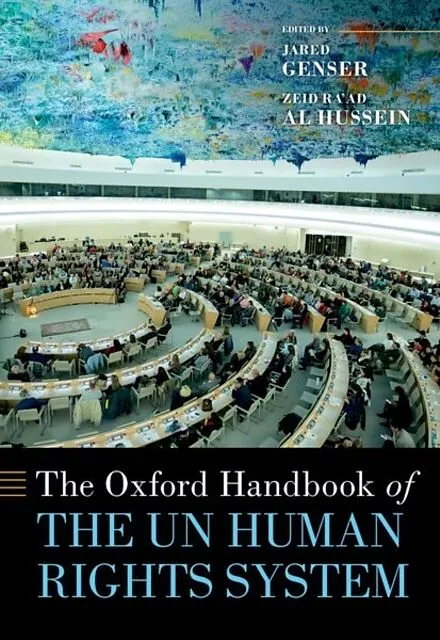
The Oxford Handbook of the UN Human Rights System
Beschreibung
Autorentext Jared Genser is an international human rights lawyer and Managing Director of Perseus Strategies, a public interest law firm. He has taught courses about the UN Security Council as adjunct faculty at Stanford Law School, Georgetown University Law C...Format auswählen
- Fester EinbandCHF 275.20

Wird oft zusammen gekauft
Andere Kunden kauften auch
Beschreibung
Autorentext
Jared Genser is an international human rights lawyer and Managing Director of Perseus Strategies, a public interest law firm. He has taught courses about the UN Security Council as adjunct faculty at Stanford Law School, Georgetown University Law Center, University of Pennsylvania Law School, and University of Michigan Law School. He holds a BS from Cornell University, an MPP from Harvard University's John F. Kennedy School of Government, and a JD cum laude from the University of Michigan Law School.
Zeid Ra'ad Al Hussein is President and Chief Executive Officer of the International Peace Institute and Professor of Practice at the University of Pennsylvania. Previously, he served as UN High Commissioner for Human Rights from 2014-2018 after a long career as a Jordanian diplomat, including as his country's Permanent Representative to the UN (2000-2007 and 2010-2014) and Ambassador to the United States (2007-2010). He received his PhD from Cambridge University.
Klappentext
Human rights have been embedded in the work of the United Nations since its creation. The very purpose of the United Nations, set forth in the UN Charter, is to "reaffirm faith in fundamental human rights" and "encourag[e] respect for human rights and for fundamental freedoms." Creating an efficient and effective machinery to do so, however, has been a persistent challenge. Not only are the human rights functions of the United Nations carried out by the UN High Commissioner for Human Rights and an array of bodies, agencies, experts, and mechanisms. But the Office of the UN High Commissioner for Human Rights, which is supposed to drive the core human rights work of the United Nations, receives only some $200 million annually, less than four percent of the UN's regular budget.
The Oxford Handbook of the UN Human Rights System is the first comprehensive and compelling practical account of the human rights work carried out by the United Nations. It explains the various parts of the system, describes the functions, strengths, and weaknesses of each key body, and examines how each of the individual parts of this system and the broader system can be improved to deliver results for the peoples of the world. This book examines these questions over time, looking back at the historical engagement of each UN body with human rights, reviewing what each body is doing now and what it has achieved, and proposing practical and targeted suggestions for reform. Importantly, each chapter is authored by either current or former diplomats who have led each part of the system or by expert practitioners. Taken together, this Oxford Handbook provides a truly unique and first-ever view of the both entire system and its individual parts as they are today and how they can be harnessed going forward for greater impact.
Inhalt
Part I. History of the UN Human Rights System
1: David Kaye: The UN Charter and International Human Rights Law
2: Kirsten Roberts Lyer and Philippa Webb: The Universal Declaration of Human Rights
Part II. The UN Charter-Based System
3: John P. Pace: The UN Commission on Human Rights
4: Eric Tistounet and Juan Miramontes: The UN Human Rights Council
5: Vitit Muntarbhorn: UN Special Rapporteurs and Independent Experts
6: Brian Tronic and Jared Genser: UN Working Groups
7: Mona M'Bikay: The Universal Periodic Review
8: Michael Kirby: UN Commissions of Inquiry, Fact-Finding Missions, and Other Investigations
9: Graeme Reid and Hannah Pierce-Carty: Sexual Orientation and Gender Identity
10: Rosa Freedman: Politics and Politicization at the Human Rights Council
11: Stephen Hopgood: Knowing the Difference-A Critique of the UN's Role in Advancing Human Rights
12: Dubravka %Simonovi : The UN Commission on the Status of Women
13: Joachim Rücker and Skylar Gleason: The UN General Assembly and Human Rights
14: Bruno Stagno-Ugarte: The UN Security Council and Human Rights
Part III. The UN Treaty-Based System
15: Suzanne Egan and Laura Notess: UN Treaty Body Strengthening, Coordination, and Reform
16: Photini Pazartzis: The Human Rights Committee
17: Aslan Khuseinovich Abashidze: The Committee on Economic, Social, and Cultural Rights
18: Mehrdad Payandeh and Chinsung Chung: The Committee on the Elimination of Racial Discrimination
19: Lia Nadaraia and Ashley Collins: Committee on the Elimination of Discrimination Against Women
20: Ann Skelton and Ashley Collins: The Committee on the Rights of the Child
21: Felice D. Gaer: The Committee Against Torture
22: Suzanne Jabbour and El na %Steinerte: The Subcommittee on Prevention of Torture and Other Cruel, Inhuman, or Degrading Treatment or Punishment
23: Alan Desmond and Stephen Damianos: The Committee on Migrant Workers
24: Ariel Dulitzky: The Committee on Enforced Disappearances
25: Miyeon Kim: The Committee on the Rights of Persons with Disabilities
26: Janet E Lord, William I. Pons, and Eric Rosenthal: The Rights of Persons with Disabilities in the Broader UN System
Part IV. The UN High Commissioner for Human Rights
27: Christen Broecker: The Office of the UN High Commissioner for Human Rights
28: Zeid Ra'ad Al Hussein and Stephanie Herrmann: Privilege No One
29: Navi Pillay and Elise Baranouski: Impartial Judge, Unwavering Advocate
30: Mary Robinson and Nicole Santiago: A Voice for Victims
Part V. The UN Secretary-General and Cross-System Coordination
31: Craig Mokhiber: Coordination and Mainstreaming: Integrating Human Rights in the Work of the UN System
32: Andrew Gilmour and Michael Russo: Human Rights Up Front-A Return to Charter Values
33: Volker Türk and Sophie Pilgrim: The Highest Aspiration: A Call to Action for Human Rights
Part VI. UN Special Advisers, Special Envoys, and Special Representatives of the UN Secretary-General
34: Karen Smith and Adama Dieng: The UN Special Adviser on the Prevention of Genocide and the UN Special Adviser on the Responsibility to Protect
35: Gordon Brown, Shaheed Fatima, and Andrew Hilland: The Special Envoy for Global Education
36: Salil Tripathi and Chris Fletcher: Business and Human Rights
37: Pramila Patten and Letitia Anderson: The UN Special Representative of the Secretary-General on Sexual Violence in Conflict
38: Radhika Coomaraswamy and Alec Wargo: The UN Special Representative of the Secretary-General for Children and Armed Conflict
39: Mikiko Otani: The UN Special Representative of the Secretary-General on Violence Against Children
Part VII. Engagement by Civil Society Organizations
40: Ted Piccone and Samuel Ritholtz: Civil Society and the UN Human Rights System
Part VIII. Emerging Challenges to the UN Human Rights System
41: David Hunter: Climate Change and Human Rights
42: Lorna McGregor: Artificial Intelligence and Human Rights
43: Katharina Ó Cathaoir: COVID-19, Pandemics, and Human Rights