
IHR WARENKORB IST AKTUELL LEER.
Haben Sie noch nichts passendes gefunden? Stöbern Sie durch unser komplettes Sortiment.
Oder melden Sie sich an bzw. registrieren Sie sich.
- Kostenlose Lieferung
- Kauf auf Rechnung
- Ex Libris Tiefpreis
- Filiallieferung und 650+ Abholorte
- Rabatt-Bons als Club-Mitglied
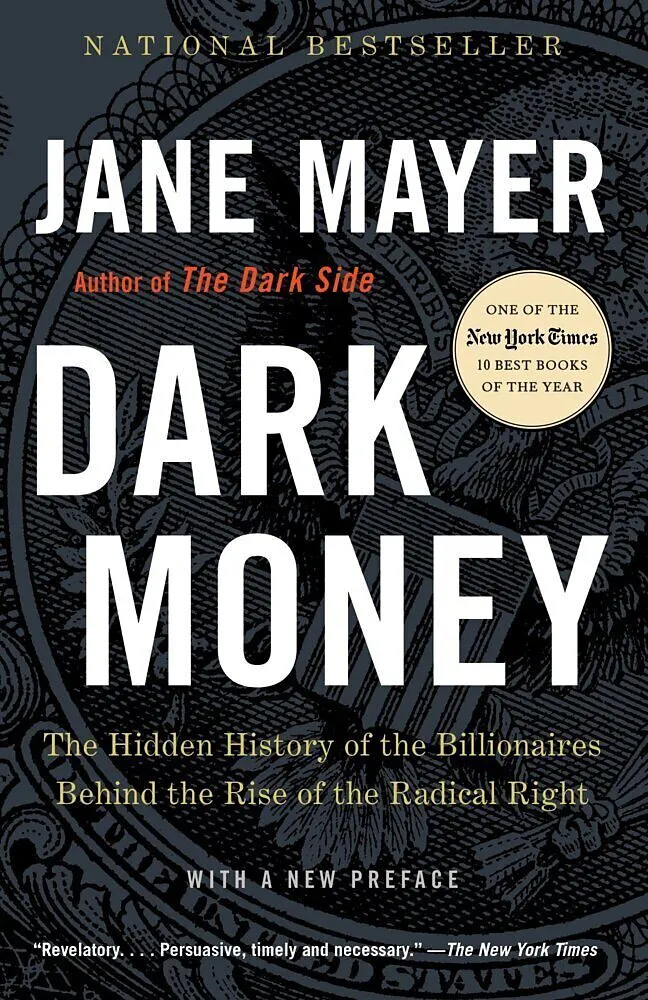
Dark Money
Beschreibung
NATIONAL BESTSELLER ONE OF THE NEW YORK TIMES 10 BEST BOOKS OF THE YEAR Who are the immensely wealthy right-wing ideologues shaping the fate of America today? From the bestselling author of The Dark Side , an electrifying work of investigative journalism that ...Format auswählen
- Kartonierter EinbandCHF 24.30
- E-Book (epub)CHF 7.55
- Kartonierter EinbandCHF 33.20

Wird oft zusammen gekauft
Andere Kunden kauften auch
Beschreibung
NATIONAL BESTSELLER ONE OF THE NEW YORK TIMES 10 BEST BOOKS OF THE YEAR Who are the immensely wealthy right-wing ideologues shaping the fate of America today? From the bestselling author of The Dark Side , an electrifying work of investigative journalism that uncovers the agenda of this powerful group. In her new preface, Jane Mayer discusses the results of the most recent election and Donald Trump's victory, and how, despite much discussion to the contrary, this was a huge victory for the billionaires who have been pouring money in the American political system. Why is America living in an age of profound and widening economic inequality? Why have even modest attempts to address climate change been defeated again and again? Why do hedge-fund billionaires pay a far lower tax rate than middle-class workers? In a riveting and indelible feat of reporting, Jane Mayer illuminates the history of an elite cadre of plutocrats--headed by the Kochs, the Scaifes, the Olins, and the Bradleys--who have bankrolled a systematic plan to fundamentally alter the American political system. Mayer traces a byzantine trail of billions of dollars spent by the network, revealing a staggering conglomeration of think tanks, academic institutions, media groups, courthouses, and government allies that have fallen under their sphere of influence. Drawing from hundreds of exclusive interviews, as well as extensive scrutiny of public records, private papers, and court proceedings, Mayer provides vivid portraits of the secretive figures behind the new American oligarchy and a searing look at the carefully concealed agendas steering the nation. Dark Money is an essential book for anyone who cares about the future of American democracy. National Book Critics Circle Award Finalist LA Times Book Prize Finalist PEN/Jean Stein Book Award Finalist Shortlisted for the Lukas Prize
Praise for Jane Mayer’s *Dark Money
*
“Revelatory. . . . Persuasive, timely and necessary.” —The New York Times
“Dark Money is more than just a work of political journalism—it’s a vital portrait of a nation that, as perhaps never before, is being shaped by a few very rich, very conservative businessmen.” —San Francisco Chronicle
“Absolutely necessary reading for anyone who wants to make sense of our politics.” —The New York Review of Books
“Deeply researched and studded with detail . . . Seems destined to rattle the Koch executive offices in Wichita as other investigations have not.” —Washington Post
“With such turmoil on the right wing of American politics, reading Dark Money is like reading the first chapter of what may be a great political page-turner.”
—Chicago Tribune
“Jane Mayer . . . is, quite simply, one of the very few utterly invaluable journalists this country has.” —*Esquire
*
“Amazing. . . . The most important political book of the year.”
—St. Louis Post-Dispatch
“Dark Money is almost too good for its own good.” —Los Angeles Review of Books
“[A] comprehensive history. . . . Stunning.”
—Salon
*
*
Autorentext
Jane Mayer
Klappentext
****#1 NEW YORK TIMES BESTSELLER AND TOP 10 BOOK OF THE YEAR • A groundbreaking exposé of the American oligarchs using their fortunes to dominate the nation’s political agenda, from “one of the very few utterly invaluable journalists this country has” (Esquire)
“Dark Money is more than just a work of political journalism—it’s a vital portrait of a nation that, as perhaps never before, is being shaped by a few very rich, very conservative businessmen.”—San Francisco Chronicle
WINNER: New York Public Library’s Helen Bernstein Book Award for Excellence in Journalism • FINALIST: National Book Critics Circle Award, Los Angeles Times Book Prize, PEN/Jean Stein Book Award; Shortlisted for the Lukas Prize
**Why is America living in an age of profound and widening economic inequality? Why do billionaire candidates and contributors dominate our elections? Why have even modest attempts to address climate change been defeated again and again? Why do hedge-fund billionaires pay a far lower tax rate than middle-class workers?
In this riveting and indelible feat of reporting, Jane Mayer illuminates the history of an elite cadre of plutocrats—headed by the Kochs, the Scaifes, the Olins, and the Bradleys—who have bankrolled a systematic plan to fundamentally alter the American political system. Through vivid portraits of these secretive figures and their carefully concealed agendas, Mayer traces a byzantine trail of billions of dollars spent by the network and reveals a staggering conglomeration of think tanks, academic institutions, media groups, courthouses, and government allies that have fallen under their sphere of influence.
Drawing from hundreds of exclusive interviews, as well as extensive scrutiny of public records, private papers, and court proceedings, Dark Money is an essential book for anyone who cares about the future of American democracy.
Leseprobe
CHAPTER ONE
Radicals: A Koch Family History
Oddly enough, the fiercely libertarian Koch family owed part of its fortune to two of history’s most infamous dictators, Joseph Stalin and Adolf Hitler. The family patriarch, Fred Chase Koch, founder of the family oil business, developed lucrative business relationships with both of their regimes in the 1930s.
According to family lore, Fred Koch was the son of a Dutch printer and publisher who settled in the small town of Quanah, Texas, just south of the Oklahoma border, where he owned a weekly newspaper and print shop. Quanah, which was named for the last American Comanche chief, Quanah Parker, still retained its frontier aura when Fred was born there in 1900. Bright and eager to get out from under his overbearing old-world father, Fred once ran away to live with the Comanches as a boy. Later, he crossed the country for college, transferring from Rice in Texas to attend the Massachusetts Institute of Technology. There, he earned a degree in chemical engineering and joined the boxing team. Early photographs show him as a tall, formally dressed young man with glasses, a tuft of unruly curls, and a self-confident, defiant expression.
In 1927, Fred, who was an inveterate tinkerer, invented an improved process for extracting gasoline from crude oil. But as he would later tell his sons bitterly and often, America’s major oil companies regarded him as a business threat and shut him out of the industry, suing him and his customers in 1929 for patent infringement. Koch regarded the monopolistic patents invoked by the major oil companies as anticompetitive and unfair. The fight appears to be an early version of the Kochs’ later opposition to “corporate cronyism” in which they contend that the government and big business collaborate unfairly. In Fred Koch’s eye, he was an outsider fighting a corrupt system.
Koch fought back in the courts for more than fifteen years, finally winning a $1.5 million settlement. He correctly suspected that his opponents bribed at least one presiding judge, an incompetent lush who left the case in the hands of a crooked clerk. “The fact that the judge was bribed completely altered their view of justice,” one longtime family employee suggests. “They believe justice can be bought, and the rules are for chumps.” Meanwhile, crippled by lawsuits in America during this period, Koch took his innovative refining method abroad.
He had already helped build a refinery in Great Britain after W…