
IHR WARENKORB IST AKTUELL LEER.
Haben Sie noch nichts passendes gefunden? Stöbern Sie durch unser komplettes Sortiment.
Oder melden Sie sich an bzw. registrieren Sie sich.
- Kostenlose Lieferung
- Kauf auf Rechnung
- Ex Libris Tiefpreis
- Filiallieferung und 650+ Abholorte
- Rabatt-Bons als Club-Mitglied
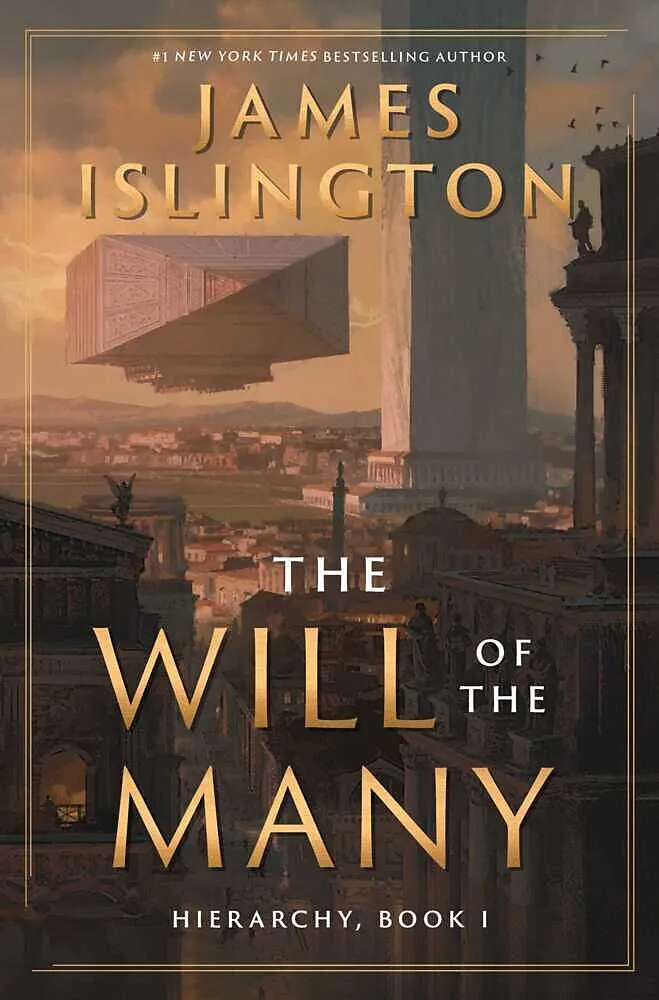
The Will of the Many
Beschreibung
At the elite Catenan Academy, where students are prepared as the future leaders of the Hierarchy empire, the curriculum reveals a layered set of mysteries which turn murderous in this new fantasy by bestselling author of The Licanius Trilogy, James Islington.V...Format auswählen
- Fester EinbandCHF 39.90
- Kartonierter Einband (Kt)CHF 18.40
- Kartonierter EinbandCHF 27.90

Wird oft zusammen gekauft
Andere Kunden kauften auch
Beschreibung
At the elite Catenan Academy, where students are prepared as the future leaders of the Hierarchy empire, the curriculum reveals a layered set of mysteries which turn murderous in this new fantasy by bestselling author of The Licanius Trilogy, James Islington.Vis, the adopted son of Magnus Quintus Ulcisor, a prominent senator within the Hierarchy, is trained to enter the famed Catenan Academy to help Ulciscor learn what the hidden agenda is of the remote island academy. Secretly, he also wants Vis to discover what happed to his brother who died at the academy. He's sure the current Principalis of the academy, Quintus Veridius Julii, a political rival, knows much more than he's revealing.The Academy's vigorous syllabus is a challenge Vis is ably suited to meet, but it is the training in the use of Will, a practice that Vis finds abhorrent, that he must learn in order to excel at the Academy. Will-a concept that encompasses their energy, drive, focus, initiative, ambition, and vitality-can be voluntarily "ceded" to someone else. A single recipient can accept ceded Will from multiple people, growing in power towards superhuman levels. Within the hierarchy your level of Will, or legal rank, determines how you live or die. And there are those who are determined to destroy this hierarchal system, as well as those in the Academy who use it to gain dominance in internationally bestselling author James Islington's wonderfully crafted new epic fantasy series.
Autorentext
James Islington is the bestselling author of The Will of the Many (the first novel in the Hierarchy series), as well as the Licanius Trilogy (beginning with The Shadow of What Was Lost). **He has sold more than two million books, and his work has been translated into seventeen different languages. He lives on the Mornington Peninsula in Victoria, Australia, with his wife and two children.
Klappentext
Featuring a reversible book cover with the original hardcover art design.
At the elite Catenan Academy, a young fugitive uncovers layered mysteries and world-changing secrets in this new fantasy series by internationally bestselling author of The Licanius Trilogy, James Islington.
AUDI. VIDE. TACE.
The Catenan Republic—the Hierarchy—may rule the world now, but they do not know everything.
I tell them my name is Vis Telimus. I tell them I was orphaned after a tragic accident three years ago, and that good fortune alone has led to my acceptance into their most prestigious school. I tell them that once I graduate, I will gladly join the rest of civilised society in allowing my strength, my drive and my focus—what they call Will—to be leeched away and added to the power of those above me, as millions already do. As all must eventually do.
I tell them that I belong, and they believe me.
But the truth is that I have been sent to the Academy to find answers. To solve a murder. To search for an ancient weapon. To uncover secrets that may tear the Republic apart.
And that I will never, ever cede my Will to the empire that executed my family.
To survive, though, I will still have to rise through the Academy’s ranks. I will have to smile, and make friends, and pretend to be one of them and win. Because if I cannot, then those who want to control me, who know my real name, will no longer have any use for me.
And if the Hierarchy finds out who I truly am, they will kill me.
Leseprobe
Chapter I
I
I AM DANGLING, AND IT is only my father’s blood-slicked grip around my wrist that stops me from falling.
He is on his stomach, stretched out over the rocky ledge. His muscles are corded. Sticky red covers his face, his arms, his clothes, everything I can see. Yet I know he can pull me up. I do everything I can not to struggle. I trust him to save me.
He looks over my shoulder. Into the inky black. Into the darkness that is to come.
“Courage,” he whispers. He pours heartbreak and hope into the word.
He lets go.
“I KNOW I’M ALWAYS TELLING you to think before you act,” says the craggy-faced man slouching across the board from me, “but for the game to progress, Vis, you do actually have to move a gods-damned stone.”
I rip my preoccupied gaze from the cold silver that’s streaming through the sole barred window in the guardroom. Give my opponent my best irritated glare to cover the sickly swell of memory, then force my focus again to the polished white and red triangles between us. The pieces glint dully in the light of the low-burning lantern that sits on the shelf, barely illuminating our contest better than the early evening’s glow from outside.
“You alright?”
“Fine.” I see Hrolf’s bushy grey eyebrows twitch in the corner of my vision. “I’m fine, old man. Just thinking. Sappers haven’t got me yet.” No heat to the words. I know the way his faded brown eyes crinkle with concern is genuine. And I know he has to ask.
I’ve been working here almost a year longer than him, so he’s wondering again whether my mind is losing its edge. Like his has been for a while, now.
I ignore his worry and assess the Foundation board, calculating what the new red formation on the far side means. A feint, I realise immediately. I ignore it. Shift three of my white pieces in quick succession and ensure the win. Hrolf likes to boast about how he once defeated a Magnus Quartus, but against me, it’s never a fair match. Even before the Hierarchy—or the Catenan Republic, as I still have to remind myself to call them out loud—ruled the world, Foundation was widely considered the perfect tool for teaching abstract strategic thinking. My father ensured I was exposed to it young, often, and against the very best players.
Hrolf glowers at the board, then me, then at the board again.
“Lost concentration. You took too long. Basically cheating,” he mutters, disgusted as he concedes the game. “You know I beat a Magnus Quartus once?”
My reply is interrupted by a hammering at the thick stone entrance. Hrolf and I stand, game forgotten. Our shift isn’t meant to change for hours yet.
“Identify yourself,” calls Hrolf sharply as I step across to the window. The man visible through the bars is well-dressed, tall and with broad shoulders. In his late twenties, I think. Moonlight shines off the dark skin of his close-shaven scalp.
“Sextus Hospius,” comes the muffled reply. “I have an access seal.” Hospius looks at the window, spotting my observation of him. His beard is black, trimmed short, and he has serious, dark brown eyes that lend him a handsome intensity. He leans over and presses what appear to be official Hierarchy documents against the glass.
“We weren’t told to expect you,” says Hrolf.
“I wouldn’t have known to expect me until about thirty minutes ago. It’s urgent.”
“Not how it works.”
“It is tonight, Septimus.” No change in expression, but the impatient emphasis on Hrolf’s lower status is unmistakeable.
Hrolf squints at the door, then walks over to the thin slot set in the wall beside it, tapping his stone Will key to it with an irritated, sharp click. The hole on our side seals shut. Outside, Hospius notes the corresponding new opening in front of him, depositing his documentation. I watch closely to ensure he adds nothing else.
Hrolf waits for my nod, then opens our end again to pull out Hospius’s pages, rifling through them. His mouth twists as he hands them to me. “Proconsul’s seal” is all he says.
I examine the writing carefully; Hrolf knows his work, but here among the…