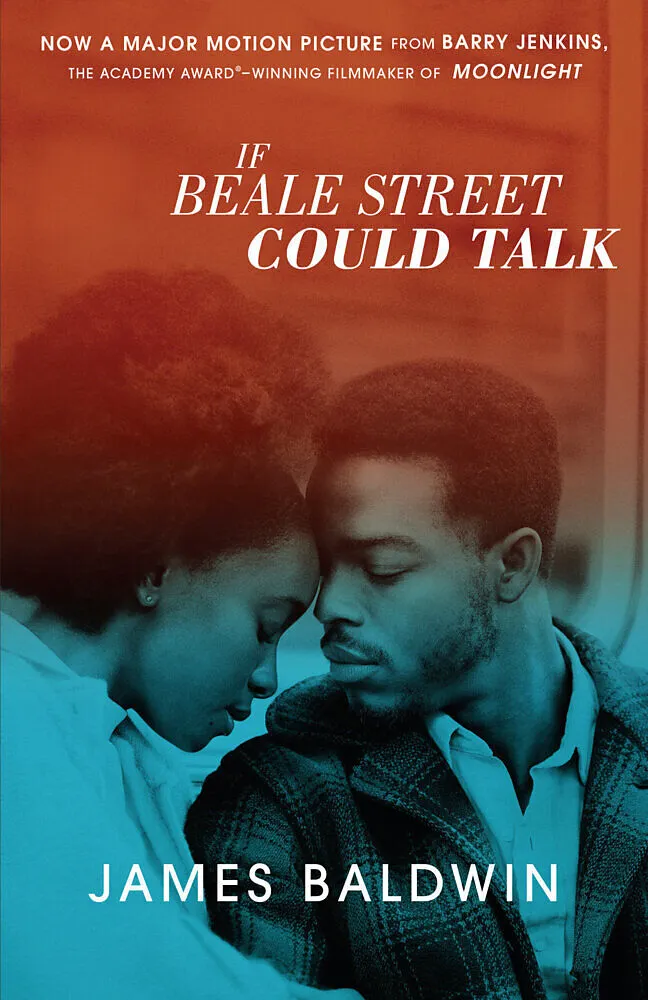

If Beale Street Could Talk (Movie Tie-In)
Beschreibung
In this honest and stunning novel, now a major motion picture directed by Barry Jenkins, James Baldwin has given America a moving story of love in the face of injustice. Told through the eyes of Tish, a nineteen-year-old girl, in love with Fonny, a young sculp...Format auswählen
- Kartonierter EinbandCHF 12.50

Wird oft zusammen gekauft
Andere Kunden kauften auch
Beschreibung
In this honest and stunning novel, now a major motion picture directed by Barry Jenkins, James Baldwin has given America a moving story of love in the face of injustice. Told through the eyes of Tish, a nineteen-year-old girl, in love with Fonny, a young sculptor who is the father of her child, Baldwin’s story mixes the sweet and the sad. Tish and Fonny have pledged to get married, but Fonny is falsely accused of a terrible crime and imprisoned. Their families set out to clear his name, and as they face an uncertain future, the young lovers experience a kaleidoscope of emotions–affection, despair, and hope. In a love story that evokes the blues, where passion and sadness are inevitably intertwined, Baldwin has created two characters so alive and profoundly realized that they are unforgettably ingrained in the American psyche.
"One of the best books Baldwin has ever written–perhaps the best of all." –The Philadelphia Inquirer
"A moving, painful story, so vividly human and so obviously based on reality that it strikes us as timeless.”–Joyce Carol Oates
""f Van Gogh was our nineteenth-century artist-saint, James Baldwin is our twentiethth-century one." –Michael Ondaatje
"Striking and particularly haunting. . . . A beauty, especially in its rendering of youthful passion." –Cosmopolitan
"A major work of Black American fiction... His best novel yet, even Baldwin's most devoted readers are due to be stunned by it." –The New Republic
"Emotional dynamite... a powerful assault upon the cynicism that seems today to drain our determination to confront deep social problems." –Library Journal
"A moving, painful story, so vividly human and so obviously based on reality that it strikes us as timeless." –The New York Times Book Review
Autorentext
JAMES BALDWIN was born in 1924 and educated in New York. He is the author of more than twenty works of fiction and nonfiction, including Go Tell It on the Mountain; Notes of a Native Son; Giovanni’s Room; Nobody Knows My Name; Another Country; The Fire Next Time; Nothing Personal; Blues for Mister Charlie; Going to Meet the Man; The Amen Corner; Tell Me How Long the Train’s Been Gone; One Day When I Was Lost; If Beale Street Could Talk; The Devil Finds Work; Little Man, Little Man; Just Above My Head; The Evidence of Things Not Seen; Jimmy’s Blues; and The Price of the Ticket. Among the awards he has received are a Eugene F. Saxon Memorial Trust Award, a Rosenwald Fellowship, a Guggenheim Fellowship, a Partisan Review Fellowship, and a Ford Foundation grant. He was made a Commander of the Legion of Honor in 1986. He died in 1987.
Klappentext
In this honest and stunning novel that inspired the award-winning major motion picture of the same name, James Baldwin has given America a moving story of love in the face of injustice. "A major work of Black American fiction... His best novel yet, even Baldwin's most devoted readers are due to be stunned by it." -The New Republic Told through the eyes of Tish, a nineteen-year-old girl, in love with Fonny, a young sculptor who is the father of her child, Baldwin's story mixes the sweet and the sad. Tish and Fonny have pledged to get married, but Fonny is falsely accused of a terrible crime and imprisoned. Their families set out to clear his name, and as they face an uncertain future, the young lovers experience a kaleidoscope of emotions-affection, despair, and hope. In a love story that evokes the blues, where passion and sadness are inevitably intertwined, Baldwin has created two characters so alive and profoundly realized that they are unforgettably ingrained in the American psyche.
Zusammenfassung
A stunning love story about a young Black woman whose life is torn apart when her lover is wrongly accused of a crime—"a moving, painful story, so vividly human and so obviously based on reality that it strikes us as timeless" (The New York Times Book Review). • Also a major motion picture from Barry Jenkins.****
"One of the best books Baldwin has ever written—**perhaps the best of all." **—The Philadelphia Inquirer
Told through the eyes of Tish, a nineteen-year-old girl, in love with Fonny, a young sculptor who is the father of her child, Baldwin’s story mixes the sweet and the sad. Tish and Fonny have pledged to get married, but Fonny is falsely accused of a terrible crime and imprisoned. Their families set out to clear his name, and as they face an uncertain future, the young lovers experience a kaleidoscope of emotions—affection, despair, and hope. In a love story that evokes the blues, where passion and sadness are inevitably intertwined, Baldwin has created two characters so alive and profoundly realized that they are unforgettably ingrained in the American psyche.
Leseprobe
Troubled About My Soul
I look at myself in the mirror. I know that I was christened Clementine, and so it would make sense if people called me Clem, or even, come to think of it, Clementine, since that's my name: but they don't. People call me Tish. I guess that makes sense, too. I'm tired, and I'm beginning to think that maybe everything that happens makes sense. Like, if it didn't make sense, how could it happen? But that's really a terrible thought. It can only come out of trouble--trouble that doesn't make sense.
Today, I went to see Fonny. That's not his name, either, he was christened Alonzo: and it might make sense if people called him Lonnie. But, no, we've always called him Fonny. Alonzo Hunt, that's his name. I've known him all my life, and I hope I'll always know him. But I only call him Alonzo when I have to break down some real heavy shit to him.
Today, I said, "--Alonzo--?"
And he looked at me, that quickening look he has when I call him by his name.
He's in jail. So where we were, I was sitting on a bench in front of a board, and he was sitting on a bench in front of a board. And we were facing each other through a wall of glass between us. You can't hear anything through this glass, and so you both have a little telephone. You have to talk through that. I don't know why people always look down when they talk through a telephone, but they always do. You have to remember to look up at the person you're talking to.
I always remember now, because he's in jail and I love his eyes and every time I see him I'm afraid I'll never see him again. So I pick up the phone as soon as I get there and I just hold it and I keep looking up at him.
So, when I said, "--Alonzo--?" he looked down and then he looked up and he smiled and he held the phone and he waited.
I hope that nobody has ever had to look at anybody they love through glass.
And I didn't say it the way I meant to say it. I meant to say it in a very offhand way, so he wouldn't be too upset, so he'd understand that I was saying it without any kind of accusation in my heart.
You see: I know him. He's very proud, and he worries a lot, and, when I think about it, I know--he doesn't--that that's the biggest reason he's in jail. He worries too much already, I don't want him to worry about me. In fact, I didn't want to say what I had to say. But I knew I had to say it. He had to know.
And I thought, too, that when he got over being worried, when he was lying by himself at night, when he was all by himself, in the very deepest part of himself, maybe, when he thought about it, he'd be glad. And that might help him.
I said, "Alonzo, we're going to have a baby."
I looked at him. I know I smiled. His face looked as though it were plunging into water. I couldn't touch him. I wanted so to touch him. I smiled again and my hands got wet on the phone and then for a moment I couldn't see him at all and I shook my he…