
IHR WARENKORB IST AKTUELL LEER.
Haben Sie noch nichts passendes gefunden? Stöbern Sie durch unser komplettes Sortiment.
Oder melden Sie sich an bzw. registrieren Sie sich.
- Kostenlose Lieferung
- Kauf auf Rechnung
- Ex Libris Tiefpreis
- Filiallieferung und 650+ Abholorte
- Rabatt-Bons als Club-Mitglied
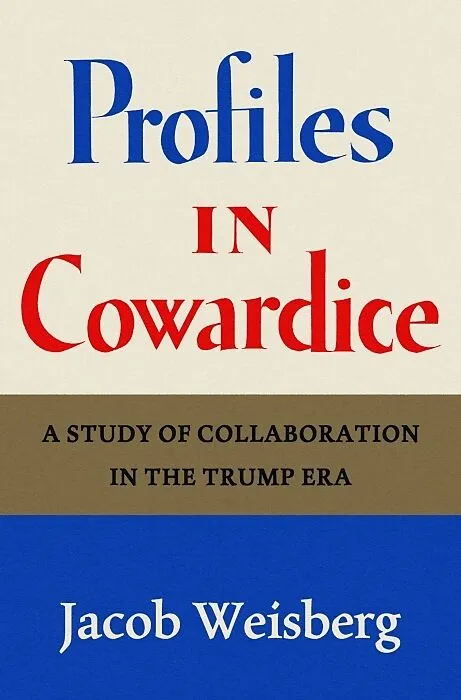
Profiles in Cowardice
Beschreibung
Autorentext Jacob Weisberg Klappentext The Instant New York Times Bestseller “Valuable and dauntless.” —The New York Times Book Review "We badly need [this] book.” —Tina Brown A devastating reckoning with the people and institutio...Format auswählen
- Fester EinbandCHF 32.40

Wird oft zusammen gekauft
Andere Kunden kauften auch
Beschreibung
Autorentext
Jacob Weisberg
Klappentext
**The Instant New York Times Bestseller
“Valuable and dauntless.” —The New York Times Book Review
"We badly need [this] book.” —Tina Brown
A devastating reckoning with the people and institutions whose failure to stand up to Trump’s brazen grab for authoritarian power has been particularly shocking and consequential**
It may be scant solace, but history will be particularly harsh to a subset of Trump enablers with a few key things in common: They have money and power. They represent intuitions that are central in determining whether America remains a free, functioning democracy or not. And they absolutely know better. History starts now.
In Profiles in Cowardice, Jacob Weisberg has written one of the first defining books of the Trump Era—how this pitch-black political moment happened, why so few resisted, and what it reveals about the character of American leadership.
Jeff Bezos, Amazon, and Big Tech. Stephen Schwarzman, Blackstone, and Wall Street. Brad Karp, Paul, Weiss, and Big Law. Mitch McConnell and the United States Senate. Eight individuals in all, together forming an entwined network of power in America, and a new way to understand how authoritarianism can take root in an open society—not by overthrowing institutions, but by bending and bullying them into submission.
The book is a masterful study of the ways people create rationalizations to justify basic human instincts such as greed, vanity and fear—above all fear. Fear is the great enemy of democracy, and the book illuminates how it operates, how it disguises itself, and how it spreads. The book is timeless: its profiles are case studies, but they are also mirrors. They ask readers to examine their own instincts, their own silences, their own thresholds for action. This is not a morality tale with easy villains. It is an attempt to describe the moral mechanics of democratic failure. By studying that failure up close, we may better understand what courage truly requires—and why it is so rarely summoned when it matters most.
Leseprobe
Chapter One
Existentialist: Brad Karp
One of my father's closest friends was a man named George Anastaplo, whom he'd known since their days together at the University of Chicago Law School. The son of Greek immigrants in St. Louis, George graduated first in his class in 1950, but he never became a practicing lawyer. He had expected to, until an issue of principle intervened.
After passing the bar, the twenty-five-year-old Anastaplo went downtown for what should have been a routine interview with the Illinois Bar Association's character and fitness committee. His interviewer asked whether he believed that a member of the Communist Party should be admitted to the bar. Anastaplo answered that he did not believe Communist Party membership should disqualify an applicant. That led to a follow-up question: Was he a Communist?
"I think it is an illegitimate question," Anastaplo replied. He believed that asking about his political views infringed on his First Amendment rights of free speech and free association.
Everyone, including the University of Chicago Law School's dean, Edward Levi, told him to just say he wasn't a Communist for God's sake-Anastaplo's politics were in fact conservative, if unconventional. At Chicago he studied under the political philosopher Leo Strauss, alongside the likes of Allan Bloom and Harry Jaffa. In the 1960s, he managed to get himself arrested in Moscow-on a family vacation-for giving out copies of American magazines in Red Square. Then he got kicked out of Greece for criticizing the colonels.
Anastaplo took his lawsuit against the Bar Association all the way to the Supreme Court, representing himself in oral argument. In 1961, the court ruled against him 5-4. The dissent by Hugo Black is deservedly better known than the majority opinion written by Justice John Marshall Harlan. "The very most that can fairly be said against Anastaplo's position in this entire matter is that he took too much of the responsibility of preserving [this country's] freedom upon himself," Black wrote. It was one of Justice Black's favorite opinions, chosen by his son to be read at his funeral in 1971. The reading ended with the dissent's resounding conclusion: "We must not be afraid to be free."
Even when he found himself driving a taxi for a time, George wasn't heartbroken about not being able to practice law. He plied his trade as an independent scholar and teacher around Chicago, including at Loyola University Law School and Rosary College. He published twenty books and innumerable scholarly essays that ranged across law, literature, philosophy, and religion. A characteristic title was The Artist as Thinker: From Shakespeare to Joyce, which gives a sense of his intellectual reach. As a Bar Mitzvah gift, he gave me an eight-hundred-page edition of Maimonides's Guide of the Perplexed. He did not appear to be interested in material things. When the Illinois Bar Association offered to right its wrong and admit him decades later, he declined.
Leon Despres, the long time independent alderman who represented Hyde Park, described Anastaplo, who died in 2014, as "Chicago's Socrates." That's just how I remember him: a thin, almost spectral presence, with eyebrows the size of dust bunnies dominating the craggy landscape of his face. He was an ancient among moderns, conducting philosophical examinations in classrooms and on sidewalks, in a rumpled suit from the era of his court case. He navigated the city by bus and bicycle, living in a world of ideas.
George Anastaplo believed that lawyers had a responsibility to the Constitution and wasn't willing to betray it for the sake of becoming one.
2
When Donald Trump returned to the White House in 2025, the legal profession came under an attack that outstripped the loyalty oaths of the McCarthy era. Judges were smeared, prosecutors prosecuted, law schools investigated. But no sector faced more targeted pressure than elite law firms with ties to people who had crossed Donald Trump.
Trump began by personally canceling the security clearance of Peter Koski and his colleagues at the firm of Covington & Burling. Koski had served under Special Counsel Jack Smith, who had brought the January 6 and classified-documents cases against Trump. Trump then withdrew security clearances and blocked access to government buildings for all of the lawyers at Perkins Coie, the Seattle-based firm that had represented Hillary Clinton and commissioned research into Trump's Russia ties. He further directed Attorney General Pam Bondi to sanction individual lawyers who "engage in frivolous, unreasonable, and vexatious litigation."
It was Paul, Weiss, Rifkind, Wharton & Garrison-a firm long identified with progressive causes and Democratic politics-that would become the test case. At 10 p.m. on a Friday night, March 14, 2025, Trump issued Executive Order 14237, Addressing Risks from Paul, Weiss, which effectively blacklisted the firm. Citing its involvement in a lawsuit against January 6 rioters, its connection to a former prosecutor in the Manhattan District Attorney's office, and alleged employment discrimination on the basis of race and sex, the order canceled all federal contracts with the firm, suspended security clearances for its attorneys, and blocked them from even entering government buildings. Outrageous and unlawful on its face, the order functioned as a political thumbscrew, designed to cause intolerable pain.
Striking at Paul, Weiss meant striking at the heart of liberal law. A Jewish firm dating to the 1870s, it prided itself on civil rights work. Its hall of fame included Walter Pollak, who had led the 1932 Supreme Court appeal for the Scottsboro Boys, nine Black teenagers …