
IHR WARENKORB IST AKTUELL LEER.
Haben Sie noch nichts passendes gefunden? Stöbern Sie durch unser komplettes Sortiment.
Oder melden Sie sich an bzw. registrieren Sie sich.
- Kostenlose Lieferung
- Kauf auf Rechnung
- Ex Libris Tiefpreis
- Filiallieferung und 650+ Abholorte
- Rabatt-Bons als Club-Mitglied
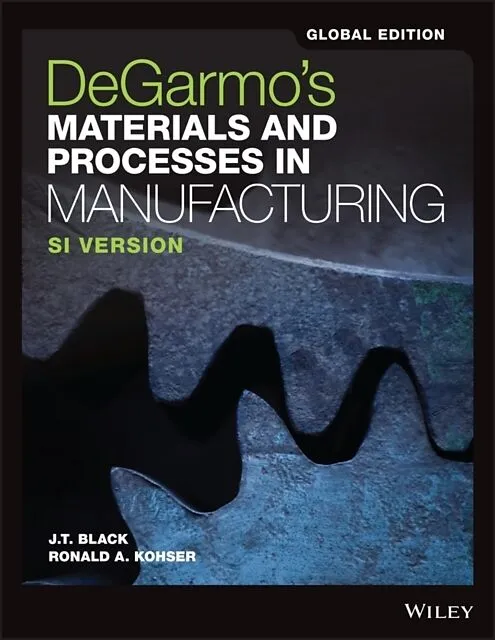
DeGarmo's Materials and Processes in Manufacturing, Global Edition
Beschreibung
Klappentext Newly revised, DeGarmo's Materials and Processes in Manufacturing has been the market-leading text on manufacturing and manufacturing processes courses for over fifty years. Authors J T. Black and Ron Kohser have continued this book's long and dist...Format auswählen
- Kartonierter EinbandCHF 82.40

Wird oft zusammen gekauft
Andere Kunden kauften auch
Beschreibung
Klappentext
Newly revised, DeGarmo's Materials and Processes in Manufacturing has been the market-leading text on manufacturing and manufacturing processes courses for over fifty years. Authors J T. Black and Ron Kohser have continued this book's long and distinguished tradition of exceedingly clear presentation and highly practical approach to materials and processes, presenting mathematical models and analytical equations only when they enhance the basic understanding of the material. Updated to reflect all current practices, standards, and materials, this edition has new coverage of additive manufacturing, lean engineering, and processes related to ceramics, polymers, and plastics.
Inhalt
Preface iii
1 Introduction to DeGarmo's Materials and Processes in Manufacturing 1
1.1 Materials, Manufacturing, and the Standard of Living 1
1.2 Manufacturing and Production Systems 3
Review Questions 24
Problems 25
2 Properties of Materials 26
2.1 Introduction 26
2.2 Static Properties 28
2.3 Dynamic Properties 38
2.4 Temperature Effects (Both High and Low) 43
2.5 Machinability, Formability, and Weldability 46
2.6 Fracture Toughness and the Fracture Mechanics Approach 46
2.7 Physical Properties 48
2.8 Testing Standards and Testing Concerns 48
Review Questions 48
Problems 50
3 Nature of Materials 51
3.1 Structure-Property-Processing-Performance Relationships 51
3.2 The Structure of Atoms 52
3.3 Atomic Bonding 52
3.4 Secondary Bonds 53
3.5 Atom Arrangements in Materials 54
3.6 Crystal Structures 54
3.7 Development of a Grain Structure 56
3.8 Elastic Deformation 56
3.9 Plastic Deformation 57
3.10 Dislocation Theory of Slippage 58
3.11 Strain Hardening or Work Hardening 59
3.12 Plastic Deformation in Polycrystalline Material 60
3.13 Grain Shape and Anisotropic Properties 60
3.14 Fracture 61
3.15 Cold Working, Recrystallization, and Hot Working 61
3.16 Grain Growth 62
3.17 Alloys and Alloy Types 62
3.18 Atomic Structure and Electrical Properties 62
Review Questions 63
Problems 64
4 Equilibrium Phase Diagrams and the Iron-Carbon System 65
4.1 Introduction 65
4.2 Phases 65
4.3 Equilibrium Phase Diagrams 65
4.4 Iron-Carbon Equilibrium Diagram 71
4.5 Steels and the Simplified Iron-Carbon Diagram 72
4.6 Cast Irons 74
Review Questions 75
Problems 76
5 Heat Treatment 77
5.1 Introduction 77
5.2 Processing Heat Treatments 77
5.3 Heat Treatments Used to Increase Strength 80
5.4 Strengthening Heat Treatments for Nonferrous Metals 80
5.5 Strengthening Heat Treatments for Steel 83
5.6 Surface Hardening of Steel 94
5.7 Furnaces 96
5.8 Heat Treatment and Energy 97
Review Questions 98
Problems 99
6 Ferrous Metals and Alloys 101
6.1 Introduction to History-Dependent Materials 101
6.2 Ferrous Metals 101
6.3 Iron 102
6.4 Steel 102
6.5 Stainless Steels 113
6.6 Tool Steels 115
6.7 Cast Irons 117
6.8 Cast Steels 120
6.9 The Role of Processing on Cast Properties 120
Review Questions 121
Problems 122
7 Nonferrous Metals and Alloys 123
7.1 Introduction 123
7.2 Copper and Copper Alloys 123
7.3 Aluminum and Aluminum Alloys 128
7.4 Magnesium and Magnesium Alloys 134
7.5 Zinc and Zinc Alloys 136
7.6 Titanium and Titanium Alloys 137
7.7 Nickel-Based Alloys 138
7.8 Superalloys, Refractory Metals, and Other Materials Designed for High-Temperature Service 138
7.9 Lead and Tin and Their Alloys 141
7.10 Some Lesser-Known Metals and Alloys 141
7.11 Metallic Glasses 141
7.12 Graphite 142
7.13 Materials for Specific Applications 142
7.14 High Entropy Alloys 142
Review Questions 143
Problems 144
8 Nonmetallic Materials: Plastics, Elastomers, Ceramics, and Composites 145
8.1 Introduction 145
8.2 Plastics 145
8.3 Elastomers 156
8.4 Ceramics 159
8.5 Composite Materials 166
Review Questions 174
Problems 175
9 Material Selection 177
9.1 Introduction 177
9.2 Material Selection and Manufacturing Processes 179
9.3 The Design Process 179
9.4 Approaches to Material Selection 180
9.5 Additional Factors to Consider 183
9.6 Consideration of the Manufacturing Process 183
9.7 Ultimate Objective 184
9.8 Materials Substitution 185
9.9 Effect of Product Liability on Materials Selection 186
9.10 Aids to Material Selection 186
Review Questions 187
Problems 188
10 Fundamentals of Casting 191
10.1 Introduction to Materials Processing 191
10.2 Introduction to Casting 192
10.3 Casting Terminology 193
10.4 The Solidification Process 194
10.5 Patterns 202
10.6 Design Considerations in Castings 203
10.7 The Casting Industry 206
Review Questions 206
Problems 208
11 Expendable-Mold Casting Processes 209
11.1 Introduction 209
11.2 Sand Casting 209
11.3 Cores and Core Making 222
11.4 Other Expendable-Mold Processes with Multiple-Use Patterns 225
11.5 Expendable-Mold Processes Using Single-Use Patterns 226
11.6 Shakeout, Cleaning, and Finishing 232
11.7 Summary 232
Review Questions 232
Problems 234
12 Multiple-Use-Mold Casting Processes 235
12.1 Introduction 235
12.2 Permanent-Mold Casting 235
12.3 Die Casting 238
12.4 Squeeze Casting and Semisolid Casting 241
12.5 Centrifugal Casting 242
12.6 Continuous Casting 244
12.7 Melting 244
12.8 Pouring Practice 247
12.9 Cleaning, Finishing, Heat Treating, and Inspection 247
12.10 Automation in Foundry Operations 248
12.11 Process Selection 248
Review Questions 250
Problems 251
13 Fabrication of Plastics, Ceramics, and Composites 252
13.1 Introduction 252
13.2 Fabrication of Plastics 252
13.3 Processing of Rubber and Elastomers 262
13.4 Processing of Ceramics 263
13.5 Fabrication of Composite Materials 267
Review Questions 275
Problems 277
14 Fundamentals of Metal Forming 279
14.1 Introduction 279
14.2 Forming Processes: Independent Variables 280
14.3 Dependent Variables 281
14.4 Independent-Dependent Relationships 281
14.5 Process Modeling 282
14.6 General Parameters 282
14.7 Friction, Lubrication, and Wear under Metalworking Conditions 283
14.8 Temperature Concerns 284
14.9 Formability 290
Review Questions 290
Problems 292
15 Bulk Forming Processes 293
15.1 Introduction 293
15.2 Classification of Deformation Processes 293
15.3 Bulk Deformation Processes 294
15.4 Rolling 294
15.5 Forging 298
15.6 Extrusion 308
15.7 Wire, Rod, and Tube Drawing 312
15.8 Cold Forming, Cold Forging, and Impact Extrusion 314
15.9 Piercing 317
15.10 Other Squeezing Processes 318
15.11 Surface Improvement by Deformation Processing 320
Review Questions 321
Problems 322
16 Sheet-Forming Processes 325
16.1 Introduction 325
16.2 Shearing Operations 325
16.3 Bending 331
16.4 Drawing and Stretching Processes 338
16.5 Alternative Methods of Producing Sheet-Type Products 349
16.6 Seamed Pipe Manufacture 349
16.7 Presses 350
Review Questions 354
Problems 356
17 Powder Metallurgy (Particulate Processing) 357
17.1 Introduction 357
17.2 The Basic Process 357
17.3 Powder Manufacture 358
17.4 Powder Testing and Evaluation 359
17.5 Powder Mixing and Blending 360
17.6 Compacting 360
17.7 Sintering 363
17.8 Advances in Sintering (Shorter Time, Higher Density, Stronger Products) 364
17.9 Hot-Isostatic Pressing 365
17.10 Other Techniques to Produce High-Density P/M Products 366
17.11 Metal Injection Molding (MIM) 366
17.12 Secondary Operations 368
17.13 Properties of P/M Products 369
17.14 Design of Powder Metallurgy Parts 371
17.15 Powder Metallurgy Products 371
17.16 Advantages and Disadvantages of Powder Metallurgy 373
17.17 Process Summary 374
Review Questions 375
Problems 376
18 Additive Processes-Including 3-D Printing 377
18.1 Introduction 377
18.2 Layerwi…