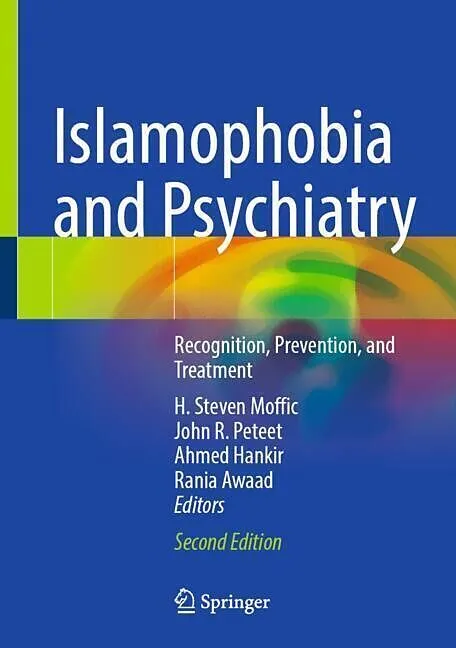
Islamophobia and Psychiatry
Beschreibung
This book is a second edition of the 2019 volume of Islamophobia and Psychiatry . This update conveys how important and challenging the subject matter remains. The first edition of this book came at a time when Islamophobia was rising in the United States and...Format auswählen
- Fester EinbandCHF 204.40
- Fester EinbandCHF 157.20
- E-Book (pdf)CHF 165.90

Wird oft zusammen gekauft
Andere Kunden kauften auch
Beschreibung
This book is a second edition of the 2019 volume of Islamophobia and Psychiatry . This update conveys how important and challenging the subject matter remains. The first edition of this book came at a time when Islamophobia was rising in the United States and elsewhere, and the adverse mental health repercussions were significant: disparagement of Muslims, Muslim fears of asking for help from psychiatry, undue fear of Muslims by others, and increased anxiety for Muslims, amongst others. Since then, Islamophobia has waxed and waned. Islamophobia plays a major role in the ongoing conflict between Israel and Hamas, and the psychological trauma ripples out into the world.
Attention to Islamophobia in this volume is thereby applied to different countries and from different religious perspectives. The focus is on psychiatric aspects, including new topics such as a Hindu psychiatrist's perspective, burnout in Muslims, learning the clinical influence of religion, a new psychiatric process to negotiate international conflict, and a unique dialogue between a Muslim psychiatrist and a Jewish psychiatrist, moderated by a Christian psychiatrist. Notably, the editors were also able to secure a rare but needed Palestinian perspective on collective trauma from a psychiatrist with lived experiences in the West Bank. Valued chapters from the first edition have been retained and revised where necessary.
First and foremost, this is a vital expert resource for all clinicians and clinicians in training who may encounter patients and colleagues struggling with Islamophobia, including for adults and child psychiatrists, psychologists, primary care physicians, counselors, social workers, nurses, administrators, and others. It is the fifth volume, following volumes on Islamophobia, Antisemitism, Christianity, and the Eastern traditions, in an unprecedented series on religions, spirituality and psychiatry.
Collects the expert thoughts of international and intergenerational experts in islamophobia and psychiatry Thoughtfully analyses the connection between antisemitism and islamophobia Includes newly written chapters and updated chapters from the first edition
Autorentext
H. Steven Moffic MD
Pro Bono Private Community Psychiatrist
Since academic retirement, he has been a prolific writer and speaker, currently including a weekday column titled Psychiatric Views on the Daily News since October 2021, and a weekly video on Psychiatry and Society since September 2020, both for Psychiatric Times. He has been the lead editor on a 4-volume series on religions and psychiatry for Springer. Other prior books include The Ethical Way: Challenges & Solutions for Managed Behavioral Healthcare (Jossey-Bass, 1997) and Combating Physician Burnout (APA, 2020). He is viewed as an expert in cultural psychiatry, social psychiatry, religion and psychiatry, psychiatric ethics, and collegial relationships. He has been an advocate and activist for mental health issues related to climate instability, physician burnout, and xenophobia, as well as successfully addressing sensitive and controversial psychiatric issues. For these contributions, Dr. Moffic was awarded the Abraham Halpern Humanitarian Award at the 2024 APA.
John R. Peteet MD
Associate Professor of Psychiatry
Harvard Medical School
After receiving his M.D. degree at Columbia University, he completed a medical internship at UNC in Chapel Hill, a residency in psychiatry at the Massachusetts Mental Health Center, and a fellowship at the Peter Bent Brigham Hospital, in Boston. For over 40 years he has been a psychiatrist at Brigham and Women's Hospital and Dana-Farber Cancer Institute, where he is an Associate Professor of Psychiatry at Harvard Medical School. A Distinguished Life fellow of the APA, he has received several teaching awards and published numerous papers in the areas of psychosocial oncology, addiction, and the clinical interface between spirituality/religion and psychiatry. He has authored or co-edited 13 books, including Doing the Right Thing and Depression and The Soul. He is the recipient of the APA's Oskar Pfister Award and is past chair of the APA's Caucus on Religion, Spirituality and Psychiatry.
Ahmed Hankir MD
Honorary Visiting Professor
Cardiff University School of Medicine
Professor Ahmed Hankir MBChB MRCPsych is Honorary Visiting Professor at the School of Medicine, Cardiff University (UK), Assistant Professor at the Schulich School of Medicine and Dentistry at Western University (Canada) and Consultant General Adult Psychiatrist (Canada and UK). Professor Hankir's research interests include global and Muslim mental health and pioneering and evaluating innovative interventions that reject mental health related stigma. Professor Hankir is the recipient of the 2022 WHO Director General Award for Global Health.
Rania Awaad MD
Clinical Professor
Department of Psychiatry and Behavioral Sciences
Stanford University School of Medicine
Dr. Rania Awaad M.D., is a Clinical Professor of Psychiatry at the Stanford University School of Medicine where she is the Director of the Stanford Muslim Mental Health & Islamic Psychology Lab as well as Stanford University's Affiliate Chaplain and Affiliate Professor of Islamic Studies. In the community, she serves as the President and Co-Founder of Maristan, a holistic mental health nonprofit serving Muslim communities, and the Director of The Rahman Foundation, a non-profit organization dedicated to educating Muslim women and girls. In addition, she is faculty of Islamic Psychology at Cambridge Muslim College and The Islamic Seminary of America. Prior to studying medicine, she pursued classical Islamic studies in Damascus, Syria, and holds certifications (ijaza) in the Qur'an, Islamic Law, and other branches of the Islamic Sciences.
Klappentext
This book is a second edition of the 2019 volume of Islamophobia and Psychiatry. This necessary update conveys how important and challenging the subject matter remains. The first edition of this book came at a time when Islamophobia was rising in the United States and elsewhere, and the adverse mental health repercussions were significant: disparagement of Muslims, Muslim fears of asking for help from psychiatry, undue fear of Muslims by others, and increased anxiety for Muslims, amongst others. Since then, Islamophobia has waxed and waned. Islamophobia plays a major role in the ongoing conflict between Israel and Hamas, and the psychological trauma ripples out into the world. Attention to Islamophobia in this volume is thereby applied to different countries and from different religious perspectives. The focus is on psychiatric aspects, including new topics such as a Hindu psychiatrist's perspective, burnout in Muslims, learning the clinical influence of religion, a new psychiatric process to negotiate international conflict, and a unique dialogue between a Muslim psychiatrist and a Jewish psychiatrist, moderated by a Christian psychiatrist. Notably, the editors were also able to secure a rare, but needed Palestinian perspective on collective trauma from a psychiatrist with lived experiences in the West Bank. Valued chapters from the first edition have been retained, and revised where deemed necessary. First and foremost, this is a vital expert resource for all clinicians and clinicians in training who may encounter patients and colleagues struggling with Islamophobia, including for adults and child psychiatrists, psychologists, primary care physicians, counselors, social workers, nurses, administrators, and others. Also important is that it should be useful for anyone concerned with the adverse repercussions of Islamophobia. It is the fifth volume, following volumes on Islamophobia, Antisemitism, Christianity, and the Eastern traditions, in an unprecedented series on religions, spirituality and psychiatry. Taken all together, they present …