
IHR WARENKORB IST AKTUELL LEER.
Haben Sie noch nichts passendes gefunden? Stöbern Sie durch unser komplettes Sortiment.
Oder melden Sie sich an bzw. registrieren Sie sich.
- Kostenlose Lieferung
- Kauf auf Rechnung
- Ex Libris Tiefpreis
- Filiallieferung und 650+ Abholorte
- Rabatt-Bons als Club-Mitglied
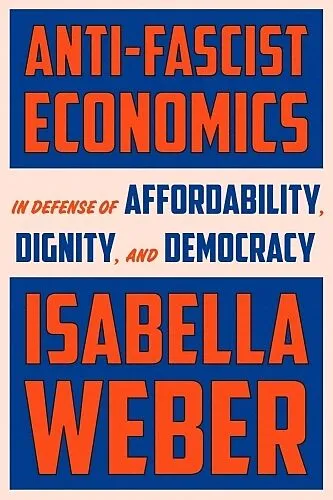
Anti-Fascist Economics
Beschreibung
As;inequality, inflation, and overwhelmingly concentrated corporate power threaten democracy, a rising-star economist asks what it would mean to create an anti-fascist economics that guarantees dignity for all. On the night of President Trump''s second preside...Format auswählen
- Fester EinbandCHF 28.50

Wird oft zusammen gekauft
Andere Kunden kauften auch
Beschreibung
As;inequality, inflation, and overwhelmingly concentrated corporate power threaten democracy, a rising-star economist asks what it would mean to create an anti-fascist economics that guarantees dignity for all. On the night of President Trump''s second presidential victory, economist Isabella Weber tweeted: "Can we now finally have a serious conversation about an anti-fascist economics?" In her view, Democrats had missed the seriousness of the affordability crisis in the wake of pandemic-era inflation, leaving room for the resurgence of the politics of resentment that Trump and the right reveled in.; Her question, though, was a bold one with implications that reached far beyond one election. Embedded within it were even more challenging ones: Why have economists avoided overtly joining political debates, pretending instead to be wholly, scientifically objective? How have policy tools been limited by this refusal? And what would it mean to consider a broader range of options that pursued the greatest good for the greatest number of people? In this paradigm-shifting book,;Weber recalls a history of mid-twentieth-century economists who took seriously the threat of fascism and their field''s role in preventing its return, and she demonstrates how the turn to neo-liberalism and an over-reliance on free markets buried the full scope of their ideas. Isabella Weber knows that if we are serious about saving democracy and preventing the further rise of fascists, we;need an economics that centers people’s needs and dignity rather than seeing their fulfillment as a welcome side effect in the pursuit of other goals. In <Anti-Fascist Economics<, Weber proposes just such a way out, applying a broader economic imagination to ensure a transformation that promises to make people''s lives better and stabilize economies in an increasingly volatile world.
Autorentext
Isabella Weber is an Associate Professor of Economics at the University of Massachusetts Amherst, an Associate in Research at the Fairbank Center, Harvard University, and a Fellow of the OSF Ideas Workshop. She works on policy responses to inflation and has advised policymakers in the US, Germany, Europe and Latin America. Her prize-winning first book, How China Escaped Shock Therapy: The Market Reform Debate, has been translated into five languages and was a Financial Times best book of the year. She has written for the New York Times, Financial Times, Washington Post, and Foreign Affairs; has been named a Time100 Next; and has a Ph.D. in Economics from the New School for Social Research, New York and a Ph.D. in Development Studies from the University of Cambridge.
Klappentext
As inequality, inflation, and overwhelming corporate power threaten democracy, a rising-star economist asks what it would mean to create an anti-fascist economics that guarantees dignity for all.
On the night of President Trump's second presidential victory, economist Isabella Weber tweeted: "Can we now finally have a serious conversation about an anti-fascist economics?" In her view, Democrats had missed the seriousness of the affordability crisis in the wake of pandemic-era inflation. By refusing to step in to protect their constituencies against price explosions in essentials and corporate profiteering, they left room amidst the global crisis for the resurgence of the politics of resentment that Trump and the right reveled in.
Her question, though, was a bold one with implications that reached far beyond one election. In a neoliberal world, we tell people at the same time: Democracy is the highest form of political organization. And: When it comes to the economy, to the material foundation of our life, the best the representatives of the people can do is to subordinate their constituencies to the corporate pursuit of profits. This basic contradiction between the rule of the people and the rule of the market makes neoliberal democracy vulnerable to the threat of fascism, she argues. Economists have too often acted as prophets of market subordination and ended up waxing the slippery slope to fascism. Isabella Weber warns that if we are serious about saving democracy and preventing the further rise of fascists, we need an economics that serves democracy and centers people’s needs and dignity rather than seeing their fulfillment as a welcome side effect in the pursuit of other goals.
In Anti-Fascist Economics, Weber proposes just such a way out. She envisions an economics that centers on essentials for livelihoods and production, that strives to make life on our planet livable for all, that confronts rather than conceals corporate power, and that charts the way towards international cooperation rather than getting stuck in the dichotomy of free trade and trade wars. To halt the further rise of fascism, we need a tangible alternative to the dystopian status quo, she insists, one that takes affordability seriously as a foundation of democracy. In this paradigm-shifting book, Weber recalls a history of mid-twentieth-century economists for whom “never again” was the North star and reinvents their thinking for our day.
Leseprobe
Chapter 1
The Fascist Transformation and Its Alternative
My friends, the world is changing. It’s not a question of whether that change will come. It’s a question of who will change it. —Zohran Mamdani, mayor of New York City
In the run-up to the fascism of the 1930s, the “political and the economic system of the planet disintegrated conjointly,” Karl Polanyi observed in The Great Transformation. We are once more witnessing such a disintegration. Institutions that appeared practically unchangeable a few years ago are crumbling. Trade wars are ending free trade globalization. The rule of the dollar is under threat. China’s rise means that for the first time since the British Industrial Revolution of the eighteenth century, a country that was on the losing end of imperialism has overtaken the United States and Europe in several key technologies. The global security architecture is being redrawn. A new rearmament race is in sight. The Bulletin of the Atomic Scientists set the doomsday clock at eighty-five seconds to midnight and warns “the world is perilously close to the precipice.” The United States is leading an onslaught on international organizations. Aggressive nationalism is back. Basic standards of humanitarianism and international law are buried along with tens of thousands of corpses in Gaza under the leadership of Israel’s far-right government and with the full backing of the United States and the complicity of most European nations. The American president is on an open mission of territorial expansion. U.S. democracy is in a full-blown constitutional crisis, and with it goes the ideal of Western liberal democracy.
Meanwhile, the human habitat is under threat from the disintegration of our natural environments in ways that would probably have been unimaginable in the 1940s. The world has just emerged from the worst pandemic in a century, and epidemiologists are warning the next one could already be around the corner. Studies showing we are approaching climate tipping points arrive in an unrelenting stream, each more alarming than the last, and we may have already reached tipping points where the damage is irreversible. The ice sheets in Greenland and the Antarctic are eroding. Mountain glaciers are melting away. Amazon rainforests are dying. Coral reefs, once wonders of color and diversity, are going white and dull. Agricultural yields from tomatoes and olives to grain, cocoa, and coffee are under threat as it rains at the wrong time and there is a drought when water is needed, as excess heat and untimely frosts kill crops. Climate change is displacing millions of people wh…