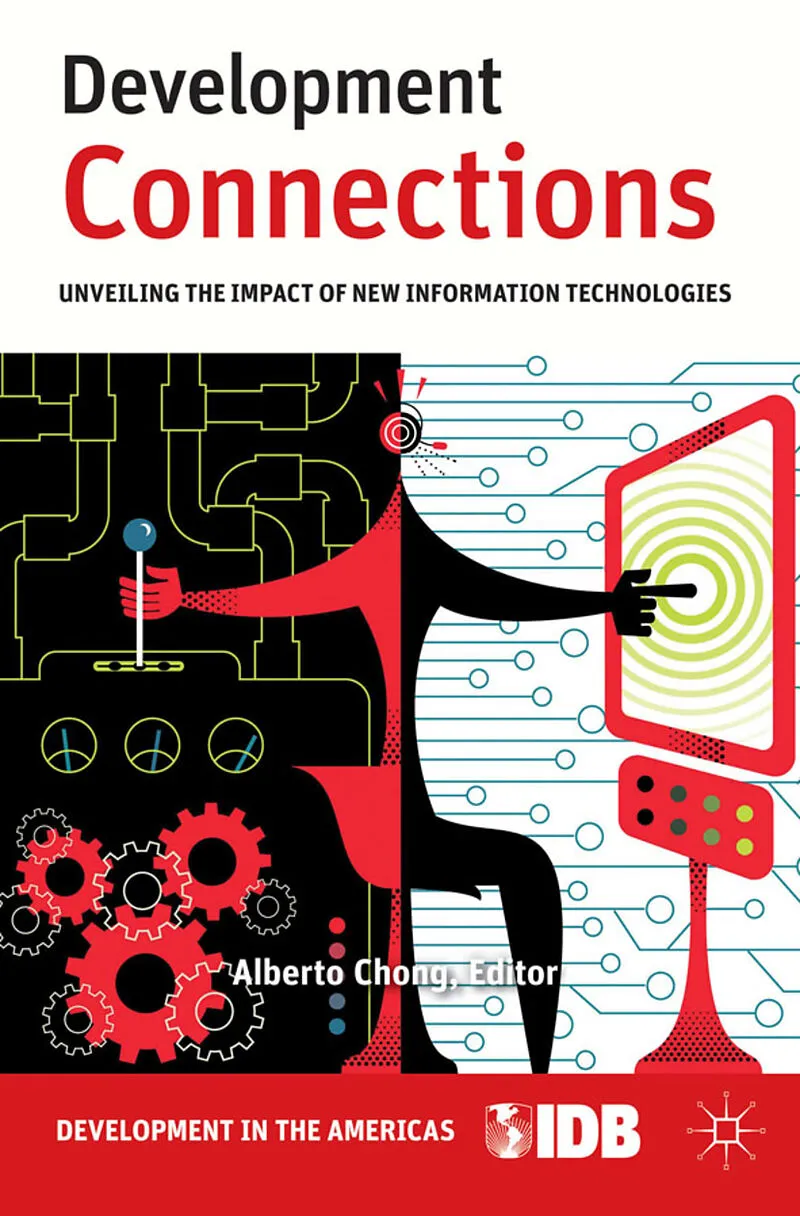
Development Connections
Beschreibung
Development Connections takes stock of recent advances in what is broadly known as Information and Communication Technologies (ICTs). The authors seek to discover how information and telecommunication technologies affect both the public and private sectors in ...Format auswählen
- Kartonierter EinbandCHF 121.20
- Fester EinbandCHF 152.80
- E-Book (pdf)CHF 23.90

Wird oft zusammen gekauft
Andere Kunden kauften auch
Beschreibung
Development Connections takes stock of recent advances in what is broadly known as Information and Communication Technologies (ICTs). The authors seek to discover how information and telecommunication technologies affect both the public and private sectors in Latin America and how they can optimize ICT returns to society.
"This book takes a refreshingly candid look at the role of Information and Communications Technology interventions for development. It starts off with a simple yet unpopular premise: that a technology may sound cool, but that does not mean it alleviates poverty. We need more than good intentions. We need to measure the impact of interventions to know what works, what does not, and why. And in the case of Information and Communications Technologies, it is not hard to imagine that technology still needs humans, and good human intentions, in order to generate positive social change." - Dean Karlan, Professor of Economics, Yale University and President and Founder, Innovations for Poverty Action
"Computers, mobile phones, and the Internet are frequently touted as miracle-working tools in the battle against global poverty. This book brings a welcome dose of realism to these claims, through experimental case studies of several information and communication technology interventions in Latin America. The conclusion? While technology has great potential, its value emerges only with the proper institutional support. No amount of technology makes up for deficient political commitment, human capacity, or institutional integrity. A must-read for anyone considering ICTs for international development." - Kentaro Toyama, Visiting Scholar, University of California, Berkeley and Co-Founder of the IEEE/ACM International Conference on Information and Communication Technologies and Development (ICTD)
Autorentext
The Inter-American Development Bank (IDB) is an international institution created in 1959 to foster economic and social development in Latin America and the Caribbean. Eduardo Cavallo is a Lead Economist at the Research Department of the Inter-American Development Bank, USA. Prior to re-joining the IDB, Cavallo was Vice President and Senior Latin American Economist for Goldman Sachs in New York. Eduardo had already worked at the IDB as a Research Economist between 2006 and 2010. Before that, he served as Research Fellow at the Center for International Development, Visiting Scholar at the Federal Reserve Bank of Atlanta, and a member of the faculty at Harvard University's John F. Kennedy School of Government's Summer Program. In Argentina, he co-founded Fundación Grupo Innova. Cavallo has published in several academic journals and is co-editor of the IDB book, Dealing with an International Credit Crunch: Policy Responses to Sudden Stopsin Latin America. He holds a PhD in Public Policy, an MPP from Harvard University, and a BA in Economics from Universidad de San Andres in Buenos Aires, Argentina. Tomás Serebrisky is Principal Economic Advisor of the Infrastructure and Environment Department of the Inter-American Development Bank (IDB), USA. Prior to joining the IDB, Serebrisky was Chief Economist of the Antitrust Commission in Argentina, Visiting Professor at Universidad Torcuato Di Tella in Argentina, and Senior Economist in the World Bank, where he led the preparation and supervision of investment projects in several infrastructure sectors. His areas of expertise are the economics of infrastructure investment, public private partnerships, logistics, economic regulation, and antitrust. Serebrisky has published extensively in refereed journals and is the author of Airport Economics in Latin America: Benchmarking, Regulation and Pricing. Serebrisky holds a PhD in Economics from the University of Chicago, USA, and a BA in Economics from Universidad de San Andres in Buenos Aires, Argentina.
Inhalt
- Introduction; David Tennant and Damien King PART I: THE PROBLEM - PAST, PRESENT, AND PROSPECTS 2. he Developmental Impact of Debt; David Tennant 3. The Debt Experience of SIDS in the Caribbean; Michelle Robinson 4. The Debt Experience of SIDS in the Pacific; Biman Prasad 5. The Debt Experience of SIDS in the Atlantic, Indian Ocean and South China Sea (AIMS); Kaymara Barrett, Altricia Dawson and Sidonia Mackenzie 6. Prospects for the Growth of Debt in SIDS; David Tennant and Kario-Paul Brown PART II. CAUSES OF DEBT ACCUMULATION IN SIDS 7. The Sources of Debt in SIDS; Damien King 8. Institutional Causes of Debt in SIDS in the Caribbean, Pacific and AIMS Regions; Colin Bullock and Christine Clarke PART III AN AGENDA FOR DEBT SUSTAINABILITY IN SIDS 9. An Assessment of Recent Remedial Action Taken by Selected SIDS; Michelle Robinson 10. Debt Sustainability and Sustainable Development in SIDS; Abdullahi Abdulkadri 11. Elements of an Agenda for Debt Sustainability in SIDS; Damien King 12. Conclusion; Damien King and David Tennant