Beschreibung
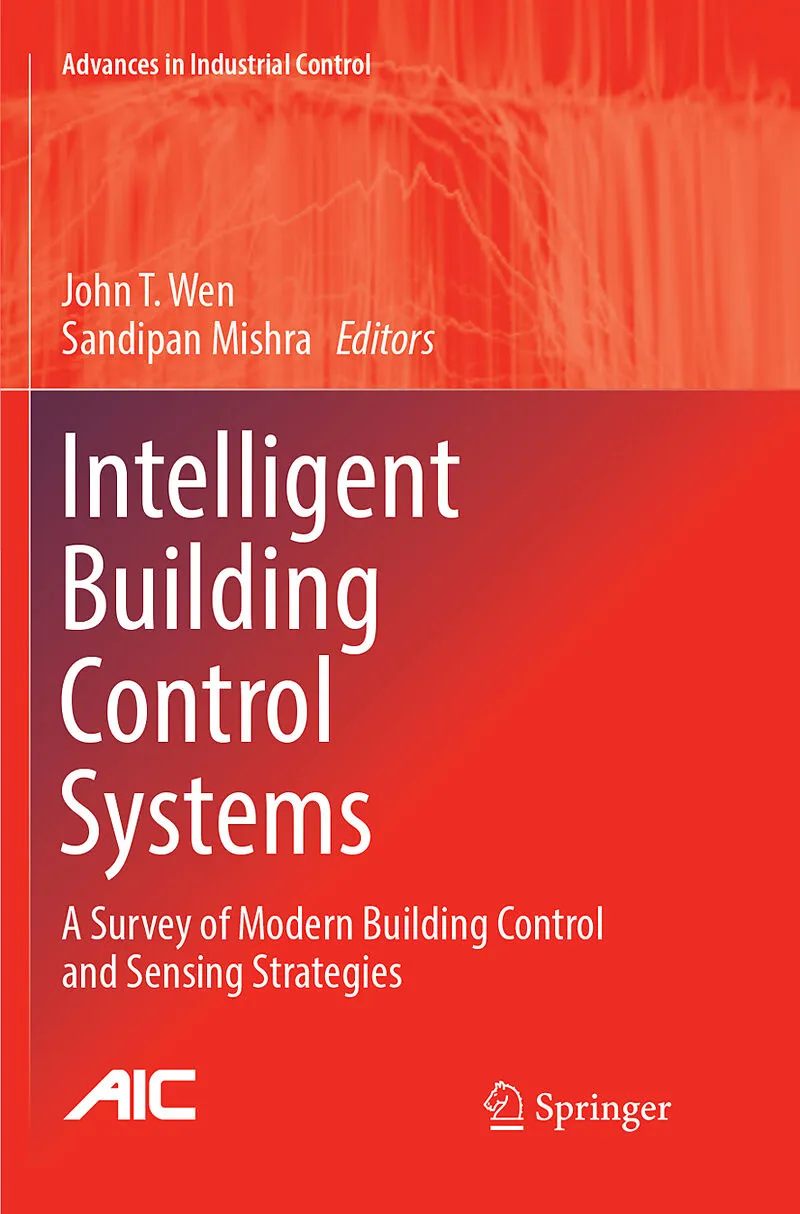
Provides a comprehensive perspective of the present and likely future of building automation and control Broadens understanding of building control and energy systems with a collection of coordinated articles from well-known researchers in academe, national r...Provides a comprehensive perspective of the present and likely future of building automation and control
Broadens understanding of building control and energy systems with a collection of coordinated articles from well-known researchers in academe, national research laboratories and industrial research divisions
Considers thermal, illumination, distributed communication and control, and grid-connecitivity issues Practitioners will benefit from case studies and to-scale implementations
Autorentext
John T. Wen has extensive industrial and academic experience in control systems. He received his B.Eng. from McGill University, M.S. from University of Illinois, Ph.D. from Rensselaer Polytechnic Institute, all in Electrical Engineering. He worked at Fisher Controls and Jet Propulsion Laboratory before joining Rensselaer Polytechnic Institute in 1988. He is now a Professor in the Electrical, Computer, and Systems Engineering. He was the Director of the Center for Automation Technologies and Systems (CATS) from 20052013 and has been the Head of the Industrial and Systems Engineering since 2013. He was awarded the 2013 IEEE Control Systems Society Transition to Practice Award based on the co-invention of the Adaptive Scanning Optical Microscope (ASOM), which was licensed to Thorlabs. His research interest lies in the modeling and control of dynamical systems with applications to motion control, robot manipulation, opto-mechatronics, thermal management, and active flow control. He isa Fellow of the IEEE.
Sandipan Mishra received his B.Tech. in Mechanical Engineering from the Indian Institute of Technology Madras in 2002 and his Ph.D. in Mechanical Engineering from the University of California at Berkeley in 2008. Dr. Mishra joined Rensselaer Polytechnic Institute as a faculty in the Mechanical, Aerospace, and Nuclear Engineering Department in Fall 2010. He is the recipient of the NSF Early CAREER award in 2013 on additive manufacturing and was a member of the 2010 Japan NXT-NSF Young investigator exchange program for nanomanufacturing. His research interests are in the area of systems and control theory, learning control, nonlinear estimation, and precision mechatronics, as applied to smart building systems, additive manufacturing, and adaptive optics.
Inhalt
Introduction and Overview.- Part I: Building-Level Design and Control.- Architectures and Algorithms for Building Control and Optimization: An Industry View.- Operating Systems for Small/Medium Commercial Buildings.- Part II: Heating, Ventilation, and Air-Conditioning (HVAC) Systems.- HVAC System Modeling and Control: Vapor Compression System Modeling and Control.- HVAC System Modeling and Control: Multi-Zone Temperature Modeling and Control.- Model Predictive Control for Forced Air and Radiant Slab Systems.- Constrained Model Predictive Control of HVAC Equipment.- Part III: Beyond HVAC: Lighting, Grid, and Distributed Intelligence.- Smart Lighting Control.- Stochastic Predictive Control Strategies for Building Energy Management Systems in a Smart Grid Scenario.- Controlling the Internet of Things: From Energy Saving to Fast Evacuation in Smart Buildings. Current and Future Directions.
10%