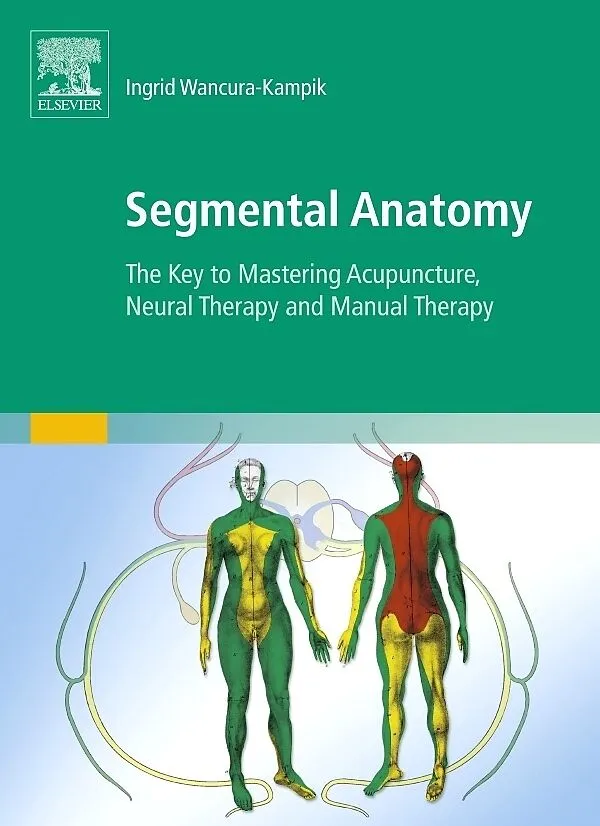
Segmental Anatomy
Beschreibung
Formidably illustrated and written, the correlations between spinal nerves and segments in skin, musclar system and bones as well as the projection areas of internal organs on the body surface area are deduced from the anatomy of the nervous system. These cor...
Format auswählen
- Kartonierter EinbandCHF 114.00
- Fester EinbandCHF 108.00

Wird oft zusammen gekauft
Andere Kunden kauften auch
Beschreibung
Formidably illustrated and written, the correlations between spinal nerves and segments in skin, musclar system and bones as well as the projection areas of internal organs on the body surface area are deduced from the anatomy of the nervous system.
These correlations between spinal nerves and the periphery of the body explain how acupuncture, neural, and manual therapies take effect .
Great accessibility through:
- Full colour images
- Drawings that depict the correlations in detail
- Cearly structured layout facilitating the reading of this complex subject
Autorentext
Dr. med. Ingrid Wancura
MD for general medicine, has a private practice in Vienna for over forty years now. She has been studying the theory of segments since 1965 and acupuncture since 1970, including studies at the University of Traditional Chinese Medicine in Beijing.
Dr. Wancura, who has also studied the Chinese language and worked in two acupuncture surgeries in Beijing, was the first to analyse Chinese acupuncture from the perspective of western science and segment theory.
She has published several books on the topic, taught and lectured at several universities and is president emeritus as well as honorary member of several acupuncture societies.
Inhalt
1
Segmentation and MetamerismWhat is a Segment?The Significance of Segments/p> 2
The Role of the Peripheral Spinal Nervous System in SegmentationThe Spinal NervesThe Branches of the Spinal Nerves The Three Spinal Nerve Branches As the Basis of the Threefold Longitudinal Division of the Body Surface The Branches of the Spinal Nerves in Detail The Dorsal Branches of the Spinal Nerves The Dorsal Branches in Psychosomatic Medicine and Evolution The Ventral and Lateral Spinal Nerve Branches and Plexuses Plexus Formation from the Point of View of Segmental Anatomy The Individual Plexuses The Pre- and Postaxial Lines, Basis of the Meridian-ines70
3
The Role of the Peripheral Autonomic Nervous System in Segmental TheoryAnatomyThe Peripheral Sympathetic Nervous System and Its Role in Segmental TheoryThe Origins of the Sympathetic Nervous SystemSympathetic Innervation of the LimbsSympathetic Effects on the Dilator Pupillae Muscle and on the Effector Organs of the IntegumentSympathetic Supply to the Head, Neck, and Limbs The Efferent Sympathetic Nerves The Afferent Sympathetic Nerve Pathways The Large Sympathetic Ganglia and Their Projections onto the Skin The Peripheral Parasympathetic Nervous System and Its Role in Segmental Theory
4
The DermatomesRadicular Innervation of the IntegumentClinical RelevanceParts of a DermatomeThe Sensory and Autonomic-Motoric DermatomesSensory DermatomesAutonomic-Motoric DermatomesPhysiological HyperesthesiaThe Maximum Points of the DermatomesThe Maximum Areas of the Dermatomes The Hiatus Lines Individual Dermatome Groups, Extent and Shape, Interactions, and utonomic Facial Expression17 Dermatomes of the Head and Neck Dermatomes of the Trunk T1 to T12 The Lumbar and Sacral Dermatomes Dermatoses and Segmentation
5
The MyotomesRadicular Innervation of the MusclesMetameric Order of the MyotomesHerringham Rules of Location and Distribution of Myotomes in the MusclesThe Muscles of the Upper and Lower Limbs and Their Corresponding MyotomesThe Individual Myotome GroupsThe Cervical MyotomesThe Thoracic Myotomes (T 1 to T 12) The Lumbo-Sacral Myotomes
6
The SclerotomesRadicular Innervation of the BonesThe Spinal Column and Its Segmental RelationsThe Individual SclerotomesThe Sclerotomes of the Upper Limb and the Shoulder GirdleThe Sclerotomes of the Lower Limb and the Pelvis/p> 7
The Enterotomesransformation of Internal Organs into Enterotomes/p> 8
Conduction of Impulses Betweeen Segments*Multisynaptic, Proprioceptive, and Viscerogenic Reflexes/p> 9
Referred PainPain Projected to the Body Surface in Visceral DiseaseProjected SymptomsOn the Location of Projected SymptomsClinical Significance of Projected SymptomsAlgetic Symptoms Hyperalgesia and Hyperesthesia of the Cutis and Subcutis (Head Zones) Hyperalgia of Muscles and Tendons (Mackenzie Zones) Comparison of Pseudoradicular Syndromes, e.g., Radiation of Pain from a Joint Capsule (Fig. 9.4) and Referred Pain (Fig. 9.3) Autonomic-Reflexive Symptoms Autonomic Effects in the Integument Effects on the Head Effects in the Shoulder Asymmetry of Posture and Movement Reflexive and Algetic Spinal Column Syndromes Asymmetry of Proprioceptive and Multisynaptic Reflexes Autonomic Organ Reflexes (Viscero-Visceral-Reflexes)
10
The Visceral Organshe Enterotomes from the Viewpoint of Segmental AnatomyInteractions and Projectional PhenomenaThe Heart: Algetic and Autonomic-Reflexive Areas of ProjectionLungs and Bronchi: Their Algetic and Autonomic-Reflexive Projectional Fields The Esophagus: Algetic and Autonomic-Reflexive Projectional Fields Stomach and Duodenum Small Intestine (Jejunum, Ileum) Cecum, Appendix, Ascending and Transverse Colon Descending Colon, Sigmoid Colon, and Rectum Kidney, Bladder, Ureterheir Algetic and Autonomic-Reflexive Projectional Fields The Genital Tract: Its Algetic and Autonomic-Reflexive Projectional Fields Testes, Uterus, Ovaries: Their Algetic and Autonomic-Reflexive Projectional Fields Prostate Gland: Its Algetic and Autonomic- Reflexive Projectional Fields Liver and Gallbladder: Algetic and Autonomic-Reflexive Projectional Fields Pancreas and Spleen: Their Algetic and Autonomic-Reflexive Projectional Fields Occurrence of Reflexive and Algetic Symptoms in Other Disorders